erk admin

spacerCircle of Good Will - Blog

The Best Consultant

November 15th, 2008

I today received the following old and beautiful Sufi story in Spanish, which I got translated automatically and I “purified” it.

“There was a man who once lived in Turkey. One day he heard speaking of a great teacher that lived in Persia, and that he possessed the secret of wisdom.

Without thinking twice, the man sold his things, he said goodbye to the family, and he left in search of that secret. After years of traveling, he was able to arrive at the cabin where the great teacher lived. Full of fear and respect, he came closer and he waited for the sage to return from his morning walk.

“I come from Turkey”, he said as soon as the sage had appeared. “I have come here only to ask you a question.”

“Well. You can ask just one question.”

“I have to be very clear in what I will ask. Can I make it in Turk?”

“You can”, said the sage. “And I have already responded to your only question. Any other thing that you want to know, you ask to your heart. It is not necessary to travel so much to discover that that is the best consultant that exists.”

And he closed the door….”


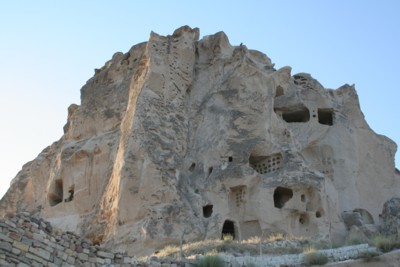
Old caves in Turkey, photo of a friend

A Lighter Side of Spirituality: Spiritual Jokes

November 14th, 2008

I yesterday dropped over a website on Buddhist jokes called “A Lighter Side of Buddhism”, by a Buddhist software engineer working at Google. His motto is, “Life is too important to be taken seriously.” Though not all jokes are easily understandable for non-Buddhists, you find a lot of funny staff.

You can also go to “Beliefnet” (“Inspiration, Spirituality, Faith”) where you find a daily joke, and you can group the jokes by faith (Christian, Jewish, Buddhist, Muslim, Hindu, Pagan, Everybody, More… ) or by topic … They have put a “Bad Joke Disclaimer” on their side, as a protection against bigots and others: “We recognize that religious humor can be risky. It is our hope that by laughing at ourselves (and others) we can make this subject more approachable. If you find any of these objectionable, we apologize. As with most jokes, the original authors are unknown – but we thank them.”

Jokes and humour are a great skill of teaching. Our spiritual teacher, Sri K. Parvathi Kumar, often brings laughter to his listeners and thus opens the doors of attention.

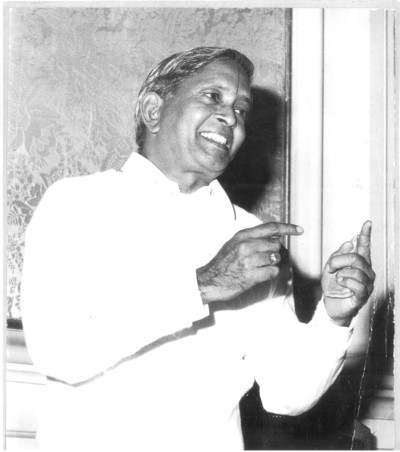
Also Master EK’s talks were full of humour. Photo of a friend.

Subtle Topics Getting into the Mainstream of Attention

November 14th, 2008

In a pause during the workshop on image language I had a talk with a colleague who is interested in yoga and spirituality. She just has finished a psychological formation over 2.5 years and is now planning to participate in a formation in esoterics, as she said. I found out on the web that it is a “spiritually oriented therapy“, by a retired pychiatrist who was head of a clinic and is working together with a healer. He is quite known here, because already before his retirement he broke the barrier between orthodox psychiatry and spiritual healing, something part of his colleagues didn’t appreciate. My friend said that for the next year the course is already full, she is trying to get into it for the following year. The spiritual psychiatrist is going with the times: You can have telephonic counseling for € 2.16/Min. …

Though still marginalised, it is interesting to see how subtle topics are slowly getting into the mainstream of attention: Last week I came across a website of the Faculty of Humanities of the University of Amsterdam, where you now can study Western Esotericism. They have a major studies trajectory “Mysticism and Western Esotericism”, with topics like Neoplatonism, Manicheism, Sufis, Kabbalah, Mesmerism, Occultism, Illuminism, and they offer courses on “Heksen, Ketters en Neopaganisten” (Witches, Heretics and Neo-Paganism), “New Religious Movement and New Age”, “Filosofen als grenswachters” (Philosophers as frontier guards)…

Having gone through long years of studies in similar fields, I don’t think that an academic approach of studying different concepts of esotericism is the right path into fields of the higher mind and beyond, for it demands more inner work than outer (mental) studies. But may such an approach inspire people to enter into a path of self-transformation.


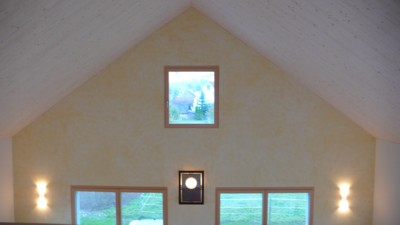
Building an enlightened house of life. Photo of a room in the house of a friend

Image Language

November 14th, 2008

Last Wednesday I participated in a workshop of my office on image language and the way we use images at the Red Cross. Though three years ago I had built up the image bank we use, I hadn’t been much into the topic of images, especially not the last year.

The meeting was held in the rooms of a media agency in Berne, by a photographer and an art director, specialist of visual  design. After an introduction to image theory, image language and picture assessment, we had a look at our publications. It was very interesting to see these visual specialists “from the outside” giving a critical look and showing flaws and shortcomings. We see the pictures with your own intentions, without noticing that they might stand in the way of the perception of others. When pointed out, you understand the questions arising, but as a lay person you normally just feel that there is something not at optimum with a picture or a detail, be it in the composition or its placement in a publication.

They showed us a number of examples of how enterprises or other organisations have defined their “image language” and present themselves according to it, giving thus a visual message linked to their vision and mission – in the form of colour selection, emotional tones or image composition. They showed us extracts of photos from which everyone immediately recognised the related organisation, without seeing any brand sign.

In the afternoon, after an input about image rights and models of  licensing we did some picture research in image banks like Gettyimages, Fotolia or Corbis. It’s not easy to find pictures for visualising a given theme.

Then we tried to define some basics of the picture language we want to use. It was an interesting discussion, to describe some do’s and don’t’s without becoming too rigid in regulations. It made me think about the way I work with pictures for the Good-Will website, especially when I am preparing powerpoint presentations on different themes of the wisdom teachings.

Seeing the costs of professional image licensing gave me an idea of the great treasure I collected with the pictures given to me by friends from all over the world, which I use for illustrating the teachings. Of course, they are not done by professionals with their high-tech equipment, but nevertheless many of them have quite a high quality standard.

Shooting or seeing photos is not just a process of the eye, but of the mind, the photographer. The way he captures a scene or how he selects a detail expresses very much of the consciousness with which he is working.


Photos of an iris, by a friend. The iris is also part of the eye and a Greek goddess of the rainbow, messenger of the gods, like Hermes. In Wikipedia it says, As the sun unites Earth and Heaven, Iris links the Gods to humanity.


Imprisoning Free Will

November 11th, 2008

Last weekend my wife and I went to see the new German film “Krabat“, after a novel by Otfried Preußler. In English the book was published under the name of The Satanic Mill. There is a movie trailer with English subtitles, and you find an interesting interview with the producer, Marco Kreuzpaintner.

We read the book in our youth and my wife again some years ago.  A fascinating story of a young orphan boy who becomes an apprentice of a miller-sorcerer who teaches his group of assistants black magic, but also subjugates them under his will – and each year one of them has to die.

The movie is esthetically well done, also the more subtle aspects are presented without getting into cheap tricks. So you see a presentation of an out-of-body experience of the main characters, traveling in their subtle bodies to a village. Though this experience was connected with black arts, it was presented in a very natural way.

The plot of the story – the miller-sorcerer imprisoning a group of students through black magic and forcing them to work – provoked thoughts about experiences we had in a group setting where someone was holding the group over a longer time in his sway. It wasn’t easy to see through the mechanisms and find a way out – just like in the film. It took us years to digest the experiences. The story in the movie didn’t discuss the traumatic dimension of the apprentices, it nevertheless reflected in their behaviour and outlook.

Keeping others’ free will under your control and manipulating them is impeding the inner connection to the soul. See the Lunar Messenger on Free Will and Freedom.


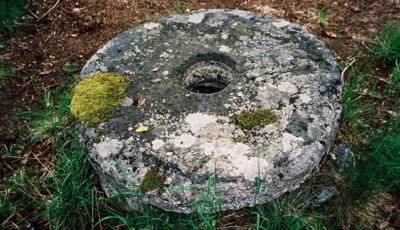
Old millstone in Sweden, photo of a friend

Elephants and the Power of Habit

November 9th, 2008

Friday a friend sent me an e-mail with a story about elephants marching through a hotel in Zambia, which was built on their migration trail. They just go into the lobby and walk through the hotel to get to their favorite mango trees in October-November, when the fruits are ripe. I found it while googling, and also a video with the elephants on YouTube.

A beautiful story about the power of habit, which is also very strong in human lives, as you can read in the related Lunar Messenger.


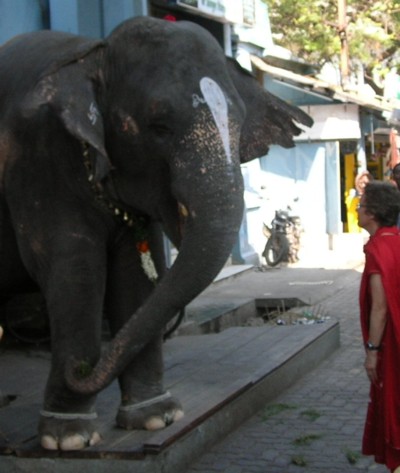
Not an African, but and Indian temple elephant in Pondicherry, January 06

Resonance of Experience

November 8th, 2008

The last weeks had been quiet turbulent at my office,  and it seems that the stormy days aren’t over yet. The launch of the new intranet is approaching and there are many things to keep an eye upon – besides other work going on. I sometimes had the feeling as if my mind was filled to the brim.  So I didn’t take much time for blogging.

Yesterday evening we had the first meeting of three evening themes of our Circle of Good-Will group in a nearby hotel, like we did a few times in the past. The general theme is The Call of the Soul, and the evenings are about 1. Awakening, 2. The Journey, 3. The Fellowship.

We had put an article into the local weekly paper, an announcement in another and distributed flyers in the circle of friends. There had been no reaction from any “outsider”, but a few friends from the yoga group of my wife and members of our group came, all together we were 9 persons.

At first it took me a moment to get into the flow of speaking. We started with singing three times OM and a little invocation and this broke the ice. Somehow it opened the inner doors and the thoughts flowed smoothly and with inspiration. I had prepared a powerpoint presentation (see the German version, English will follow later) with beautiful photos mostly of sunrises from all around the world. Soon there was a magic spell in the room, which continued the whole time. It is fascinating to experience the subtle presence and sweeping away the dross of everyday troubles and the previous flurry. The thoughts from the wisdom teachings are so uplifting, and everyone in the room felt their inspiration.

After a little pause my wife conducted a short meditation: We sang 21 times OM and then observed the silence for 10 minutes. Afterwards everyone said what he or she experienced during that time. It is fascinating how the field created through the group meditation gave all of us an experience of deep silence and relaxing inner expansion. You cannot describe this experience with words, it needs to be experienced…

However, when you share the experience after meditation the words still resonate with the taste of the experience and give a clearer understanding.


Sunrise over the Lake Titicaca, photo of a friend

The Moon

November 7th, 2008

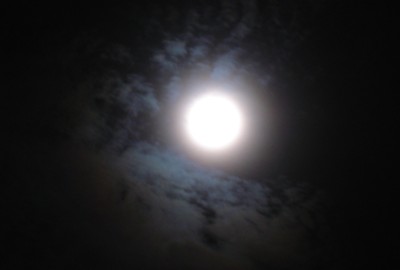
A friend sent me today a very beautiful powerpoint presentation about “The Moon”, with great photos and Beethoven’s Moonshine Sonata. Enjoy.

From Living Experience to a Chapter in a Book

November 1st, 2008

Yesterday evening I discovered a parcel in the mailbox – a book I had ordered some weeks ago. It is about the “Religious Communities in the Canton Berne” (Switzerland). The author, Stefan Rademacher, from the Institute of Religious Studies of the University of Berne, had come for a talk in summer 2006. At first I was a bit sceptical, but his impartial approach to work out a “map” of the different religious groups in our area was somehow fascinating. He is avoiding the word “sectarian”, since it is emotionally charged and stigmatising. We had quite an indepth conversation about the Circle of Good Will and our backgrounds. A week after the talk he sent me the draft of his article, which I reviewed, and he included the corrections. And now it is a section in the book, in a chapter on theosophy and its offsprings…

My thoughts went back to the days of my study of religious science in the 70ies in Germany. The academical and distanced approach to a topic which deals with inner transformation and relation to one’s deepest roots is somehow a paradox. A systematized approach to deeper realities is of a great importance, but you can’t stay at a distance to yourself when going through a process of transformation. As long as you do, you stay in the intellect and out of the experience. You only have a shallow aftertaste.

“Foodscapes”

October 28th, 2008

A friend sent me a beautiful powerpoint presentation about “Foodscapes” (see also as PDF). In the text it says:

“The British photgrapher Carl Warner created a series of landscape images utilizing basic food ingredients found in a typical kitchen. The images “Foodscapes” (made up of the words Food and Landscapes) show scenes including, caverns, submarines, forests, beaches etc. using fruits, legumes, cheeses, pastas, breads among others.

The photographer is known in his neighborhood of Kent in England, as he spends hours in stores looking for the best pieces of broccoli, peppers, fruits etc. to compose the landscape scenes. To achieve depth, to give a realistic three-dimensional feel to the photographs, each still life is composed on a table measuring 8ft by 4ft. The foreground is only about 2ft across.  In addition, they are taken in stages so the fresh foods do not get wilted or stale before the photo is finished.

“I like to the way small aspects of nature look a lot like the larger counterparts. “, says  Carl Warner. He also confesses that up to now, he has not been able to convince his four kids to eat their vegetables.  “At least I cannot say that they enjoy eating fruits and vegetables as much as I do”, says Carl.

The photographs will be used for a and advertisement campaign for supermarket chain in England. Warner also plans to put these together in a coffee table book to promote healthy eating for children.”

Carl’s Website , go to: >website>fotographics. Or to the site print sales.

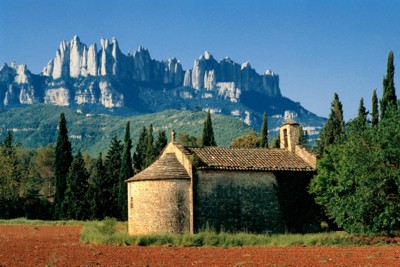
Not a foodscape, but a landscape-photo of Montserrat, Spain, by a friend.