February 19th, 2007
I yesterday got from a friend a short video file also posted on Google Video, “Driving in Russia“. It shows car accidents in a tunnel seen from a monitoring camera. The kind of driving reminds of video-games like Need for Speed etc., but these are real people causing real accidents and not just bumper cars.

Seeing the video you might laught or shake your head. In reality it’s quite sarcastic what you see when you think of the consequences.
The traffic rush is an expression of the hectic pace of today’s life, which is stimulated by an overactive mind. It is also a metaphor for the stream of routine action just running on through a tunnel of focus. You often keep going on even if something comes crossways and throws you off the line, where it would be better to stop for a while, observe the situation and go on slowly, with more attention to the “traffic” of events. Stopping the routine traffic of daily life through interludes of silence is an important part of spiritual work.
Posted in Social | No Comments »
February 18th, 2007
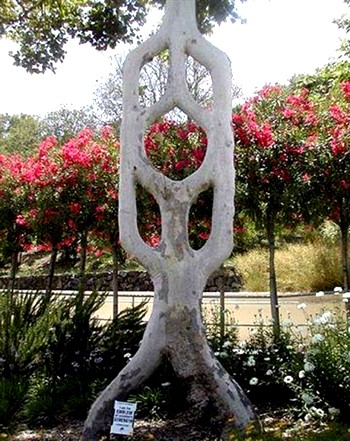
Last week a friend sent me pictures of amazingly grown trees. I found out that they were originally grown by Axel Erlandson (1884-1964), the son of Swedish immigrants in Central California. He shaped his trees for over 40 years and created the worlds most outstanding examples of Arborsculpture. He would create designs on paper first and then plant in the specified patterns; pruning, grafting and bending them. When Erlandson was asked how he got his trees to grow like this, he would reply, “I talk to them.”
Later the trees were put into a park to attract people to the Tree Circus.

What we call our character can be cultivated in a similar way. We can transform our nature through loving attention and long-lasting focus. This process of cultivation of character through right thinking and living has been beautifully described by Thackerey in his words:
“Sow a thought and reap an action; sow an action and reap a habit; sow a habit and reap character; sow character and reap destiny.”
The effort to control one’s lower impulses needs repetition, until it becomes a habit, a second nature. When a new habit is established, the repetition needs no effort after a certain time. The habit will be engrafted, like the grafting of a tree. When you keep a branch of a tree under soil for some time, the branch begins to send roots into the soil, making it an independent tree, so that you can cut off the branch from the parent tree to make it an independent plant. So a new habit should become independent of the old, unprogressive habit, and cutt off from the old one.
This is the purpose of repetition in learning new things and especially in spiritual training. See also the Lunar Messenger on “The Power of Habit”.
Posted in Nature and Man | No Comments »
February 17th, 2007
Last week an article in the Swiss newspaper Der Bund about “What managers can learn together in a zoo” presented the trainer Lorenz Nufer who uses animals as metaphers and mirrors for managers. In the zoo they study different forms of behaviour and organisation: Wolves have extreme forms of hierarchy and baboons have a lot of conflicts, where you can study how they solve them. Enterprises are not just like zoos, but the way man and gorilla hordes are showing off resembles a lot. Watching animals helps to get a distanced view on one’s own behaviour. Discussing about behaviour forms of animals helps getting blocked forms of communication go again. Behaviour-oriented learning can leave deep traces, but you have to deal with it in the right way and not just like a funny experience. A transfer has to be done in order to get to a deeper understanding. The event of an excursion into a zoo is only an instrument and not a solution by itself.
Many executives react on increased challenges according to the motto “try harder”, and they make increased efforts, which are neither useful for the individual nor for the organisation. Bot the persons concerned don’t get out of that pattern. With an exercise which they cannot solve alone they can be empowered to realise that they have to look for help and not to go on trying by themselves. Those who have really experienced the need for help are likely not to repeat the old patterns.
In spirituality animals are also often used as examples to illustrate the behaviour of man or his different faculties. So the mind is normally compared to a monkey jumping around and very difficult to be controlled. In the Book of Rituals Dr. Krishnamacharya writes: “Since man has crossed the consciousness of all the living beings on this earth during his course of evolution his consciousness contains the association (Vasanas) of all the animals in his behaviour. This is the only possible explanation of the animal behaviour of man.”

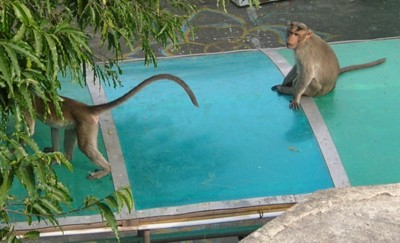
Apes playing in an Indian temple.
Posted in Communication and Interacting, Nature and Man | No Comments »
February 16th, 2007
Today I got an e-mail from a friend telling that for some month she was together with a man who had had much to do with drugs and alcohol. During that time it seemed that her problems were increasing while many things seemed to be going on very easy for him. She suddenly realized in meditation the reason for her present situation, she felt like being contaminated from his energies. She then decided to get her energy back, and from that day on the other one seemed to encounter only crosscurrents. People were now less friendly with him and everything he tried to do didn’t work.
From a spiritual perspective what my friend experienced is called vampirism of energy. It is the complete opposite of the true, harmonious, mutual exchange of energy. The excessive use of alcohol and drugs destroys the subtle tissues of the body and cuts the person off from the natural supply of psychic energy. So he might suck his supply from other person’s stock.
People do not want to understand that all kinds of alcoholic drinks, drugs, smoking, and so many other poisons decompose the human nature and that they infect space with their poisonous breath. In the book ”New Era Community” # 97 of the Agni Yoga series it says about such people:
“As a result of being with them, enormous fatigue is felt. They not only do not think about others, but even their own instinct of self-preservation is becoming dim.”
To a certain extent it is possible to counteract such violent selfishness. For this it is important to keep in contact with your inner resources and to try to have no dealings with people who absorb one’s energy uselessly.
If people learn the importance of exchange and cooperation, then they will also deal in a constructive way with energy.
Posted in Spiritual Life | No Comments »
February 15th, 2007
Mitchell Baker, head of the Mozilla Foundation, just published in her blog The Mozilla Manifesto where she describes 10 basic principles for the internet, such as: “Transparent community-based processes promote participation, accountability, and trust”, or “Magnifying the public benefit aspects of the Internet is an important goal, worthy of time, attention and commitment.” If you enlarge the focus of the principles over the focus on the internet, you see that these are principles for co-operation within and between groups in a participative manner.
So you read (brackets viz. additions in brackets are added to enlarge the focus): “Individuals must have the ability to shape their own experiences (on the Internet).” “(The Internet; read: The group activity) should enrich the lives of individual human beings.” or “Individuals must have the ability to shape their own experiences (on the Internet).”
To know more about this topic, you might like to read the Lunar Messenger on Groups and Group Consciousness.
Posted in Science and Technology, Social | No Comments »
February 13th, 2007
A friend just sent me pictures of incredible body paintings. With some Google search through different blogs I found out they were from Guido Daniele, an Italian body painter and multimedia artist. The pictures show different kinds of animals painted on fingers and arms of models. Have a look at his website.

(c) Guido Daniele
Posted in Art, Culture and Beauty | No Comments »
February 11th, 2007
Two days ago in the evening my eldest son came back from a ski camp and yesterday he had a strong cold with fever, so that this night he was sleeping in my bed together with my wife and I slept in his bed. In the night I woke up from a dream of which the last fragments I remembered were about Harry Potter and packing books to go to school. Did I pick up thoughts hanging around the corner of this bed?
I sometimes feel like picking up thoughts, impressions or feelings which pop in but don’t belong to me. They seem to come from another person or a situation, and they fade away again when the person is out of “sight”. It’s not just with physical encounters, but also via a phone call, a letter or an e-mail. There is a taste of a quality of the person – it might be joy or sorrow, anger, desire or some power play. Sometimes I mistake these “visitors” as belonging to me, sometimes their echo goes on for a bit longer before dissipating again. If I remain an observer, it helps neutralising the influence. Otherwise I get lost in it for a moment.
I just read in the booklet “On Change”: “Observing change is the means to stay afloat. Non-observation of change drowns you.”
I experienced an anger with an e-mail I received two days ago. In a subtle way the anger was with me until my wife and I spoke about it that the ordering tone in the e-mail had made me protest. There were complex feelings related with it, which, when observed, faded away, and I realised that, without excusing myself, the problem was not with me but with the other person. The feeling then faded away.
In the wisdom teachings the mind is described as the moon reflecting the impressions on its surface. For this you might read the Lunar Messenger on The Play of Illusions. The picture with the reflecting moon is from Tamariu beach, Spain.
Posted in Spiritual Life | No Comments »
February 10th, 2007
Reading in the booklet “On Change” by K. Parvathi Kumar I came across three sentences – some food for thought:
- Changing times demand strategic changes in the vision.
- ‘Heterarchy’ enables implementation with greater vigor than ‘Hierarchy’.
- A decentralised plan enables better implementation of change. “Center everywhere. Circumference nowhere”, is the Aquarian dictum.
At my job as well as in group cooperation of voluntary work I often experience that myself and other people tend to get frustrated if their point of view is not included in “hierarchical” top-down decisions, from the “more important” to the “lesser” people. The “upper ones” tend not to perceive the perspectives of the “bottom”. It demands often a much greater effort to include than just to dictate. But the danger of dictating is that I feel estranged and lose my commitment, resulting in inner emigration and anger.
I’m trying to learn to directly speak about delicate points. I just read an article in a magazine about Jakob Kellenberger, president of the ICRC in Geneva and former diplomat (see blogpost), that he is is always speaking cleartext in negociations: “I always directly start speaking about the problem. I am convinced if the other has the impression that you don’t dare to speak about the difficult points he thinks that you don’t feel confident with the matter or you fear confrontation.”
Posted in Experiences | No Comments »
February 9th, 2007
It’s the month of Aquarius, and you might feel quite some strong energies of change in the air. At work I experienced again winds of change, with a collegue in my team leaving and the new one beginning, and the second just also gave his note of leave to start something new. On other planes also a lot of changes are silently happening, nothing for a blog-note however. Here you find the picture of the month and the comment, from the Lunar Messenger.
Picture of the month of Aquarius. See Picture of the Month to send a postcard.
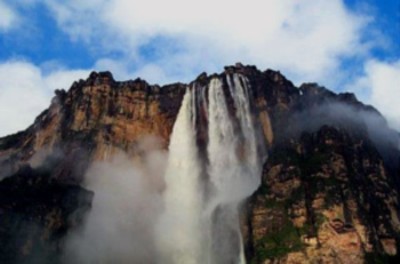
Space is considered to be like waters, because it is full of light and waves. The ancient seers therefore spoke about the waters of space, whose manifestation on the physical plane is water, the basis of life on earth. The photo of a waterfall at the Gran Sabano, Venezuela, by Evelia Mujica, illustrates the infinite flow of life force.
Posted in Experiences | No Comments »
February 9th, 2007
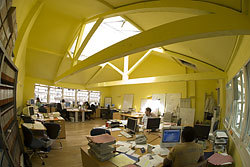
I just came across a study released in November 06 by Konica-Minolta on the “Impact of Colour” on the psychological wellbeing of employees. Each week for six weeks the colour of the office of an independent fashion recruitment agency was changed and the responses and behaviours were monitored. Six colours were surveyed in total: red, grey, blue, green, yellow and black.
(c) Konica-Minolta
Results: “It’s not just Monday mornings, rush hour or having to work late that can affect the office environment. Colour has a huge impact on the workplace in many ways and its importance shouldn’t be underestimated,” says Robert T Sethre of Konica Minolta.
Employees’ psychological wellbeing was found to be 72% less positive when they were working in a blue environment as opposed to any other colour. They were found to be less positive about their work-life balance (64%), pay and benefits (51%) and job security (40%). Blue creates greater job dissatisfaction and unrest amongst employees.
On the other hand, yellow was found to be the colour to spread a little sunshine through the workplace. The psychological wellbeing of employees with yellow surroundings was found to be 72% more positive, while 85% reported feeling more energised and focused. Employees in a yellow environment were also more positive about their work-life balance.
Fiery red stimulated passions and some employees reported feeling angrier. With black people claim to feel tougher and more macho. The highest proportion of respondents (52%) perceived themselves to be least productive in a grey office, which suggests they find it dull and uninspiring.
Grey and black howevever are the colours of most of the clothes I see here in Switzerland – what a contrast to the bright colours of the sarees in India… Have a look on the Lunar Messenger on Light and Colour if you would like to know more on the subtle effects of meditating on colours.
Posted in Health and more | No Comments »





 (c) Konica-Minolta