
erk admin

spacerCircle of Good Will - Blog

The Beginning of the New Year

December 31st, 2010

This night we are passing from December 31st, 2010 to January 1st, 2011, and start, in our counting, a new year. At the threshold stands Janus, the god of gates, doors, doorways, beginnings, endings and time in Roman mythology.
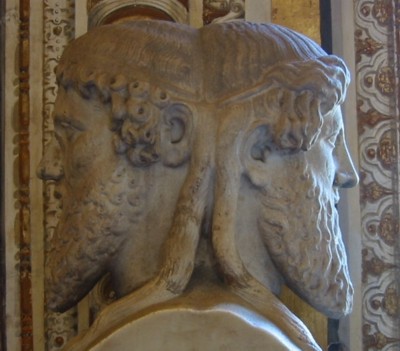
Bust of Janus from the Vatican (Wikipedia)

There are many different new years, and it is good to remember the relativity of our social convention as per the 1st of January, a date which is neither a threshold on the planet nor in cosmos. It took quite a long time before 1 January became the standard start of the civil year.

Here are some thoughts of Master EK (Ekkirala Krishnamacharya) about “The Beginning of the New Year” and how it is celebrated in traditional India as well as some thoughts about purification:

“Where does the year begin or end? Cyclically seasons emanate from it to blossom and come to fruition. In this gyration of the year all living things – trees, as also creatures that are aquatic, earthly and airborne – have their own individual beginnings. It is natural for each to consider its own emergence as the beginning of the year. It is a similar line of thinking that made man come up with the idea of “Samvatsaradi” (adi=beginning, Samvatsara = year). Men brought up in different regions have taken a different approach to this concept of the New Year. People residing on the equator have a different New Year different from those of people residing at the North and South poles. This has given rise to the differences in the customs and habits of people belonging to different continents and countries.
Various traditions connected with the New Year have come into vogue over the years. By the earth’s going round the sun once, the solar year is formed. Depending on the movements of the Sun and the Moon, the full moon and the new moon, the lunar year is formed. In this way, a total of nine types of measurements of years as also the astrological knowledge required to arrive at them were available from lakhs of years to a few countries like India. What are widely in use in a majority of the nations are solar and lunar months. What is now regarded as the beginning of the year, January 1st, is based on the astrology of Huns. What is observed as the beginning of the year in India, ancient Egypt, Greece Mesopotamia and all the Arab countries is based on lunar calculations. This is “Chaitrasuddha pratipat.” Usually this falls around 14th or 15th of April.

There is a scientific principle behind considering April as the first month of the year. Every year in the sun’s course from the south to the north crossing the equator, is referred to as vernal equinox. It is considered a sacred day. It is from this day that fresh tender leaves appear on the trees and a new quickening of life all round occurs. That day also marks the beginning of what in a solar calendar is called the month of “Mesha”. This corresponds to March 21st in the present age. Our ancient people in India accepted as the beginning of the year the day following the first new moon that occurs after this date. They called it springtime may be because fresh impetus for life is activated during this time all over the cosmos. This impulse lies dormant like the oil in the human body or the ghee in milk. It is said in the Rigveda that if the year were to represent the yajna of life, then, this impulse is like the offering of ghee made during yajnas. Treating that as the beginning of the year ancient scientists identified six seasons based on the laws of nature operative during each of those seasons.

March 21st tallies with our solar calendar. Not only that, the human year seems to abide by the ancient astrological calculations of other nations also. As proof of the fact that the solar calendar was followed by many other nations in determining the beginning of the year, we may examine the names of few more months. September corresponds to “Saptama” which means “Seventh”. September will be seventh month only if March were to be the first month. Similarly, October corresponds to “Astama” or eighth month, November to “Navama” or ninth month and December to “Dasama” or tenth month, only when March is taken to be the beginning month of the year. These are months whose names have not been polluted by the encroachment of politics. All the others are changed so drastically as not to leave even a trace of the earlier names or forms.

It is an age old tradition in India washing one’s hair on New Year’s day wearing new clothes and eating chutney made of tender neem flowers. In the olden days, ten days prior to the New Years’ Day used to be declared as holidays to all the departments pertaining to all professions. People were expected to tone up their bodily systems in accordance with the time honoured rules laid down to safeguard one’s health. They were encouraged to get all defects and shortcomings rectified so that perfect health may be re-established. This is not to say that they were forced to swallow medicines. Medicines may alleviate diseases but they can never improve health. Scientists have always been emphatically declaring that protection and promotion of good health depends on the informed care one takes of one’s food and recreational habits. In keeping with the in built nature of each of the seasons, spring time always causes a thorough overhauling of the entire body. This takes place in a gentle way in the case of a healthy man. In diseased people this forces the diseases to flare up. This discovery made our ancient scientists to evolve a technique that can ensure the smooth working out of this springtime “scrutiny”. Ancient sciences like Ayurveda have been saying time and again that everyone should start using such health techniques at least ten days before the New Year’s Day. Those techniques are; one should take an oil bath everyday preferably using gingelly oil, new sprung neem flower should be eaten every day. Pieces of raw mangoes (not pickle) should also be eaten. Tamarind fruits just plucked from the trees should be eaten. Sugar cane juice should be drunk. It is as a symbolic representation of all these rules that the tradition of eating “Ugadi pacchadi” has come into existence. Only as a token of past tradition, little quantities of tamarind water and neem flowers are added now in ugadi chutney. Sometimes raw mango pieces are also used. Some people use jaggery in the place of sugar cane juice. At present, even these little quantities of prescribed health foods are eaten not on all the ten days but only on the New Year’s Day morning, and that too, as a chore to be attended to perfunctorily. The scientific principle behind this technique is now lost in the womb of time, leaving behind only a ‘token’.

This does not mean that the token should be discarded. It only means that the proven scientific truth should be properly followed so as to gain maximum benefit. The ultimate objective of the techniques mentioned above is to enhance the quality of bodily fluids, blood, minerals, flesh etc. These techniques are called elixirs, that is aids that give a tonic boost to the physical body. But this perspective of “rasayanams” is changed now. “Rasayanam” is now understood as a tasty to eat Ayurvedic medicine. Well, coming back to the Telugu New Year and the health techniques enjoined to be practised on that day, we have to admit that they are passing on a tradition that has the backing of science. On that count, let us put these techniques to good use by our implementing of them in our lives.”
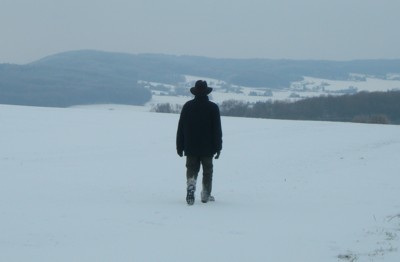

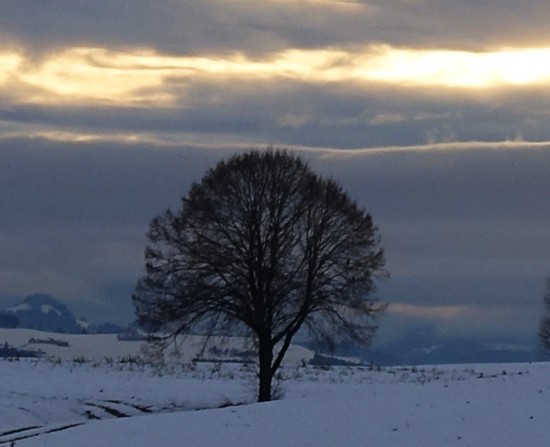
Walking into the New Year. Photo of a friend
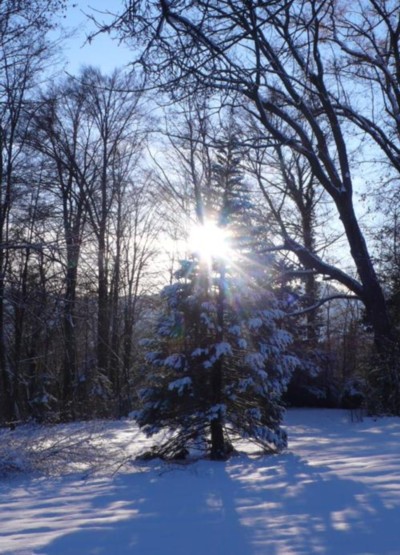
Winter Impressions

December 25th, 2010

Winter has the country in its strong grip. Through a snow and ice-storm we arrived two days ago in North Germany, and all the roads are covered with high snow. Walking into the town of the place where I spent my childhood I helped three times pushing cars to get running. Today, Christmas morning, I will meet an old friend with whom I lived together a number of years during the times of my studies. We had “wild times” together. In the meantime he has become a professor of literature, but somehow he remained young in his heart. Whenever I meet him we have a long walk and exchange what has happened over the years.
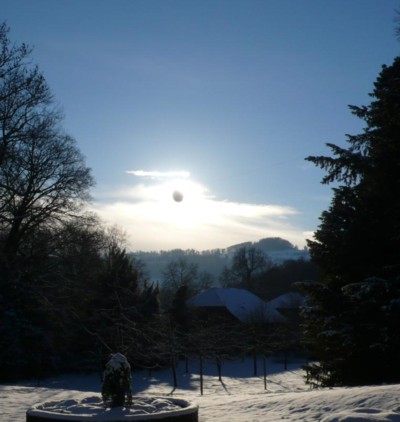
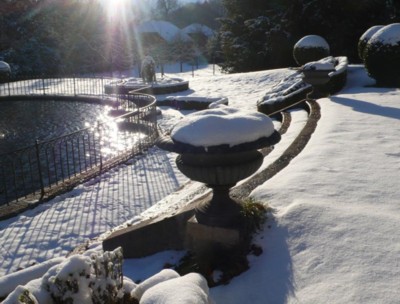
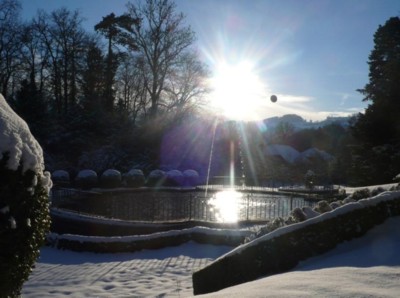
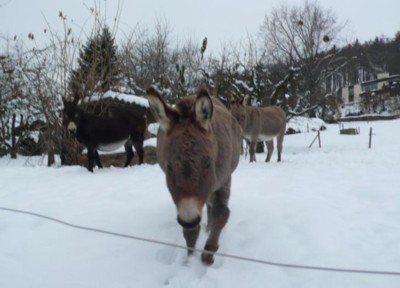
The two last weeks in Switzerland I took a few winter pics with enchanted impressions.

Merry Christmas!


Christmas tree in the evening sun


Artificial solstice – a black sun hanging between the trees of the park


Villa Mettlen with a christmas tree in the park

Snow balls and black sun


Sun on a stone pile


Enchanted garden


Fountain of light and black sun


Sinking gardens (work of art)


Donkeys in the snow


Setting sun over a farmyard


Christmas scenery at a farm entrance


Santa Claus at the farm entrance

Christmas Greetings Flourishing

December 18th, 2010

At the moment Christmas or winter related videos are flourishing, and mails with seasons greetings.

Here is a nice video with a song about the snowman and a boy walking in the air:

And here is a beautiful version of the song by “Celtic Woman”.

Another funny video is “The Digital Story of Nativity” or “Christmas 2.0” 🙂

But if you want to write someone a nice e-card, you find 5 themes on the Good-Will site.


A Christmas tree in our village

Intimacy with Nature

December 11th, 2010

A friend sent some beautiful photos about Tippi Degre, born 1990, who grew up in Namibia, Africa, as a child of French photographers in an incredible intimacy to wildlife.

This is a trailer from a documentary made on her returning to Africa, and bridging two completely different cultures, meeting old and new friends.

A Hymn to Zeus

December 11th, 2010

A beautiful hymn, though it probably is a modern interpretation.

A Story about Shambhala

December 7th, 2010

A Spanish friend sent this  beautiful story about Shamballa, which I put into English with the help of automatic translation:

“Shamballa is a sacred kingdom hidden in some remote corner of the Himalayas. The Tibetans believe fervently in the existence of Shamballa. In this paradisiac place reigns beauty and kindness, because their residents have reached the illumination transcending suffering. Many consider that it is even possible to arrive at Shambhala, but the road is long and full of dangers. He who has the luck to arrive at its doors – often by chance – should take advantage of the opportunity to penetrate into the Kingdom.

If he doesn’t go it and leaves it, it will stop later on; perhaps he will never again find it. The doors of Shamballa open up a single time in one’s life, and if you don’t cross them you are outside forever.

This myth teaches us something very important that we often forget: “Life doesn’t wait”. Therefore, if we have an aspiration, we should try to make it a reality. If we don’t take the initiative with the first enthusiasm, perhaps we don’t make it again.

It is sad to allow the days and the years to pass by without anything important happening. Those who never take a risk for anything are the first ones that complain about being bored by life. They wait that the change, happiness, arrives like a gift for them.

If the door of Shamballa opens up in our lives, let us enter without doubting. It is preferable to make a mistake several times than to fall into routine.”


The painting “Shamballa” by Nicholas Roerich shows the glacier peaks of the mountain range of Thang-La which reminds of the White Island. The painting stems from Roerich’s expedition through the Himalayas, Tibet, and the Desert Gobi in the 1920s. Many thanks to the Roerich Museum in New York.

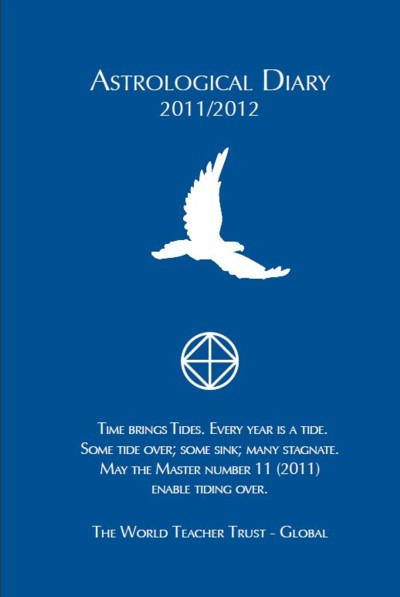
Astrological Diary 2011 / 2012 of the WTT – Free Download

December 7th, 2010

Every year the World Teacher Trust-Global publishes an Astrological Diary running from Aries to Pisces. You can use it to go into the qualities of time and to work with them inside.

The Astrological Diary 2011/12 contains the daily positions of the planets, references to important events for the spiritual practice, information about the moon phases and constellations of the moon (Nakshatras) as well as an aphorism of the day to meditate and ponder upon. You find some short information about this inner work in the booklet on Time.

A Christmas Flash Mob

December 7th, 2010

A friend from Canada sent me the link to this inspiring video of a flash-mob singing a Hallelujah. It was a surprise for the shopper having their lunch in an Ontario shopping mall food court. The recording was arranged by a photo agency to wish a Merry Christmas.

Online Frauds

December 4th, 2010

Last Wednesday I received a mail which seemingly came from an Indian friend. When reading it in the evening, I had a short moment of hesitation, but then I got “trapped” by the story and the fact that certain points in the mail seemed to be authentic – but it was faked. My friend told me he came from India to Madrid to help a niece in health troubles. She had to undergo surgery and since the operation would be too expensive in Spain he decided to bring her back to India. He now asked me for financial help with a substantial sum in Euros, and said not knowing about our financial situation even if I just could help with some part of it would be warmly welcome and he would pay it back as soon as he is back home. He indicated an address in Madrid, with his full name (which isn’t part of his e-mail ID) and “confirmed” to me the e-mail was “really” from my friend and he asked me to transfer the money via Western Union.

So I looked up in our Euro account and saw that there was just enough. I tried to transfer it via Western Union with online banking, but since the opening of the transfer section takes 24 hs, I phoned to the support hotline and a very kind lady told me that I also can transfer the money via Cash International, which would even be cheaper. She then guided me through the process…

Early next morning I woke up with a certain suspicion why my friend had greeted me with “hello” and not the usual “Dear Brother …” Maybe he was under stress, I thought, reminding me that my wife suspects me often to be over-critical.

Later in my office I had a quick look into my private mail account to see if anything had come in from my friend. There it was. He thanked me for the quick response and asked if I could let him know the Western Union code for identifying. I wrote him I had sent the money via Cash International and didn’t get a code but suppose that he will need to identify with a passport.

Only then I saw another e-mail from a Spanish friend who is in Visakhapatnam, India, at the moment, with the header “Urgent”. I opened the mail and read: “The email ID of hotmail xxx has got hacked, and they succeeded. Please don’ t respond to any mail coming from that email ID hotmail. It’s very important that you inform everybody who can be concerned….” I answered, thanking her and telling: “It is already too late, I reacted on the e-mail.”

Since I couldn’t access to the Postfinance account from my office I phoned to my wife and she immediately contacted the support. They said, it’s already too late, the money is out. But they told her to contact the police, and this my wife did. The police then contacted again the security service of the bank and they could stop the transfer process. So virtually “in the last minute” the money was saved. It was only some days ago that I read about the hacking of hotmail and other accounts from big providers, but I hadn’t imagined that I would become a victim and I thought I knew their tricks, being in touch with such questions also professionally.

I sent an information to the mailing list of our group members informing them about the hacked account, and another Indian friend replied: “The hackers always do that and try their luck. But I’m glad the transfer was duly stopped and saved yourself a lot of trouble. There is a blog some victim wrote. Very informative.” And later he wrote: “The fraud e-mails have good language to convince and catch victims. They present the picture beautifully. Quite a few of my friends’ mails have been hacked that way – same – asking for money – stuck in some city! They send them out to contacts in the address book and look for any unfortunate victim to respond! It is really lucky that your transaction was thwarted. I delete such mails and then their address in my book so that I would not forward any mails to that hacked one unwittingly, later on.”

In the evening I heard from an IT-specialist how he got tricked online and lost some money, though he knew very well of possible tricks. And yesterday another friend told me how she got trapped very intelligently through a skype chat contact and lost some money.

We have to be very alert.


A way in the mist leading “nowhere”

Passing Over and Karmic Links

November 21st, 2010

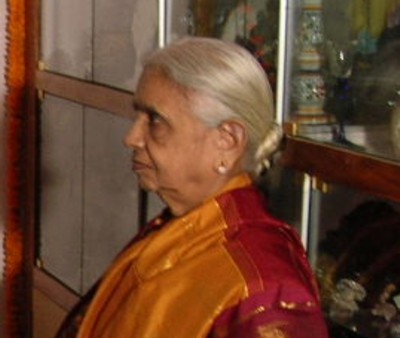
This morning I heard about the passing-over of the mother of Sri K. Parvathi Kumar and a friend asked me to translate an information about it. This made me think of several situations I had met her in India – a silent, deeply spiritual old woman. I remembered a passage mentioning her in the book of Sri Kumar about his father: Sri Sastri Garu – Story of a Disciple:

“Sri Sastry was married to the lady Ramalakshmi, who hailed from yet another family of good lineage. Her father too was in the path of Kundalini Yoga and was also a great Rama devotee. He recorded in a book 30 million times the name of the Lord, as a penance during 30 years! The marriage was an arranged marriage by the elders. Sri Sastry’s father, Sri Jagannadha Sastry, admired the prevalence of yogic path in the family of Smt. Ramalakshmi and therefore decided that the marriage be conducted as between the two. Sri Sastry was 20 years of age and Smt. Ramalakshmi was 14 years when they were married in the Vedic style, at Vijayawada. They set up their family life at Madras, where Sri Sastry was working at that time. As per the job requirements they lived in Salem, Visakhapatnam, Eluru, Rajahmundri, Vijayawada, Anantapur, Cuddapah, Nizamabad etc., the various district headquarters. Smt. Ramalakshmi was a highly co-operative wife in fulfilling the noble aspirations of Sri Sastry; besides, she was also a keen follower of Sri Sastry in gaining comprehension of the Scriptures. Sri Sastry used to explain to her every night the profound concepts of Sri Bhagavatha, after their daily duties were done with. They daily recited the recommended lengthy citations of Sri Bhagavatha for a minimum of an hour.
They were blessed with 7 children during the course of their family life, six sons and one daughter. All were well conceived. There was not a single miscarriage. They lived like friends, with unity in thought, in speech and in action.”


August 2005

Also this morning I came into contact via a blog-comment with a lady living in the Italian speaking part of Switzerland who had been visiting the family in 1980. She sent me two photos and wrote about her deep relation with Master EK who passed over in 1984. It is interesting to note the karmic links leading people together.