erk admin

spacerCircle of Good Will - Blog

Archive for the ‘Social’ Category

The Business Model of Giving Things for Free

Saturday, October 11th, 2008

I just read the latest issue of the Swiss “NZZ-folio” magazine the topic of which is “For Free – Business Model of the Future?“. Some articles show how people get blinded when they hear that they can get something for free – they forget that normally there is a catch in it. Free newspapers, free phones, free drinks,  – there are many ways of seducing and of capturing the attention.

Of course little value is often attached to things which are given for free or for half the price, and on the web it is nearly taken for granted that you get content or a lot of software for free. The motives of doing so vary – personal satisfaction, making a name for oneself, getting people attracted to some other offer… There are enterprises engaged in philanthropic activities, where there is no financial “return on investment”, but a gain in reputation. But the self-related motives remain, though they might not be visible at the first sight.

There are people doing service activities with a selfless motive, or even without a motive at all. This way of acting is not catchy. But the thing is that by receiving benefits you remain in a receptive mood and get into passivity. You have to give something so that the flow of energy doesn’t get stuck with you.  You might like to read more about the power of giving in the issue on Giving and Taking of the Good Will in Action. And you might be interested in our free distribution of wisdom books or our free newsletter –  this kind of “hooking” isn’t dangerous 🙂

Wisdom is flowing for free, for those who are really seeking it from the right sources and use it for the right purposes.


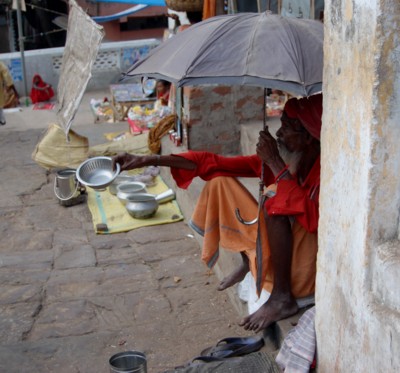
When you just receive without giving in one way or the other you create attachment and remain a beggar. Photo by a friend, India 07.

Quick Clicks to Change the World?

Saturday, September 27th, 2008

The present US finance crisis also spills over into e-mail requests to sign petitions like that of AVAAZ making a call to act now.  A friend asked me what I think of such initiatives.

AVAAZ says: “The global financial crisis is spilling over into our lives, threatening jobs, savings, pensions and public services everywhere — worldwide recession could be next, while the public bears the cost. It’s time for citizens around the world to raise our voices and demand that the fundamental causes of this crisis are addressed — we need tough rules to stop the financiers’ folly, and a new framework that better serves the public interest.”
They address European, US and world leaders: “We urge you to take a lead in fixing the fundamental flaws and loopholes which made the global financial crisis possible, including basic problems of debt and risk, incentives and transparency.” – and then they ask you to sign the petition with a click.

I’m not judging about the necessity of measures counter-acting excessive greed and its consequences… But  I normally keep a distance to these click-collection campaigns. I had participated once in one of the AVAAZ campaigns, for Tibet. and there I saw that you are per default registered into their mailing list (from which you later can resign), so they are a bit enforcing participation.

For me these click-collections are kind of a show. The idea is fascinating – a click from the desktop, like in a computer-game – and then you feel that you have done something against global crises. But changing the world cannot be done with a quick click.

Of course coordinated actions are powerfull, courageous commitment for the well-being of ones fellow-humans or nature is of a great value. And also an englightened public opinion.

Action is generally understood as a means for change. Much less, however, the value of a silent, inner work of transformation. It is much more effective to change oneself first and thus create a change in the world. This inner work is not showy, it demands patience and endurance. It is not a quick-click activity or an online-game.

The global crises are the results of collective past actions, called Karma. When people are ensuring a high standard of living on the basis of bank-depts, and the banks speculating with hot air, it is no wonder that the card-house of illusionary values collapses. It looks like magic to witness hundred billions of dollars just disappearing into the void. Was there any real value before? What is a value and the quality of money? You might like to read the Good Will in Action on “Money and Good Will“.

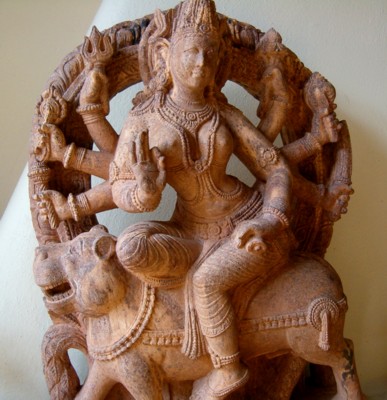
We are in the month of Libra, and in the East they are worshiping now the Goddess Durga, who is creating the illusions of matter and its impenetrability. She is depicted as sitting on a lion or a tiger, symbolizing the wild, untamed personality instincts. The gambling of the banks reminds of such a “ride on a tiger” – but of people with blind-folded eyes.


Durga-statue in the house of a friend.

The Universal Nation

Wednesday, September 24th, 2008

Yesterday I got an e-mail from an Argentinean friend living in Southern Spain. He announced that he had just started a bi-lingual blog called “The Universal Nation – La Nación Universal“. His keynote starts with the words:

“The abolition of the system of nations as independent sovereign states is the present’s paradigm, and the greatest global need, and the solution to many of the major problems of modern humankind, all at once….
Today’s paradigm –21(st) century’s paradigm– is not nationalism, nor regionalism, nor continental integrations but, directly Universalization: a so-called Universal Nation – or the social habitat of World Citizens.”

It is a topic he has been pondering upon since long. In a chat with me last Sunday he wrote that the thoughts he intends to express through the blog are the synthesis of his experiences in this life, to be a good service to some extent…

Though he isn’t talking in the blog about personal experiences, just expressing his thoughts about the basic need of overcoming the separation of national borders and barriers, it is still a topic of a very intense nature concerning his life: Some years ago I had a talk with him while he was still living in Germany and trying to get a permission to stay. The authorities gave him a hard time and in the end he left Germany – an end of a cycle, as he said. He is an artist, a dancer and philosopher. I appreciate very much his energetic, kind and open-minded nature. (You might read here a blog-note about his father.)

The problem of nationality and borders is limiting the free movements more and more. The fear of strangers taking away jobs and over-flooding the cultural settings of a country is very strong – and the walls are getting tighter. The national personalities are developing…

Master Morya says: “I wish to see you moving over the face of the world when all national boundaries, because of their multitude, will be erased. How can we fly when pinned by a small nail! Reflect upon the need of travel for humanity.” (Agni Yoga – Community in the New Age § 93)


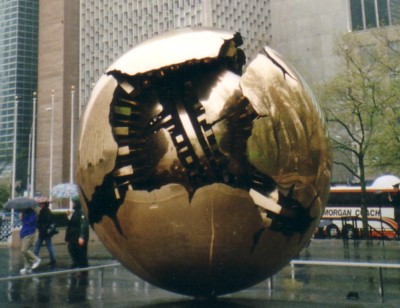
Separativity will break the unity of the world into many pieces. A very symbolic sculpture in front of the UN-building in New York.


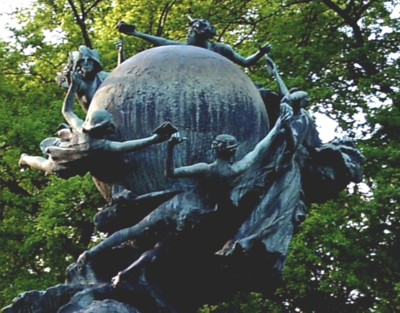
World Union – overcoming division and seeing the inter-connectedness of all life. A statue in Berne erected on the occasion of the founding of the World Postal Union

Insight into Decision Making

Wednesday, September 24th, 2008

An Indian friend forwarded me today the following text with an interesting story about decision making. How would you decide?

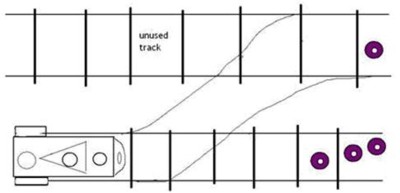
“A group of children were playing near two railway tracks, one still in use while the other disused. Only one child played on the disused track, the  rest on the operational track.

The train is coming, and you are just beside the track interchange. You can make the train change its course to the disused track and save most of the kids. However, that would also mean the lone child playing by the disused track would be sacrificed. Or would you rather let the train go its way?

Let’s take a pause to think what kind of decision we could make…

Most people might choose to divert the course of the train, and sacrifice only one child. You might think the same way, I guess. Exactly, to save most of the children at the expense of only one child was rational decision most people would make, morally and emotionally. But, have you ever thought that the child choosing to play on the disused track had in fact made the right decision to play at a safe place?

Nevertheless, he had to be sacrificed because of his ignorant friends who chose to play where the danger was. This kind of dilemma happens around us everyday. In the office, community, in politics and especially in a democratic society, the minority is often sacrificed for the interest of the majority, no matter how foolish or ignorant the majority are, and how farsighted and knowledgeable the minority are. The child who chose not to play with the rest on the operational track was sidelined. And in the case he was sacrificed, no one would shed a tear for him.

The great critic Leo Velski Julian who told the story said he would not try to change the course of the train because he believed that the kids playing on the operational track should have known very well that track was still in use, and that they should have run away if they heard the train’s sirens.. If the train was diverted, that lone child would definitely die because he never thought the train could come over to that track! Moreover, that track was not in use probably because it was not safe. If the train was diverted to the track, we could put the lives of all passengers on board at stake! And in your attempt to save a few kids by sacrificing one child, you might end up sacrificing hundreds of people to save these few kids.

While we are all aware that life is full of tough decisions that need to be   made, we may not realize that hasty decisions may not always be the right one.

Remember that what’s right isn’t always popular… and what’s popular isn’t always right.
Everybody makes mistakes; that’s why they put erasers on pencils. “

Osho – Strange Consequences

Sunday, September 21st, 2008

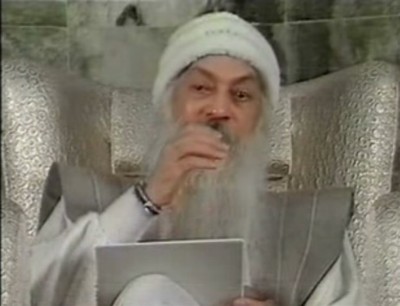
Today a friend sent me the link to a YouTube-video of Osho (Bhagwan Sri Rajneesh) talking about “After Friedrich Nietzsche declared that “God is Dead” – the word F*CK has become the most important word in the English language…” Really funny and philosophical

Photo from the video (c)

Ready for the Blogosphere?

Friday, August 8th, 2008

Two days ago I read an interesting report (PDF) from Alertnet, the humanitarian support branch of Reuters Foundation. It is the summary of a workshop from July 24 in London about “Are Aid Agencies ready for the Blogosphere?” Nearly 50 people attended from 30 British-based organisations, plus experts from the media and non-profit sector.

In the blog-post on the workshop they write: “As one blogging true believer has said, blogs should be written while sitting in front of the computer in dirty pyjamas. They’re not the type of thing you write while wearing a suit. Much of aid agency communications is of the wearing-a-suit variety. Open and frank discussion is rare.”

About 2 years ago I tried to get the organisation where I work blogging – and resigned after a while, for there was to much skepticism from the side of the management. (However, I started then this blog.) Now it seems that a new interest of the international department is coming up again. I’ll sketch a conception draft in the next weeks, when I find some time…

Other aid agencies have started in the last times. A friend from the Swiss branch of a big international NGO to whom I sent the link about the Alertnet-workshop told me that it came just in time – they are about to launch a blog and he is just preparing a presentation to the management body.

Blogging can also be dangerous: A Swiss blogger about web security and anti-spam was attacked last weekend by spammers with a diffamation campaign, where in a faked mail he was announcing his suicide (I also got this mail). He got 10’000 reply-mails and a visit from the police in the night who wanted to prevent his suicide – of which he didn’t know. And the Google copyright expert William Patry just closed his blog because he was writing about the dangers of the copyright development and had loyalty problems with his job.


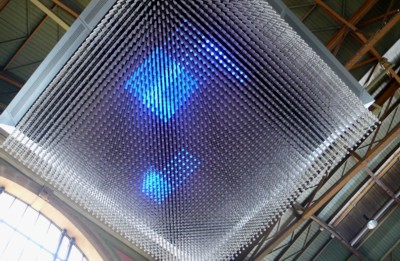
Not from the blogosphere, but from another sphere: artwork at the roof of Zurich Main Station.

A Candle for Tibet

Sunday, August 3rd, 2008

A friend of our group today sent me the link to the site of the campaign: “Candle4Tibet“. The initiative says:

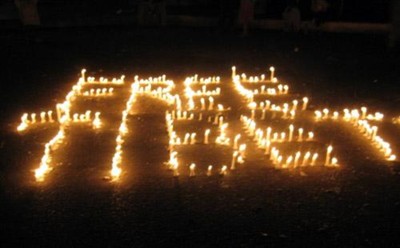
“August 7th 2008 is the day before the opening ceremony of The Olympic Games in Beijing. On this day we aim to create the world’s greatest LIGHT PROTEST, when at least 100 million people from all over the world will light a candle and say YES to freedom in Tibet!

All you are asked to do is to light a simple candle
on August 7th at 9 pm in your own time zone.

Light the Candle at your home, workplace or in a public place. Put the candle in your Window, or on your desk, or anywhere else where other people will see it and hopefully do the same.

Our light protest will be seen by billions on TV screens all over the world on the day the Beijing Olympics open. We are not against the Olymipcs or anything else for that matter, we stand for Freedom. Period.

On the following day we will issue letters to every head of state in the world to tell him exactly how many people from his country wish Tibet to be free. We will also demand that each one of them will act for the freedom of Tibet.

We will also issue letters to the general secretary of UN, the government in Beijing and to other global organizations with data on global participation”

They also plan to flare mountain tops and sky scrapers with red smoke. A peaceful way of protesting for freedom. May it strengthen global solidarity.


From the site Candle4Tibet

From National Holidays to a Celebration of World Unity

Friday, August 1st, 2008

Today Switzerland is celebrating its national holiday, at the date supposed to be its establishment in 1291 – though historians doubt it

What to take pride in as a nation? This topic is stimulating the minds on such occasions, and it is a fertile field of patriotic moods. I yesterday read articles in some newspapers on this theme, discussing the situation of freedom in a time of excessive administrative regulations (NZZ) or if there are really good Swiss jokes (not really, says the Tages-Anzeiger). Other countries seem to celebrate with less intellectual embarrassment, as I saw in India last January: “I love my India”.

Of course, national identity is an important factor for a sound and stable social system, and celebrating the accomplishments of a nation certainly contributes to form a meaningful national identity. Like an individual, nations also have their personality and soul qualities. The personality traits, in their gross forms for example chauvinism, racism or xenophobia, are often supported by economic egotism, which always has an eye to one’s own interests (money, money…), and also the feeling of social or cultural superiority (we are the champions…).

The soul qualities of a nation show in its power of integration, of humanitarianism, of a responsible and committed attitude towards the welfare of the environment without the egotistic eye. In spirituality crises and conflicts are seen as times of growth towards a large scope of consciousness, and this is also true for nations. If they don’t learn to share, crises will teach them.

Many people are feeling the need to celebrate global festivals like the earth day, celebrating the global village or festivals of good will in order to rise the awareness of the oneness of life. They are good ways to install the feeling of unity and inter-connectedness.

So the love for one’s country can expand towards a love of the greater global whole and the readiness to take the related responsibilities of exchanging and sharing. Like Michael Jackson and his crew once sung: “We are the world, we are the children”. Maybe it’s the hymn of a future celebration of global unity. As the refrain says: “We are the world, we are the children. We are the ones who make a  brighter day, so let’s start giving.”


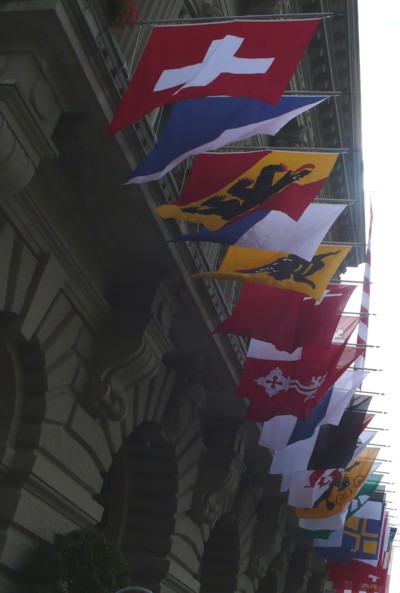
Flags of the Swiss cantons and the national flag in front of the Swiss Federal Building, for today’s celebration

4th of July: The American Dream – and Awakening into a Greater Whole

Friday, July 4th, 2008

I yesterday got an e-mail forwarded by a friend. It was about the American dream, on the occasion of Fourth of July, the national US holiday, being this year the 232nd birthday. The original mail said:

“Our American Dreams have been built and realized on the bedrock of faith, freedom, hard work and sacrifice since 1776. As part of the industry that has brought The American Dream of Homeownership to more families than any other country in the world we stand proudly beside you in shouting – ‘Happy 232nd Birthday America!’ ”

I first wasn’t sure if the “Dream of Homeownership” was meant ironically – in view of all the news about the real estate crisis in the USA caused by the present lifestyle on loans. Also some Swiss banks had been drawn into the maelstrom…

My friend from Texas had answered: “Yes, the American Dream is a strong motivator to work hard because here merit does get rewarded. However with time, the Dream itself needs upgrading since many have found that even after its realization in its present form, they remain unsatisfied. This upgrade should be in the realm of human development in the currency of life – consciousness. The present Dream is wealthy in the currency of material welfare – dollars, but very poor in the currency of life, which is why we struggle with life because the demand is greater than our ability to cope.”

For an onlooker there are other strange scenes coming into the dream, making it somehow a nightmare. There is the feeling of collective fear and a crave for security – the “right” to have guns and the related killings, the “border control syndrome” in the wake of 9/11, and the US having also forced other countries to launch new biometrical passports in the name of “security”.
Outer security can never replace the inner feeling of security, which has also to do with right action or the karmic results of wrong actions. The “victim” of aggressions is likely to become a future aggressor, also in the case of nations.

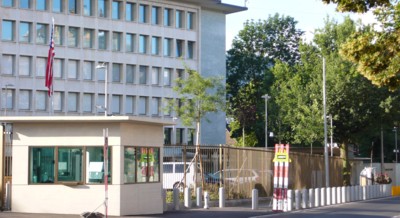
A small observation about security: For several months reconstruction work was going on with a house and its surroundings at the corner of the street in which my office is located, about 150 meters away. Since one month it is now the seat of the American embassy in Switzerland. The security preparations created some kind of a fortress – especially deep anchored fences, steel bollards along the road, entrances with security screening buildings. At the place where the old embassy had been, a street had to be blocked in order to avoid any approach of dangerous vehicles. The same is done with the street of the Israeli embassy. Other embassies are less “high security zones”, some with fences, some just houses along the streets.

Yesterday preparations for the celebration of today’s Fourth of July were going on in the garden of the American embassy. When I went home I saw soldiers of the guard screening someone bringing articles for the party. Tonight the party will start, this afternoon the street is reserved for the guests.

A contrast to this “dream of freedom”:

When I go home with my bicycle I come along the front of the Swiss “House of Parliament”. It is in the centre of the city, a few hundred meters from my office. No special fences, direct access, though at the entrance there is some screening. Directly in front of the building there was the party zone for the Euro08, and two times a week the place is used as a market where farmers sell their products. Sometimes I see members of the government, ministers, walking around in the city, just like other people do, without any security guards around. A feeling of normalcy with politics, not much fuzz about it, no high security ghetto.

May the 232nd birthday inspire the Americans to awaken from the “Dream” state of separativity into a higher awareness of oneness, of integrating into a greater life, sharing the needs of the greater whole and behaving on a friendly basis also with other nations, which don’t share the same sets of convictions. This certainly will create lasting security, based on the unity of existence.


The American embassy in Berne, this morning.

Football Mood

Friday, June 13th, 2008

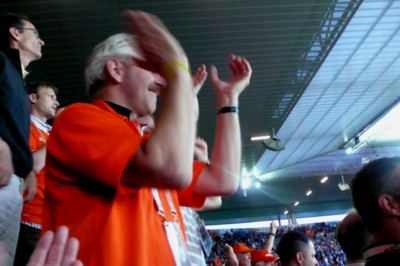
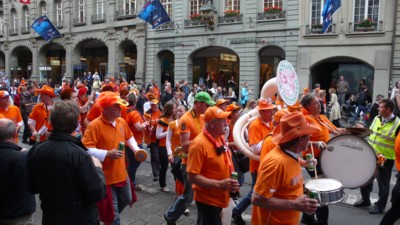
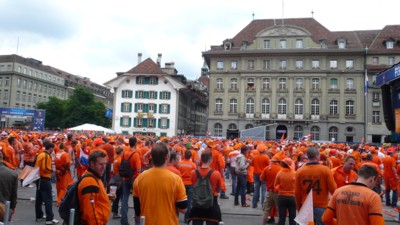
Last Monday after the visit to Microsoft we returned to Berne, where the city was sprinkled all over with orange – the Dutch football fans had invaded the town, a peaceful, though not silent invasion. It was quite a contrast – the cool, focused ambiance at the Microsoft center and the emotionally charged atmosphere of the fans. The tickets for the game already promised: “Expect emotions” and indeed, you could feel it.

I’m not at all a football fan and was a bit sceptical about mass hysteria, especially in the stadium. The media had fuelled it over the last weeks until overkill. But already in the corporate hospitality center, where we had our dinner, there was a hilarious, cordial mood, mainly of middle-aged people mainly in orange, with orange hats and other orange decorations – a carnival. I said to myself: “Get ready to plunge into a collective solar plexus center in upheaval.”

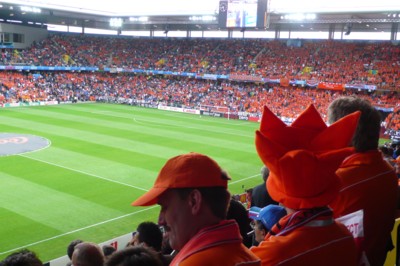
In the stadium the colour orange was prevalent, the blue of the Italian Azurros was mainly in one block, but obviously a minority. And normally dressed people, too.

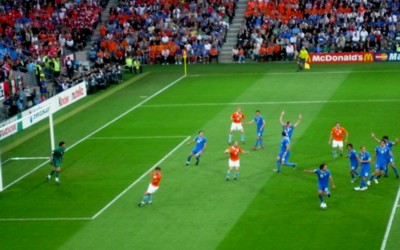
Music and announcements heated up the public. The players came in like gladiators into a Roman Coliseum. The game began. It soon became visible that the Dutch team had an excellent group cooperation in the way they were exchanging the ball between the different players. The Italians, however, seemed to be more a collection of strong individualities. In a newspaper they later spoke about the Italian world champions as the “divas”.

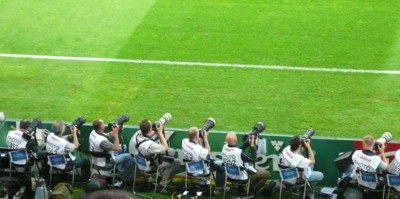
The point of focus – the football – changed from one side to the other in rapid moves, but all were focused on this one point, not only the camera men all around the field, ready to catch a good shot.

The football is like the “I AM”, the point of focus of our awareness. When you are not linked to the higher self, your point of focus gets tossed around all over the field of activities. The teams – your interests – push it into ever-changing directions.

It soon became clear that the good group cooperation of the Oranjes was stronger than the individualistic strength of the world champions. The game ended 3 : 0 for the Dutch. A huge emotional outburt of joy went through nearly the whole stadium – except the Italian corners.

I also was taken by the waves of joy, but I was astonished that the Dutch fans were very civilized. When the masses left the stadium, it went quickly and in a totally ordered way. I had to review some of my prejudices.

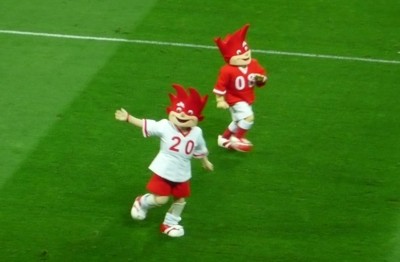
Of course the whole was also a big marketing activity, and the sponsors claimed their rights of attention. The mascots moved over the field wishing all a good-bye.

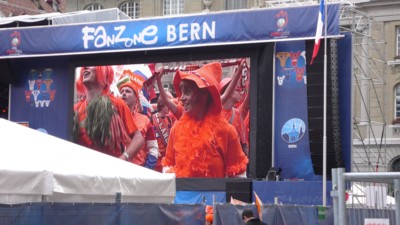
Today at noon, when I crossed the city, it was orange all over: The fans were moving with bands through the streets, in the fan-zone the music played and warmed up the emotions for tonight’s play against France. Will the emotions of the party-mood still be there tomorrow? The Swiss were mourning the two lost games scattering all their football hopes.


Screen in the fan-zone in front of the government building


Dutch fans in the street


Orange all over