
erk admin

spacerCircle of Good Will - Blog

Archive for the ‘Social’ Category

Launch of Google Outreach: Webtech Meeting Refugee Protection

Tuesday, April 8th, 2008

Today I was in Geneva at the office of the UNHCR, the UN organisation for the protection of refugees.
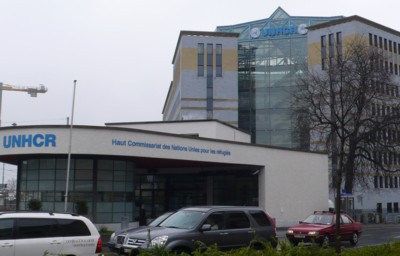
Together with Google Earth they launched for Switzerland the new online mapping programme, Google Outreach (up to now it is only available in certain countries), and at the same time unveiled the outreach programme for the UNHCR:
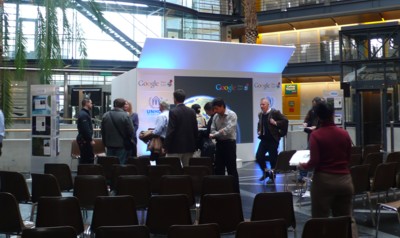
“It’s absolutely fantastic. The potential for us and the potential to serve our interests and to serve the refugee interests round the world is quite substantial and we need now only seize the opportunity and move ahead with it,” Deputy High Commissioner for Refugees L. Craig Johnstone told more than 250 staff and invited guests at a launch ceremony in the atrium of UNHCR’s Geneva headquarters. Johnstone said the pilot UNHCR layers, which are now live on Google Earth Outreach and available from the UNHCR-site, made it possible to zoom in on specific refugee situations
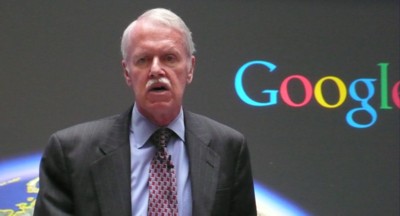

L. Craig Johnstone

And indeed, it was very fascinating to see the the scope of possibilities this new technology offers. Rebecca Moore, manager and founder of Google Earth Outreach, gave an insight into the new application, showing different examples already realised.
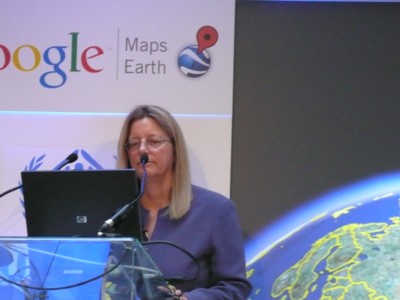

Rebecca Moore from Google

With layers you can place information and media into Google Earth (a downloadable program) and Google Maps (online version). Now Google Earth Outreach gives non-profits and public benefit organizations the knowledge and resources to greate maps and virtual visits to projects.
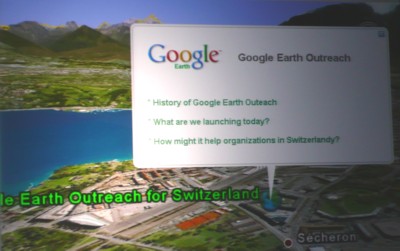
This way you can directly show people what is at stake at a place and not just speak about it. You thus can raise the awareness and reach a broader audience – at the moment there are more than 350 million Google Earth users world-wide. You can use the tool to educate people, inspire action and influence decision-makers.

To show the impact of photos to sensitize people to what is happening in other parts of the world, Zalmai, internationally reknown photographer, born in Kabul and and refugee himself, who had just returned from Afghanistan, showed very impressive pictures of the horrible living conditions of internally displaced people there.
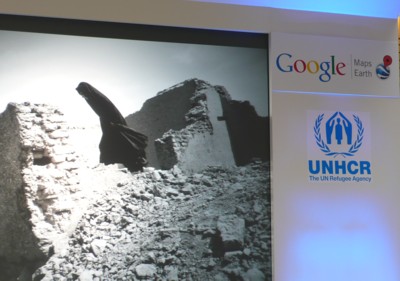
In the afternoon there was a tech-session to explain how the magic works, and a a manual for developers (pdf) was handed out. And we did some experiments with the spreadsheets to create information for Google Earth – it’s really not difficult to use.

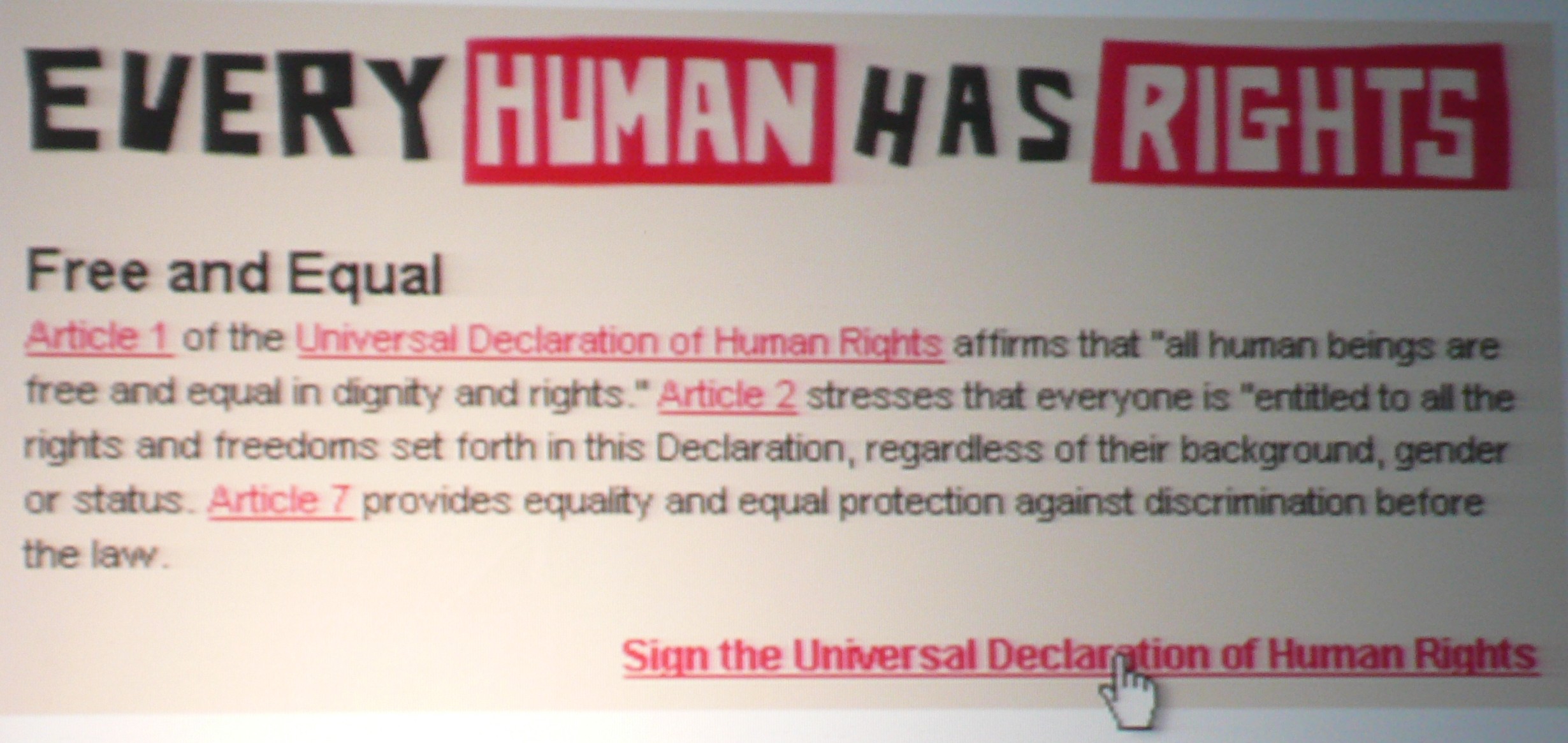
Google also just launched an initiative together with “The Elders” – a gathering of world leaders coming together to guide and support the people – called “Every Human has Rights“, on the occasion of the 60th anniversary of the Universal Declaration of Human Rights. Google is now placing the 30 Articles of the declaration into the download version of Google Earth, so that you can see them at different parts of the globe, where they are at stake. This way also the knowledge about the human rights is spread all over – a very inspiring initiative.
At my office we are already using Google Maps to show the areas of world-wide activities. And since yesterday the Circle of Good Will can also be found on Google Maps. But I don’t know yet whether in my office or privately Google Outreach will come to a use… Nevertheless it is a great tool for inter-connecting the world and thus bringing in a fresh air of the Aquarian age.
Overcoming Boundaries

Tuesday, April 1st, 2008

Last Friday I got the notice from the Swiss Federal Office of Migration that I was granted Swiss citizenship. I had applied for it last September, when I read that Germany now allows double citizenship with members from EU countries and Switzerland. Since my wife is Swiss, I didn’t have to go through all the paraphernalia of the normal process.

Somehow this system of national states and their identities impregnating the way of thinking and feeling always remains something mysterious for me, and it was so already when during my studies I was going through political philosophy.

On the rational side I understand these mechanism of creating and protecting a national individuality, with its multiple regulation systems of in- and exclusion.

On the side of feeling I find it strange how borders circumscribe parts and parcels of the earth, defining mine, thine, ours, yours, on the micro and macro level. And then all this game of natives and foreigners, friends and foes, influencing others territories by way of manipulation (via economical, religious or power pressure).

Of course when passing a border you often sense that there is another flavour, another tone or way of interchanging. And this gets even much more accentuated with another language, another writing system …

On the plane of the soul you get away from all these definitions and limitations, like “I am a Swiss / A German / a European / American”, or “I am a teacher / a student”, “I am a husband / wife”, even “I am a man / a woman”. The soul knows no such delimitations, it is “I am”, or even “THAT” – “That I am” – existence expressing itself as consciousness, with a mind, wrapping up into a body.

And so all this cascade of localizations and limitations goes on. Keeping the limitless background of existence in your awareness through a meditative re-connection helps staying aloof and not getting stuck in some ideological imprisonment.

You might like to read the Lunar Messenger on “Free Will and Freedom“.


A path to the blue yonder

Cages of Concretised Mind and the Free Flow of Fresh Life

Monday, March 24th, 2008

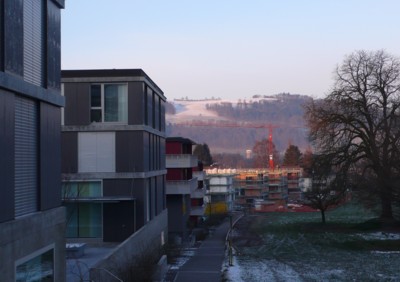
Whereas nature is very beautiful in our surroundings and breathes a wide and uplifting air, it seems that man is doing his best to create for himself cages to imprison the soul. On a nearby meadow shoe box-like gray blocks have been set up and are still being constructed, devouring the green:

muri1.JPG

They are sold with the euphemistic slogan “Living in the Orchard”, but the ambiance they radiate is like living in the suffocating gray-in-gray of materialistic life:

muri3.JPG

It is a high-standard settlement in a rich municipality near Berne, and the blocks are filled with shops, a bank, a large underground supermarket, old people’s homes and offices. The whole is very symbolic of the mental attitude in sway: The objective life is developing, but the subjective life is starving. The intellectual mental concepts keep on repeating themselves everywhere along the same lines:

muri4.JPG

Planning is a mental process, ruled by rules and regulative restrictions, restricting the free flow of ideas, which is in tune with dynamic, ever new original life. A life spreading comfort and well-being, beauty and cordiality. Thus the outcome of mentally crystallised planning is but repeating the same square-head patterns, the cube being the symbol of matter ruling over spirit. Ironically the name of the building company is “All real” – but which reality? – the outermost, concrete-tized.

muri12a.jpg

The rhythms and forces of nature seem to be kept outside, and they, too, seem to be helpless in trying to reach man:

muri5.JPG

Snow-White and some dwarfs in a nearby garden are losing their colours, and people look at these beings like past superstitions, having themselves lost the inner view of subtle realities:

muri6.JPG

But although a cold wind was blowing yesterday, bringing snow instead of gentle spring breezes, there are fresh colours on the way:

muri2a.JPG

And although the birds still are suffering from ice and a backlash of winter

muri10.JPG

you find everywhere already the forces of spring at work:

muri11.JPG

And there is not only a sunrise in nature, but you find also new forms of human life seeking expression.

muri7.JPG

So spring is in the air, an Aquarian breeze at Easter, lifting the souls up from crystallised stagnation. Even in mainstream society.

muri9.JPG
Photos from yesterday and this morning in our village

As per living in cages you might like to read the “Good Will in Action” on “Body and House“.

World Forum of Civil Societies Network UBUNTU – Statement on the 60th Anniversary of the Universal Declaration of Human Rights

Sunday, March 16th, 2008

The World Forum of Civil Society Networks UBUNTU have worked out a very important Declaration on the context of the 60º Anniversary of the Universal Declaration on Human Rights UDHR. This Declaration was published with the first 50 signatures on 14 March 2008 in the International Herald Tribune (London – NY). Since last Friday dozens of people and organizations are signing this Declaration (and we have signed it, too).

The drafters of this Declaration have given a clear message to the world: to reach peaceful societies we need to promote human right to peace, right to development and environment protection.

By signing this Declaration you can express you support of the UDHR.

By the way, the name of the world forum UBUNTU, “is an age-old African term for humaneness – for caring, sharing and being in harmony with all of creation. As an ideal, it promotes co-operation between individuals, cultures and nations.”

globe1.JPG
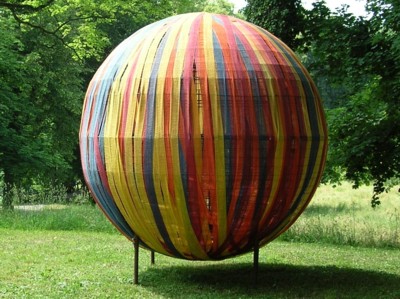
Colourful globe of world union – sculpture in the Elfenau Park, Berne, June 2007

Knowing Where to Tap

Wednesday, March 12th, 2008

An Indian friend sent me today the following excellent story (and then I saw that it is posted in many blogs…):

A giant ship engine failed. The ship’s owners tried one expert after another, but none of them could figure out how to fix the engine.

Then they brought in an old man who had been fixing ships since he was a young. He carried a large bag of tools with him, and when he arrived, he immediately went to work. He inspected the engine very carefully, top to bottom.

Two of the ship’s owners were there, watching this man, hoping he would know what to do. After looking things over, the old man reached into his bag and pulled out a small hammer. He gently tapped something. Instantly, the engine lurched into life. He carefully put his hammer away. The engine was fixed!

A week later, the owners received a bill from the old man for ten thousand dollars. “What?!” the owners exclaimed. “He hardly did anything!”
So they wrote the old man a note saying, “Please send us an itemized bill.”

The man sent a bill that read:
Tapping with a hammer $ 2.00
Knowing where to tap $ 9,998.00

Effort is important, but knowing where to make an effort makes all the difference!

tapping.JPG
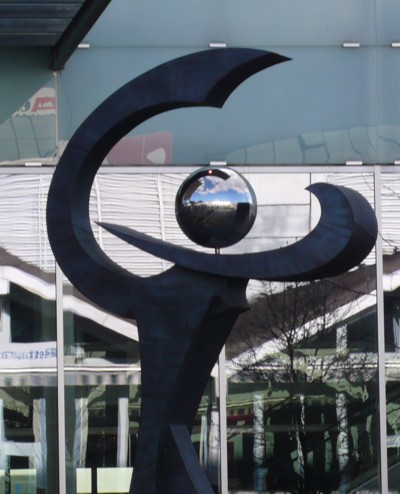
Knowing where to tap… Statue in front of the BEA Fair building, Berne, this afternoon

Worlds Within Worlds

Tuesday, January 15th, 2008

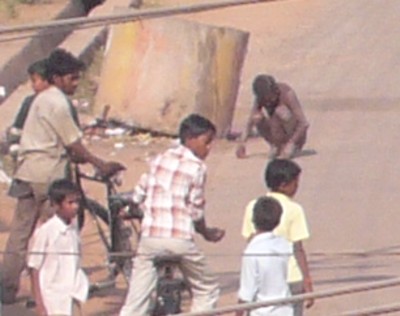
When walking through the village where the Guru Pooja celebrations took place, we repeatedly saw a naked man crawling through the dust of the street – a mentally disabled person. In Western countries they would have taken him away and placed him in a mental hospital or some home – with professional care, but away from his familiar surrounding.

Here nobody seemed to take note of him, it was totally normal: He was playing with the dust or some sticks, while chicken were running around of him and cows eating from the garbage bin. People were sitting in front of their doors, chatting or pursuing some activity. The motor rickshaws passed around the man like around a street dog, and he seemed not to take notice of them, living in his own world. Worlds within worlds.

man.JPG

The Story of Stuff

Friday, December 14th, 2007

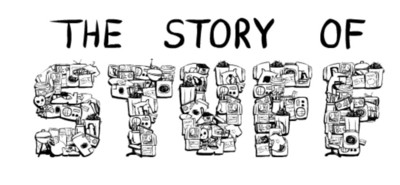
A friend sent me the link to an incredible interactive movie of The Story of Stuff, that explains very well and simple how life is organised and consumerised on this planet. The presentation shows that

“all the stuff in our lives affects communities at home and abroad, yet most of this is hidden from view. The Story of Stuff is a 20-minute, fast-paced, fact-filled look at the underside of our production and consumption patterns. The Story of Stuff exposes the connections between a huge number of environmental and social issues, and calls us together to create a more sustainable and just world. It’ll teach you something, it’ll make you laugh, and it just may change the way you look at all the stuff in your life forever.”

Have a look at :

storyofstuff.jpg

Books, Books, Books…

Friday, November 30th, 2007

The Million Book Project, an international venture led by Carnegie Mellon University in the United States, Zhejiang University in China, the Indian Institute of Science in India and the Library at Alexandria in Egypt, has just completed the digitization of more than 1.5 million books, which are now available online, as a press release communicated on November 27.

The project was initiated in 2002, and now anyone who can get on the Internet now has access to a collection of books the size of a large university library. The Million Book Project represents the world’s largest, university-based digital library of freely accessible books. At least half of its books are out of copyright, or were digitized with the permission of the copyright holders, so the complete texts are or eventually will be available free. As per the countries engaged in the project, most of the books are in English or in Chinese. However, more than 20 languages are represented among the 1.5 million books, a little more than 1 percent of all of the world’s books.

Though the long-term goal of the Universal Library is to make books, artwork and other published works available online for free, about half of the current collection remains under copyright. Until the permission of the copyright holders can be documented, or copyright laws are amended, only 10 percent or less of those books can be accessed at no cost.

“Knowledge is structured in consciousness”, says an old Eastern wisdom saying. Digitalising is an important step of making books virtually accessible to all, but only what you have integrated into your live becomes part of your living – no matter how many books are the outflow of the mental activity of mankind over the centuries.

books.JPG
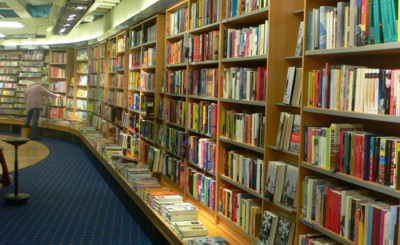
A bookshop in Berne. In a virtual library you can’t just take a book into your hands and start turning the pages.

Financial Wizards and Emotional Roller-Coasting

Tuesday, August 21st, 2007

The wisdom teachings say that your character has to be developed and your life firmly oriented towards good will before you can be entrusted with subtle powers or energies without causing harm. Money is a very concrete kind of energy, and it seems that dealing with great amounts of it can have disastrous effects and damage your life.

I read this week an article in the German magazine “Der Spiegel” online about brokers: Those financial pros who shift most money are the most psychically disturbed persons. The “roller coaster drive” of the stock markets causes great stress to the traders. Many bankers, fund managers or brokers easily get into an emotional exhaustion. Studies have shown that rage attacks, depressions, fear or all kinds of psycho-somatic symptoms are very frequent, much more often than in other branches of society. Alcoholism, drug or medication abuse are quite normal, as well as gambling and sexual excesses. The most successful brokers, who control enormous amounts of capital seem to be mentally and emotionally most deranged. The more stress, the more they have a tendency to manipulate and become dishonest. This destructive development often ends in broken marriages or even suicides.

“A lot of these guys have manic-depressive tendencies that are triggered by the volatility of the market. They also lack the insight or the coping skills to deal with the stresses of the market,” said Dr. Alden Cass, clinical psychologist and president of the Catalyst Strategies Group. “As a result, it’s natural to find higher levels of depression amongst them.” Cass’ research found stockbrokers to be at higher risk for mental health problems such as burnout and anxiety disorders than the general population, but they rarely seek help or utilize assistance services. When Cass tried to contact the persons eight months after his study, more than a quarter of the most successful brokers wasn’t anymore at their post – they had been either fired, changed their job or just burned out and gone away: Money makes the world go round – or people…

You absolutely need a solid inner foundation when you are working in such hot-spots of money and power, but also in “lower voltage” contexts. Money is energy, and energy has to be handled with great care. Using money for right purposes helps creating and upholding an equilibrium.

You might like to read the newsletter from “Good Will in Action” on “Money and Good Will“.

rainbow.JPG
Rainbow and tramway current lines, yesterday evening: channelled energy, like money directed into a creative direction.

Work and Living a Meaningful Life

Sunday, August 19th, 2007

Last week I read an interesting interview in the NZZ with Theo Wehner, professor for work psychology at the Center for Organization and Work Sciences of the ETH Zurich, about the identity crisis of the work society:

Often in our modern society people don’t succeed in blending work, meaning and fun. In surveys about one third of the persons employed said they would like to stop working if they could. However, two thirds would like to continue, though under changed conditions.

In the 1980ies people said they would like to change their working conditions, in the 1990ies they wanted to have less pressure of time, and now they want more “authority over time” or leisure time.

People however, who lose involuntarily their work are often so much blocked that they can no longer even fulfil their personal duties nor their hobbies. Working is a measure for disciplining and socialising.

It is more and more difficult to find meaning in modern industry and service jobs. Work is being experience as being chopped up into little pieces, and one’s own contribution cannot be experienced within the whole.

Many people commit themselves to voluntary work without payment in charitable or non-commercial activities. They want to do an activity which they like and which is meaningful to them. This is more important than making new acquaintances or giving money for some charitable activity. They found out from their researches over the last years that the main purpose is to do something meaningful, and this is difficult to find in many jobs.

Most volunteers are middle-aged people, where they feel that they want to give something back to society. If they cannot do this, there is the danger of burnout or “mentally giving notice”. Jobless people first want to find a job before going into volunteer work. They found people who after having lost their jobs weren’t anymore able to do their previous activities in an association.

People who had a meaninful life normally can also cope well with the situation of retirement and find something new. The dream of “never working again” seems to be the result of a failed work relation and not a way into freedom.

See also the blogpost on “How to live happy” or the post on The Future of Volunteer Work.

neuorientierung.JPG
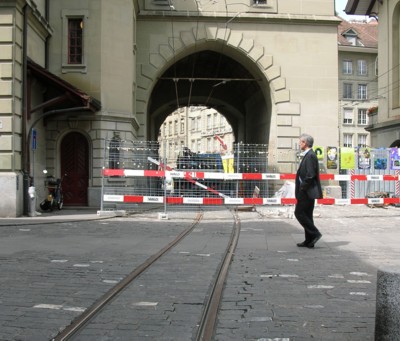
When the old tracks are blocked: Finding a new orientation in work life.