
erk admin

spacerCircle of Good Will - Blog

Archive for the ‘Social’ Category

Construction, Conflicts and Learning

Wednesday, August 15th, 2007

At my office at Swiss Red Cross I saw last week the pdf of a poster “Trinconmalee – 4500 Houses”, to be printed soon in Sri Lanka. It showed a picture of many colourful houses, which had been constructed in an area destroyed by the Tsunami of 2004. With the financial help of a “cash for repair and reconstruction“-program people had rebuilt houses themselves – an interesting approach to support them in the rehabilitation of their fully or partly damaged dwellings.

houses.jpg
Click on the picture to see the whole poster.

Today I read a news in the Neue Zürcher Zeitung (NZZ) about Tamil refugees exactly in this area, who had to flee, hardly their houses destroyed by the Tsunami had been reconstructed. The article described the violence between the government troups and the Tamil rebels, and the refugees being caught between the front-lines and depending from the help of international NGOs, who are slowly withdrawing from post-Tsunami reconstruction.

It is a tense situation, and it seems that the long list of ongoing atrocities of the civil war, ongoing since 1983, won’t end soon. How much suffering will be needed until people find a way out of ideological obstructions and mutual suppression of opponents until a common ground is found for realising peace?

From a spiritual point of view these conflicts, however bitter they might be, are learning processes, which don’t end just with the present life. Suppressing opponents doesn’t solve the tensions. Unless you learn to settle your conflicts in a peaceful way and to integrate opposing viewpoints, the lesson to see the greater whole is still to be learned. It might take a long time, but Nature is patient.
Rebirth Control

Wednesday, August 8th, 2007

Some days ago I read in the Neue Zürcher Zeitung about new directives the Chinese government just has released to “administer the reincarnations of living Buddhas in Tibetan Buddhism”: The Buddhist monks have no longer the right to search for reincarnations by themselves. The Party decides who is a living Buddha. Ignoring the rules leads to punishments, and the reincarnation is illegal. So after their birth control politics the communist� rulers also have rebirth control mechanisms in their empire.

It’s such a silly thing, and wouldn’t it be another political power play to subordinate people and infringe free will, I would have laughed. The decision is a means to break the age-old reincarnation lines of insubordinate monasteries. Now 4 authorities have to agree, if a Buddha is a genuine incarnation, the monastery, the local government, the administration for religious affairs and the Chinese State Council. It is unclear if living Buddhas also have to register retrospectively. However, the newspaper reported, that not all living Buddhas are devout people. So-called reincarnations are working as businessmen and executive consultants in Chinese cities…

Maybe the whole rebirth control politics serves a good purpose in the end: The purely materialistic government might control social and religious structures, but not the reincarnation process of souls. Spirit will turn out to be stronger in the long run, even in our dark age, and the real reincarnations of highly-developed souls will find their ways to fulfil their purpose.

Our spiritual teacher, Sri K. Parvathi Kumar, once remarked, that in the Americas many native Americans who had been killed by the European colonists have come back in the bodies of white Americans and are now much involved in activities furthering a respect of nature and environment. Maybe a similar destiny happens to the souls of the suppressed Tibetan Buddhist exponents. Though old traditional forms will necessarily break this way, the essence will keep on living and enlivening the search of man along the eternal path.

buddha.jpg
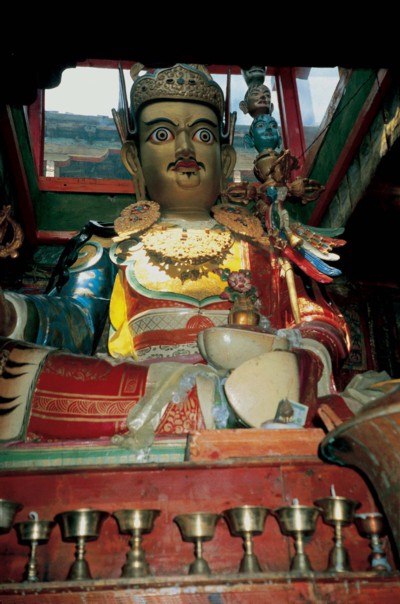
Buddha-statue in Lhasa, photo of a friend

How to Live Happy

Wednesday, August 1st, 2007

I just read an interview with Bruno S. Frey, a Swiss professor of economy and happiness researcher in the Migros consumer magazine. The essence: Important factors for happiness are the relations with family and friends, but also a job giving enough autonomy and recognition of one’s work by the superiors. To be happy is the result of a good life. And a good life consists in doing what seems to be meaningful for oneself.

Research has shown that this is the case when people do voluntary work and give money for good causes. However, running after happiness is of no use. If you try to do it, it slips away. A materialistic attitude makes you unhappy, idealists and optimists are generally happier people.

These findings are very much in tune with the wisdom teachings, saying that good living is a result of acts of good will. They give you satisfaction and at the same time you learn to become less selfish. You might like to read the Good Will in Action on the Value of Service (PDF) or the post on The Future of Volunteer Work.

children.JPG
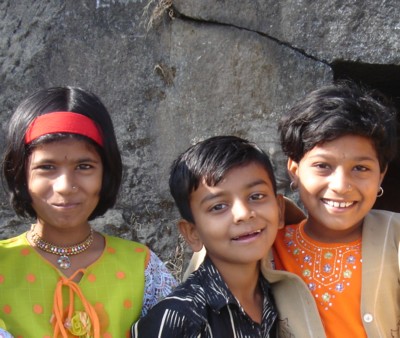
Children in India

Checking up Web Rumours

Saturday, July 7th, 2007

From time to time I get e-mails from friends with certain appeals for help or other curious stories. I normally check them up at Snopes, and most of the stories turn out to be hoaxes.

So I got today an e-mail from Argentina with the photo of a badly burned baby, where there was a call that people should forward this mail so that 0,03 Euro would be donated to rescue that child. I checked it up on Snopes and quickly found that the story was partly true and partly false. And it was already collected there in 2005 – as the case of a real Polish baby.

The perverse thing is: Of course nobody is giving any money by forwarding the e-mail to your friends, it is a sarcastic hoax which only increases the amount of unwanted mails. People misuse the compassion of others with these dirty tricks.

snopes.jpg

Participation Inequality

Saturday, July 7th, 2007

User participation is the big credo in the new online-development called Web2.0. But there are only a few who are actively participating or expressing their opinions.

This week I read an article of Jakob Nielsen’s Alertbox, (Nielsen is a world-famous researcher on usability, the user-friendliness of the web, and Alertbox is his bi-weekly column) where he writes about “Participation Inequality“:

“All large-scale, multi-user communities and online social networks that rely on users to contribute content or build services share one property: most users don’t participate very much. Often, they simply lurk in the background. In contrast, a tiny minority of users usually accounts for a disproportionately large amount of the content and other system activity….

User participation often more or less follows a 90-9-1 rule:

  • 90% of users are lurkers (i.e., read or observe, but don’t contribute).
  • 9% of users contribute from time to time, but other priorities dominate their time.
  • 1% of users participate a lot and account for most contributions: it can seem as if they don’t have lives because they often post just minutes after whatever event they’re commenting on occurs….

The problem is that the overall system is not representative of Web users. On any given user-participation site, you almost always hear from the same 1% of users, who almost certainly differ from the 90% you never hear from… Blogs have even worse participation inequality than is evident in the 90-9-1 rule that characterizes most online communities. With blogs, the rule is more like 95-5-0.1.”

This participation inequality is a general situation in life: in a school class few pupils are really committed, the same it true in a local community, in politics, in environmental groups – or in a spiritual movement. They set the tone and give shape to a group or a trend.

There is always a big group of passers-by or of onlookers – that’s like things are. They might be interested, but don’t take up any commitment. On the spiritual path people who are just interested stagnate, active commitment is the way to progress: “In every way engagement in duty to the fellow beings fulfils the one in all ways and always.” (K. Parvathi Kumar)

See also the blogpost on “A Child Appealing to the UN to save the Future” as an example for committed action.

passanten.JPG
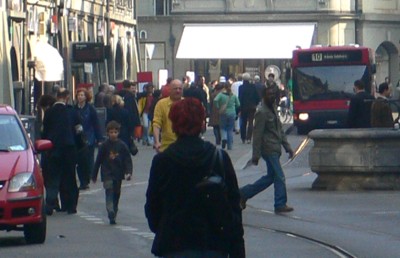
Passers-by, City of Berne, April 07

The Inspiring Power of Great Souls

Wednesday, July 4th, 2007

A friend just wrote me:

“I have experienced today something special and would like to share it with you. Our oldest son (he is 8 years old) is quite special, he is challenging us very much. … To some extend it can be very difficult with him. Yesterday was again a difficult day: He kept on quarrelling with his brothers, was teasing them all the time and didn’t feel like doing anything. I gave him a book with a short report about Gandhi and told him to copy it on a piece of paper and take it to school the next day.

After reading the content he started asking many profound questions. Today he took the paper to school and it was put on the wall of the classroom. Since then his disposition has totally changed, very strangely. In the evening I looked with him a short passage from the film “Gandhi“: He hardly could breathe because of his concentration: It was a beautiful sight. I will order the autobiography of Gandhi and read it with him every day during summer holidays. I never experienced something similarly with him. His intensity, his affection were nearly frightening. Tonight he nearly didn’t go to bed and wanted to keep on discussing about it.”

The lives of great men and women, especially of initiates like Gandhi, are inspiring examples, which can awake in the soul the aspiration towards the ideals they incarnated. Therefore it is good to read such biographies to give an orientation to the soul.

gandhi1.JPG
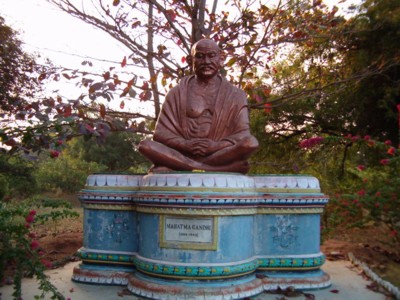
Statue of Gandhi in a seminar centre near Hyderabad, India, Jan. 2004

Reap as We Sow

Tuesday, June 26th, 2007

I today got a German powerpoint-presentation entitled “Reap as we sow”. When I had a look on the web to verify if there is an English source and if the content is genuine, I saw it had been posted in different versions on many sites since 2001, with and without comments and different titles. Here is one post from the BBC-website (“Where was God on September 11th?”, the text isn’t from the author mentioned there…). Though it is also not just genuinely the text of Anne Graham, the daughter of Bill Graham, as it is claimed, its worth reading. Here a small appetizer:

“For years we’ve been telling God to get out of our schools, to get out of our government and to get out of our lives. And being the gentleman that He is, I believe that He has calmly backed out. How can we expect God to give us His blessing and His protection if we demand that He leave us alone?”

And where the text on the above site ends, it goes on in another post with:

Probably, if we think about it long and hard enough, we can figure it out. I think it has a great deal to do with “WE REAP WHAT WE SOW.”
Funny how simple it is for people to trash God and then wonder why the world’s going to hell. Funny how we believe what the newspapers say, but question what the Bible says. Funny how you can send ‘jokes’ through e-mail and they spread like wildfire but when you start sending messages regarding the Lord, people think twice about sharing. Funny how lewd, crude, vulgar and obscene articles pass freely through cyberspace, but public discussion of God is suppressed in the school and workplace. Are you laughing?
Funny how when you forward this message, you will not send it to many on your address list because you’re not sure what they believe, or what they WILL think of you for sending it. Funny how we can be more worried about what other people think of us than what God thinks of us.

(followed by “Pass it on…”)

cacao.JPG
Reap as we sow: Cacao fruits from a floral art exposition

“Things are good” – Good News

Monday, June 25th, 2007

Following today news-posts on the Climate Savers Computing initiative, which brings together industry, consumers and conservation organizations to significantly increase the energy efficiency of computers and servers (Intel, Google, Dell, HP, IBM, Lenovo, Microsoft, WWF and many others have joined it by now), I came across a website called Things Are Good: good news.

They are trying to inspire change by celebrating all the good in our world. They started the site to bring the attention to news that benefits people – that encourages people: “Negative news is easy to find, we aim to make positive news easy to find. Don’t stop reading those other news sources, just remember not to get bogged down by them.”

Anybody can write for ThingsAreGood. You have to register here and you can publish with a web text editor: ” What’s good? Anything that looks at the news with a positive spin and doesn’t contract our list of categories. Here’s the full list: Direct Action / Energy / Environment / Equality / Freedom / Fun / Health / International Events / Mind Space / Peace / Random Act of Good / Spin da News / Technology / Tolerance / Transportation.

So if you want to read some inspiring news or get active yourself, have a look at the site.

thingsaregood.jpg

The Inner Broom Cupboard

Tuesday, June 19th, 2007

I sometimes get mails from friends about astonishing things, situations or information. Generally I try to verify them via a web-search before considering them, and some of the stories turn out to be fakes. There are also stories coming which sound phantastic, and people seem to be attracked by them. I try to keep neutral towards them and don’t go into any details, for mostly I don’t see any relevancy for me. I could take them as true or as fairy tales or a rumour of “urban legends“. One such story came to me yesterday, about the “Children of Winter“, by Sorcha Faal – see also her blog.

Normally when I come across such stories / information, I put them inwardly into a “broom cupboard”, where they can stay without disturbing. I don’t need to judge pro or con, I can just leave them there. I might also take them out later when needed. I also use the cupboard when I come across seemingly opposing doctrines in systems of wisdom teachings.

This inner cupboard is very practical: It helps you to keep in good humour and to stay open-minded, without getting drawn into any queer things and theories going against a good sense of discrimination.

bhutan_vogel_400.jpg
Bird in Bhutan, being carefull and discriminative with the cactus

Taking a Stand or Entering into Opposition

Saturday, May 12th, 2007

My wife said to me this morning: I have now come to understand the difference between entering into a confrontation with someone and taking my own stand.
In the past I used to avoid taking a stand, because I didn’t want to confront with the view of others and start quarreling, so I often kept silent.
In the last time I came to declare my standpoint in an open way. This isn’t confronting the other, who might have another standpoint. I can accept it, and when I declare my view, we can enter into an exchange.

When you insist that your standpoint is right and the other’s is wrong, you are entering into an opposition. Then you try to convince or manipulate the other to take your view. Political party ideologies are making their mark through partiality and not by synthesizing. This carries in itself the seed for conflicts with the opposing opinions and for aggression.

If, however, you are centered in your self and express, this is the way I see the thing, you can be open to the other’s viewpoint, accepting it as another facet of the whole. This way the picture of truth gets rounded up, and you can open up to new vistas of understanding.

stones.JPG
Stones on a beach at the Gulf of Bengal