
erk admin

spacerCircle of Good Will - Blog

Archive for the ‘Social’ Category

Google Online Mapping Initiative against Darfur Genocide

Thursday, April 12th, 2007

You might have read many times in the media, that a terrible genocide is going on in Darfur, Sudan. To date about 2,500,000 civilians, targeted because of their ethnic or racial identity, have been driven from their homes, more than 300,000 people killed, and more than 1,600 villages destroyed by Sudanese government soldiers and government-backed militias. Nevertheless the public reaction of governments is still quite low.

Google and the US Holocaust Memorial Museum have just started an unprecedented online mapping initiative to visualise the systematic destruction of tens of thousands of homes, schools, mosques etc. by using satellite images: All users of the free Google Earth™ can now download a mapping layer prepared by the museum, which gives detailed information on the situation.

Here you find suggestions of the museum what you can do with this mapping and also other ways to help rising the awareness for the atrocities going in in Darfur. So you can add placemarks on locations in Darfur and Chad identifying destroyed villages, refugee camps, or other evidence that helps people understand the crisis. An innovative approach to collect, share and visually present to the world critical information on emerging crises and to sensitise the public!
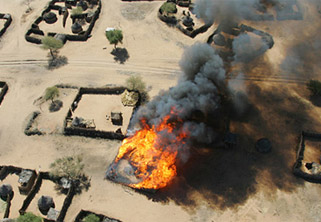
burningdarfur.jpg Google/USHMM

See also the online-game “Darfur is Dying” as well as the blogpost on “Computer Games against Disasters“.
New Forms of Collaboration

Friday, March 30th, 2007

Yesterday I was at an Office 2007 and Sharepoint launch event of a Microsoft partner agency, for my job. At first there were high-flying slogans about a colourful future with “wow”-effect by a Microsoft official (“Empower the people with the right tools and softwares and there is nothing they cannot do…”), decorated with video-clips (WMF streaming), which didn’t run that well as the promised future. After a presentation of functionalities (the best presentations are not much usefull when you forget that beamers have other colour resolutions than laptop screens, and a big part of the texts wasn’t readable) and a practical example of complex group co-ordination, there was a fascinating talk about “Increasing Productivity in Information Work” by a collaboration researcher:

The number of people who don’t collaborate face to face has been tremendously increasing during the last few years, and they had done researches on the impact of these changes on new ways of collaboration at distance. I don’t want to go into details, only 2-3 thoughts:

A few years ago everyone was happy with more features available in a program, today the difficulty is to sort out and reduce the complexity to what is really relevant to the people. This sorting-out is mostly done with our head and not by the softwares available.

Most workers in our society are brain workers, but this is nowhere noted in the assets of an enterprise. A major part of our business activities isn’t organised along the needs of creative work, but of a work environment structured differently, in old patterns. In the knowledge work 90% is not visible and only 10% physically visible work.

For the tremendous changes going on in society new forms of collaboration are needed. I was thinking of the collaboration not only at work, but also in the different good-will activities I’m in. Our monthly Lunar Messenger for example, a small project, involves people not only here in Switzerland, but also in Germany (the French translation), Mexico and the US. I’m working in other projects involving also Belgian, Spanish, Argentinian co-workers. It needs quite a lot of co-ordination and brainwork, but the outcome is fascinating, and all are working for free. All this is a group collaboration going on at distance. So also “Good Will in Action” on Cooperation.

networking.jpg

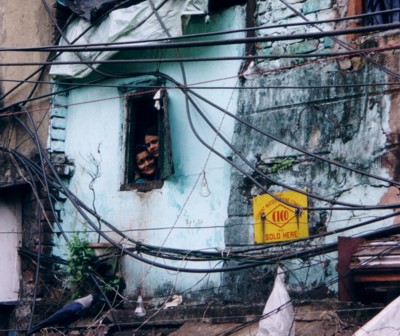
In collaboration good networking is important. Cables, Bhutan

When does Compassion Lead to Action?

Thursday, March 29th, 2007

We all get frequently confronted with news pictures or situations about people in need, with an open or hidden appeal to help. Where do you act? Where do you withdraw? Where does a “compassion fatigue” set in?

In their new blog “VoxBlog online debates“, AlertNet (the humanitarian branch of Reuters press agency: alerting humanitarians to emergencies) writes:

“Reading your morning paper, two articles catch your eye. One is about a new study that finds almost 4 million people have died in war-torn Democratic Republic of Congo. The other tells the story of “little Mary”, a 12-year-old Ugandan girl whose lips were cut off by rebel fighters. Which story makes you react?”

They take up the discussion from an interesting article by Paul Slovic in “Foreign Policy“. A short extract:
“A recent study I conducted with Deborah Small of the University of Pennsylvania and George Loewenstein of Carnegie Mellon University found that donations to aid a starving 7-year-old child in Africa declined sharply when her image was accompanied by a statistical summary of the millions of needy children like her in other African countries. The numbers appeared to interfere with people’s feelings of compassion toward the young victim.
Other recent research shows similar results. Two Israeli psychologists asked people to contribute to a costly life-saving treatment. They could offer that contribution to a group of eight sick children, or to an individual child selected from the group. The target amount needed to save the child (or children) was the same in both cases. Contributions to individual group members far outweighed the contributions to the entire group… When writer Annie Dillard was struggling to comprehend the mass human tragedies that the world ignores, she asked, “At what number do other individuals blur for me?” In other words, when does “compassion fatigue” set in? Our research suggests that the “blurring” of individuals may begin as early as the number two.”
(Paul Slovic studies risk and decision-making and is professor of psychology at the University of Oregon. )

When I’m being flooded by calls for help or donations, I sometimes ask myself, where does compassion lead me – or others – to action? With certain themes I have a clear decision, but there remains a blurring area, where to help – and do it. Beyond the individual decision there remains a general impulse of good will, even though physical action is only possible in certain situations.

swamibegging.JPG

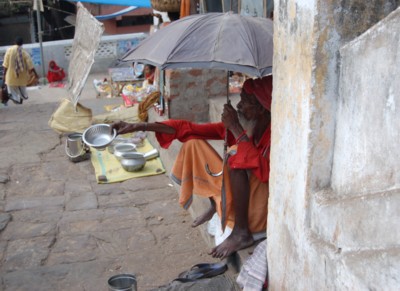
A swami begging in front of a temple in Simhachalam, India.

The Web – Noosphere or Filthy Film?

Tuesday, March 27th, 2007

After many years I yesterday wrote again a letter to the editor, to the Swiss NZZ. There was an article by U.J. Wenzel about “The more or less thinking hull – Is the internet the medium of unification?” The author wrote about Teilhard de Chardin’s “quixotic vision” of the noosphere – the total of a global sphere of human thought, with an evolution towards an ever greater integration, some kind of a supra-mental plane. (I was fascinated by Teilhard de Chardin’s thoughts during my study of philosophy some 30 years ago.)
Wenzel said that some “enthusiasts” see in their phantasies the internet with its covering of the earth as an expression of such a “collective consciousness” – while for him it is more like a filthy film of pornographic and violence glorifying pictures. Chats are full of gossip, blogs repeat thoughts of others, and the web spills over with copy-paste replicas… For him the trend goes towards plagiarizing the plagiarisms.

Isn’t the filth in the web just a reflection of the state of the mind, mainly of the masses? Like in society, there are many spheres, many different forms of expression.
From a spiritual point of view the evolution of consciousness is a very slow process, going on over eons. However, in the present time the speed of life has lead to an ever-increasing inter-linking in the world. The dangers of this development are countered by a tremendous upsurge of new initiatives and efforts. Especially the web, for example with its growing open-source communities, is part of this trend.

We are living in a dualistic, or more precise: multi-faceted world. Seeing meta-trends beyond the range of an intellectual mind however needs a broadenend awareness.

cloud.jpg

A long way up to higher evolution: Cloud over a mountain near Mykene, Greece

Doll House Scenes

Saturday, March 17th, 2007

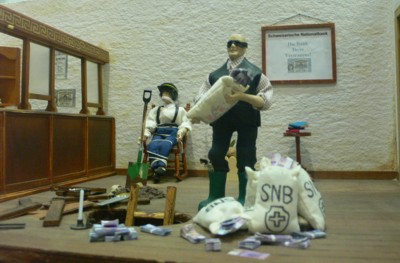
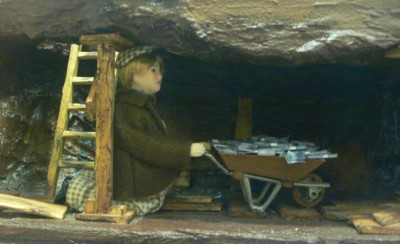
In a showcase of a shopping gallery in Berne I saw some doll houses done in most minute details – replica scenes of paintings of Carl Spitzweg like his famous Bookworm or the Poor Poet, but also models of an old blacksmith’s shop or street scenes. A fascinating model was that of a bank robbery in the “Swiss National Bank“, where the robber had tied up the clerk, and in the underground there was a partner carrying away great sums in a miniature wheelbarrow:

bankrobbery.jpgpartner.jpg

I asked myself how much time the constructor had to invest to build these doll houses, to sew the clothes, to prepare the bundles of money. The doll houses didn’t look like toys for playing, but like models you just put somewhere, where they will collect dust. A Sim City of another time…

Though the robbery scene isn’t that peaceful like the others, the doll houses somehow look funnily playful and the “actors” lost in their little worlds.
Not only the semi-realistic pattern reminded me of our tiny worlds in which we live. When you look at them from above, from an inner distance, you have to smile how easily we lose ourselves in games with “little toys”, seeming so important to us. Doll house scenes.

Bridging the Gap between Personal and Public Attitudes

Sunday, March 11th, 2007

The European Union just decided about obligatory measures for climate protection in the fight against global warming. The president of the EU commission, José Manuel Barroso, was asked by journalists about his personal commitment in this fight. He is driving a German luxury car as well as a big cross-country vehicle, known for high CO2-outputs. He answered that he doesn’t want to do without his cars, that it is not a matter of moral role models, but of political solutions of Europe.

auto.jpg

Where does arrogance start? It seems to be normal that politicians take their liberty of living in contradiction to their official opinions. Nations too take their liberties to behave against their declared positions: Many EU-countries are far from reaching their own Kyoto-commitments. If these will really be effective remains a question. Nations are made of individuals and thus often behave like unintegrated personalities.

On the spiritual path these discrepancies between a behaviour out of outer compulsions and different inner attitudes are quite dangerous, for tensions arise. If we want to behave in a good way, we should do it for ourselves, to be truthful towards ourselves. Then only we can come to an integration of the different areas of our personality and fill the gap between knowledge and action.

Dress Codes and Judging People

Tuesday, February 27th, 2007

Today I read an article in the Heise.de newsticker about the “Free and Open Source Developers Meeting FOSDEM” helt last weekend at the Free University of Brussels. The article characterised the participants as follows: “Long-haired male developers with t-shirts were the majority of the participants, followed by short-haired developers with t-shirts, who were built a bit more bulky. Two developers in tailor-made suits really attracted attention. They turned out to be Russian software engineers … ”

It is fascinating to observe the dress codes of different social groups. People might think they are free to dress as they like, but it is like strict dress regulations: Whosoever oversteps the unwritten rules of a peer group is irritating the social classification system. You observe this with professional as well as with leasure time dress codes, not to speak of special social group codes.

At my student times I used to play with the code when I was going with short hair, tie and suit to the university where the style of the co-students was quite otherwise. A few years before I used to wear long hair, an echo of the hippie times. According to the outfits the reactions were very different…

Seen from a spiritual standpoint, dresses are wrappings around the body and the body is a wrapping around the soul. We normally identify ourselves with the habits and forget that they are just envelopes. You might read more about the “envelopes” in the Lunar Messenger on “Body and House“. See also the blogpost on Dress Codes and Normalcy.

sadhus.jpg

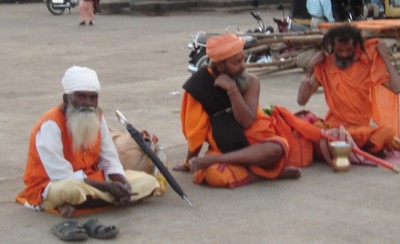
Sadhus in Northern India – imagine them sitting in a western bank.

Crashes in the Tunnel of Routine Actions

Monday, February 19th, 2007

I yesterday got from a friend a short video file also posted on Google Video, “Driving in Russia“. It shows car accidents in a tunnel seen from a monitoring camera. The kind of driving reminds of video-games like Need for Speed etc., but these are real people causing real accidents and not just bumper cars.

russia.jpg

Seeing the video you might laught or shake your head. In reality it’s quite sarcastic what you see when you think of the consequences.

The traffic rush is an expression of the hectic pace of today’s life, which is stimulated by an overactive mind. It is also a metaphor for the stream of routine action just running on through a tunnel of focus. You often keep going on even if something comes crossways and throws you off the line, where it would be better to stop for a while, observe the situation and go on slowly, with more attention to the “traffic” of events. Stopping the routine traffic of daily life through interludes of silence is an important part of spiritual work.

Mozilla Foundation: 10 Basic Principles – Not only for the Internet

Thursday, February 15th, 2007

Mitchell Baker, head of the Mozilla Foundation, just published in her blog The Mozilla Manifesto where she describes 10 basic principles for the internet, such as: “Transparent community-based processes promote participation, accountability, and trust”, or “Magnifying the public benefit aspects of the Internet is an important goal, worthy of time, attention and commitment.” If you enlarge the focus of the principles over the focus on the internet, you see that these are principles for co-operation within and between groups in a participative manner.

So you read (brackets viz. additions in brackets are added to enlarge the focus): “Individuals must have the ability to shape their own experiences (on the Internet).” “(The Internet; read: The group activity) should enrich the lives of individual human beings.” or “Individuals must have the ability to shape their own experiences (on the Internet).”

To know more about this topic, you might like to read the Lunar Messenger on Groups and Group Consciousness.

The End of the Blogging Bubble or Reducing the Noise on the Internet?

Tuesday, February 6th, 2007

In yesterday’s isue of the French Swiss newspaper Le Temps there was an article stating that more and more people who have started a blog are frustrated and that blogging might dissolve itself sooner or later. The writer, Luc Debraine, quoted an article from New York Times that tens of millions of bloggers normally just have one reader. For many blogging is a big illusionary bubble, of the hope that their personal expression is creating attention, an interactive exchange, to get publicity. The result is nil: Bloggers are melancholic beings fighting like Don Quichotte against windmills. Many are disappointed and turn again away from blogging. The American web research institute Gartner is estimating a sum of 200 million ex-bloggers.
“There is too much noise, too much gossip and useless images on the internet”, says Bruno Patino, the French president of the site monde.fr. “This arena threatens to us sweep us away. The tendency will be more towards the agora, towards a reorganizing space. For me the main theme for 2007 and 2008: the reduction of noise on the internet.”

An intelligent thought easy to agree, but difficult to realise. Outer silence comes from inner silence, and this is rare nowadays. The web is just a mirror reflecting the trends: Today each individual is trying to establish its identity and therefore trying to be different from others, in the frantic pace of life. Individual initiatives are often just blossoms of a day and not long lasting. The long breath comes through inner depth, by following a path, a search of a red line through life.

Reducing the mental noise is essential on the spiritual path, thus reducing inner and outer gossip. But it is like swimming against a stream, the mainstream. You need a training, and a guidance is helpful. In the booklet On Silence by K. Parvathi Kumar you can find beautiful thoughts on the import of silence.