After subscribing to the blog, you receive an e-mail with a link, please confirm it to be subscribed. In case your provider blocks the mailings, your address will be removed from the list.
You can unsubscribe by just entering your e-mail into the subscribe/unsubscribe field.
Last week I did the first trip over several days, after 19 months “pause”. Good friends from Heiligenberg (“Holy Mountain”) in the German Lake Constance area had invited me for a visit. Since the pandemia regulations have now become less strict, I could cross the frontier again without any controls…
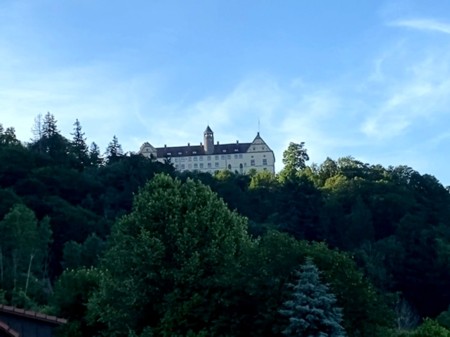
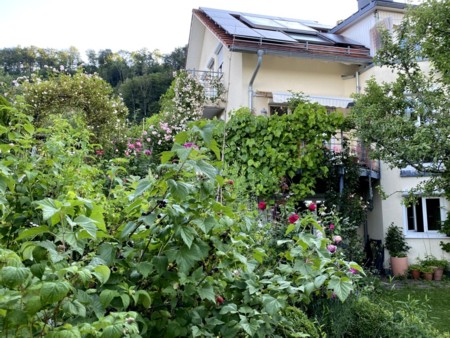
The couple lives in a house at the foot of the Heiligenberg mountain with a gorgeous view towards the lake and the Heiligenberg Castle above. On arrival, I noticed that my camera had taken holidays from me and stayed at home – so I borrowed the mobile of Sabine to take at least some shots.
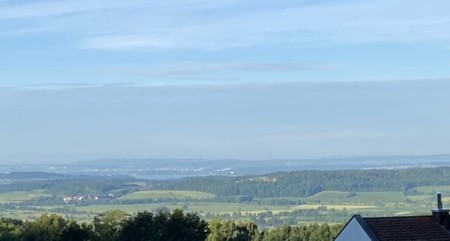
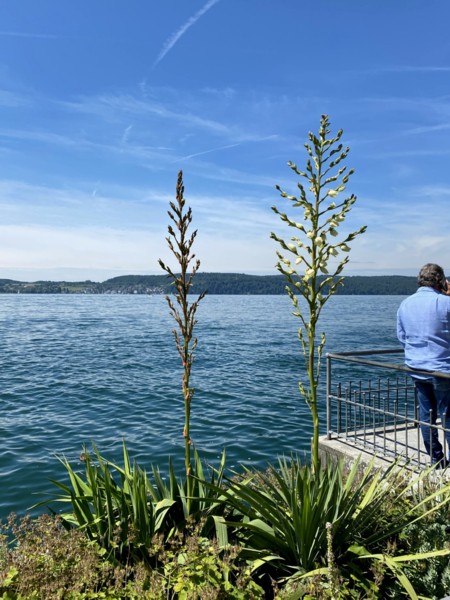
Early morning view direction of Lake Constance, sitting on the balcony for breakfast
Heiligenberg Castle
Even without meeting physically, we have a lot of contact with group activity exchanges. But physical meetings cannot be replaced by zooming… It was a very hearty stay.
Thursday afternoon Manfred and Sabine took me on a trip to a beautiful ridge along the lake overlooking vineyards near Meersburg. And Friday morning we went to the Beuron Archabbey, a monastery now of the Benedictine order and in earlier centuries of the Augustinians. It was founded in the 11th century AD and is located in the upper Danube valley.
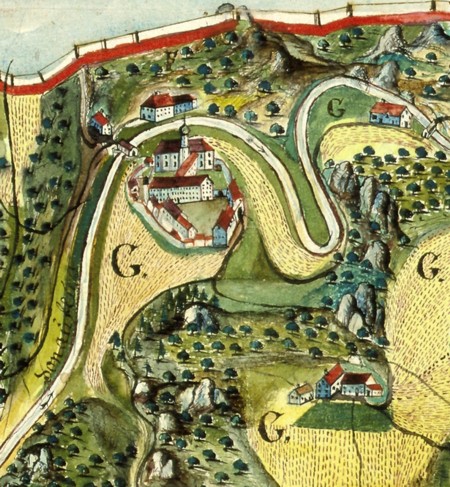
Map of the Beuron monastery from 1787 AD
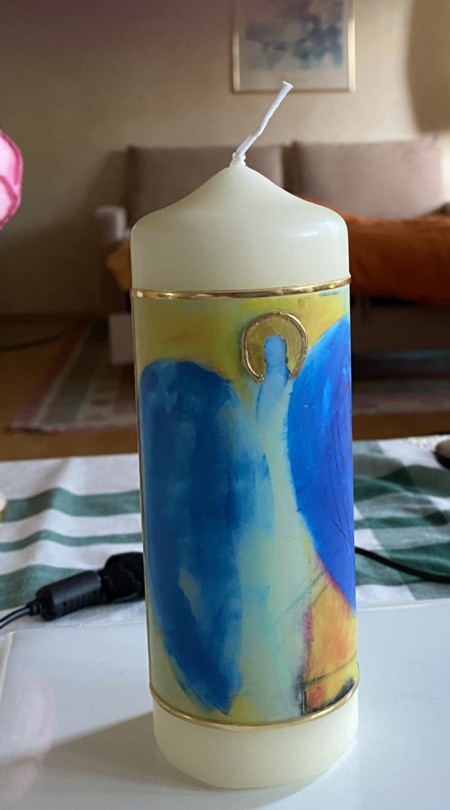
When we entered the church, a mass was going on. The air was full of frankincense smoke and organ music was filling the space. We preferred to do a little walk along the Danube and to come back later. The monastery has beautiful artwork of the Beuron Art School. The church ambiance brought up reminiscences of long-gone childhood times – I first went to a kindergarten in a monastery near my parents’ home and later served there as an altar boy over years. Parents and relatives wanted to make me a priest. I escaped to other directions but impregnations remained… In the souvenir shop, my friends bought for me a candle with a beautiful blue angel…
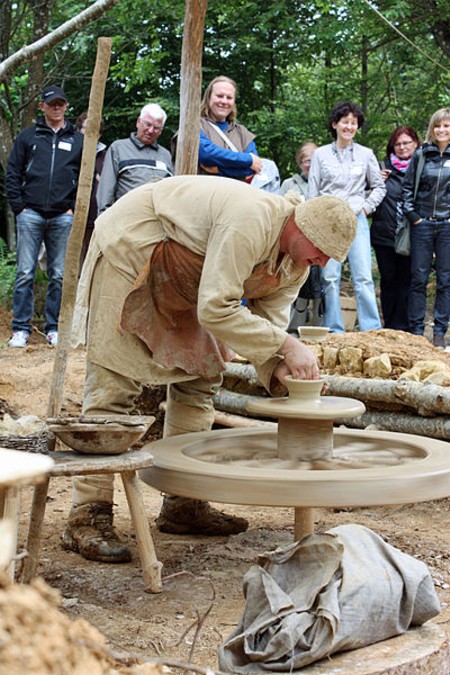
Later we drove to the nearby Campus Galli, a kind of museum and construction site (see their German website), where craftsmen and volunteers are using 9th century resources to create a monastery based on the St. Gallen monastery plan. It is the only surviving major architectural drawing from the middle-ages and copies of it were displayed at the site. The workers not only help with the construction, but also act as costumed interpreters. It was very impressive to see blacksmiths, weavers, carpenters, crockers, or coopers doing their work and to talk to them. How many steps were needed to come to the present way of living…. On the marketplace, we had our lunch with “dinnele”, a medieval kind of warm flat bread from a stone oven with cheese.
Crocker at Campus Galli Meßkirch (c) creative commons 3.0
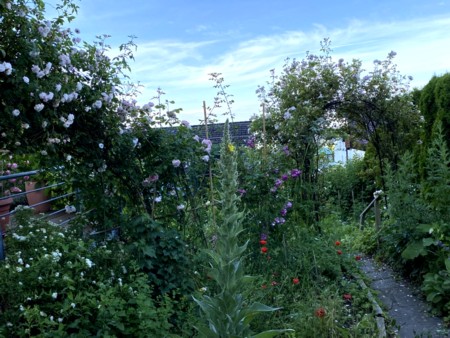
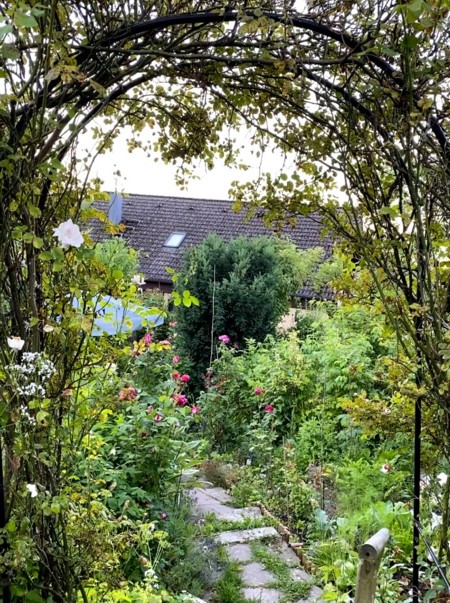
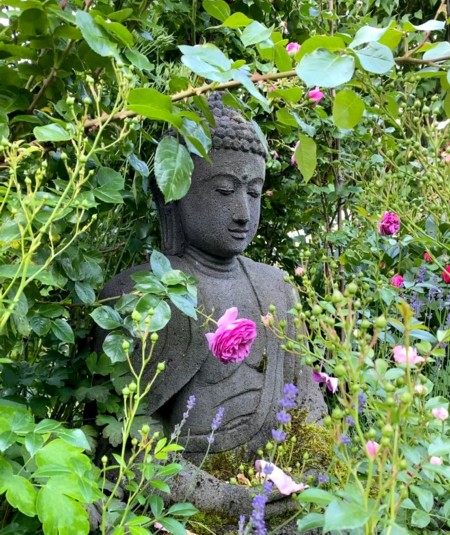
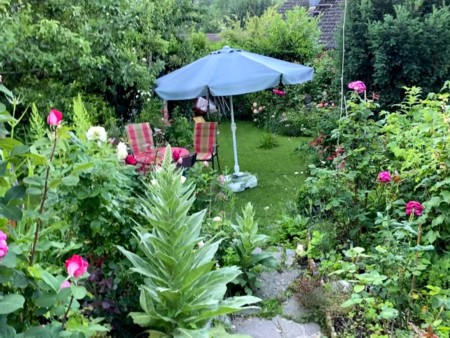
Sabine is a language teacher and Manfred is a former engineer and manager of a huge German electronic enterprise. He later deeply went into the knowledge about herbs and the healing powers of plants. He built up a large network of people interested in cultivating existing herbal knowledge, applying it and making it available in an understandable way. And he developed a beautiful garden with many kinds of roses and other plants – I very much enjoyed relaxing there under an apple tree, smelling the roses in the air….
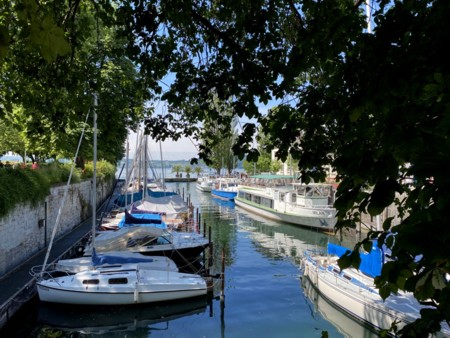
Saturday morning Sabine took me to the market in Überlingen. A regional horticultural show is going on over the summer. Plenty of people were strolling along the lake and through the lanes. Near the ship landing point a group of artists was playing the “Pandemia Fairy Tale”… Life seemed to be nearly “back to normal”, with a Mediterranean ambiance.
Instead of pictures with other people not having agreed, the writer….
In the afternoon two friends came for a visit – meditation and intense exchanges, which weren’t possible since a long time.
Sunday morning Sabine and I had an intense working session on the navigation structure for a future website of the German speaking WTT community – a team project. The time was running by, the sunny days as well. Soon I was back to the highway. Rich memories remain.
Last Wednesday, 19 May, I took my second anti-covid19 vaccination – there is a blog-post about my first vaccination on 21 April and about the antecedents. When I now came again to the vaccination centre at the university clinic of Berne, the queue at the entrance was longer but I had good luck: inside the tent with a corridor and a number of cabins, a patient just left and I was immediately called in. The doctor asked some questions about how I had digested the first shot – a little nausea in the evening, feeling groggy the first two days, on the third day like having a veil inside the head with some difficulties to concentrate, but from the fourth day on it was OK.
I didn’t tell what I further had observed: During meditation and on more subtle planes, there was a feeling of fog, which took more time to dissolve. After a few days I thought, everything is OK again and that the body had well digested the vaccination. There was an undercurrent of nervosity which I didn’t link to the post-vaccination reactions of the body / subtle bodies. I thought it was because of the ongoing work load and the general rush of events, which is high, though outwardly I’m living quite secluded.
Eight days ago, I contacted a couple who are friends, and especially she clairsentient, asking what might be the reason for the ongoing tenseness, if I had caught some disturbing elementals. They said that there is nothing in my aura but that they observed in my system some ongoing effects from the vaccination, a kind of subtle fissures. They did some energetic work and asked if I now felt better, and I said that yes.
Last weekend, I mentioned this observation to an American friend. He told me that his wife is a naturopath and has a number of patients having various after-effects of vaccination. We spoke about the impact the vaccinations have, but also the need to take them, in view of the much stronger impacts coming in through Covid 19 and especially its newer variants.
This was at the backside of my mind when I sat down for getting the second vaccination – it took just a few seconds. Then I received the vaccination certificate and my yellow international vaccination document with the stamps – the momentary “ticket” for travelling abroad, until the Swiss authorities, in coordination with the EU, will give out a “vaccination passport”… They told me I could immediately leave again the centre, since there was no allergic reaction the first time. And so I went out. Rain started dripping and then pouring down while bicycling back home.
In the afternoon I felt OK but the next day there was like a dense grey veil in my head. I felt disarranged, rattled. In the afternoon a friend came and brought me homoeopathic vaccination support with three little bottles of globules from a naturopathic pharmacy. The set contained Sulphur D12 to be taken one day before vaccination, Ledum C 30 for painful injection sites and Thuja C 30 for one day after injection. I took the Thuja. My friend also gave a dose of each for my wife who didn’t yet have the vaccinations and left.
When afterwards I went for a walk in a nearby forest, I was so dizzy that I thought I would not be fit to drive a car. After the evening meditation it got better – maybe it was because of the homeopathy. Today it is better, but there is still a basic tension. The body is still working to adjust.
An update: A friend asked how I am doing now – I am very fine, meditations clear, the system stable. As per my perception, everything is OK, also in the subtle realms. The debris of the vaccination substance out of the body, the necessary anti-reaction of the body well digested. I spoke with friends who are sensitive people and had taken one or two vaccinations without feeling anything. They told me of group members with normally a good sense of discrimination believing that the soul escapes from the body through the injection point… As per my experience, THAT I AM (the Soul) is permeating everything and, though sometimes my perception being clouded THAT is always there, continuously. Another friend told me, “so even if your spiritual protection prevents your problems, it’s not the case of the others…” seeing blood share from the vaccinated ones and the coming children from vaccinated people polluting the global DNA… I am not going to try clarifying views of “many mediums and healers … checking for real the disconnection of their vaccinated clients when they meet them.” I am reminded of the wisdom stories about the effects of maya (the misperception of reality) on believing the unreal to be real – only when awakening the reality of the dream dissolves. Discussion about it does not help. But wakeful observation is needed. Some of my friends had intense reactions with the second vaccination, others do not want to get vaccinated. It remains a choice with imponderabilities in each direction.
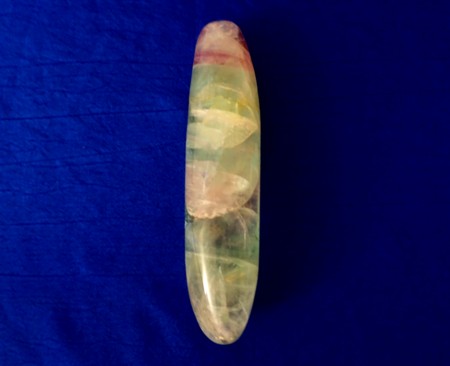
A crystal near my desk as a visualisation of the injection
I took the first anti-covid19 vaccination 10 days ago. I first wanted to wait with blogging about my experience until I had the second vaccination in mid-May (see the blog-post here). But yesterday, Sri Kumar gave a text asking to inform this to all groups: “As regards vaccination: Guidance is sought if we should take the vaccination. Two versions are emerging. One is Yes. The other is No. My view is, it is safer to vaccinate than to stay without. Eliminate Fear and Doubt from mind. Follow the Gov.tal direction of the land. It does not affect the spiritual progress. Master DK also expressed this view during the last pandemic.”
I decided taking the vaccination before and I now decided to write this blog-post, because having sent out the message, I then received mails of members confused or opposing the statement…
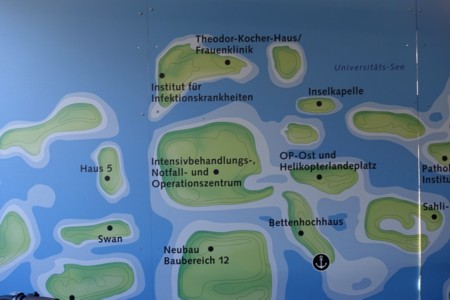
Extract of the “map” of the University Clinic of Berne “Insel” (island) – at the top the “Institute for Infectuous Diseases”
For the last year I tried to remain an observer as per the whirlpool of information and opinions about what to do with the Covid-19 pandemic. People sent me their thoughts and partly urged me to forward “important info”. I listened and read but didn’t act – and I didn’t add my opinions. I felt like in a hornets’ nest.
All my life, I was a sceptic as per vaccinations, never taking any since after childhood days – until recently. I witnessed a slow change in my attitude. The many pieces of mere information and opinions didn’t really influence me, but exchanges with friends did and the first cases of corona in my close surroundings as well as deaths of near ones of friends due to corona. (For those understanding German, there is an interesting – a bit lengthy – article on “Anthromedics” about questions around Covid19 vaccinations by leading anthroposophical doctors from Germany and Switzerland; see the section: The Process of Vaccination Decision) – the anthroposophists are not known for being vaccination-friendly but here they strongly recommend this vaccination in view of all the more serious short and long term damages done by the virus and its variants.)
Queue in front of the vaccination centre tent
In January, I had a Skype call with my cousin, a doctor of biology, saying “Of course, I will get myself vaccinated. And of course, it is clear for me as a biologist that every vaccination has side-effects if it is to be effective. The healthy child of close friends became wheelchair dependent since 50 years now and I saw other cases of vaccination injuries. But it is a matter of benefit-risk assessment, and the impact of covid-19 on health in short and long-term perspective is a much more serious toll. And for a biologist it is clear that the more aggressive versions of the virus will quickly outrun the softer ones and further escalate the matter.”
Beginning of December 20, a friend gave me the text of an e-mail she was going to send to Master Kumar expressing her concern about vaccination impact, saying that many doctors are fighting against the big lies and manipulations of those who want to impose the vaccine on us. “It has not been checked enough, but they are in a hurry to implant it. This vaccine has terrible side effects in the body, it causes genetic bad changes and disorders in the cells of the body… and will kill great parts of the population.” And she asked what attitude we should have towards the vaccination. He just answered “Just take the vaccine and get out of all fuss”.
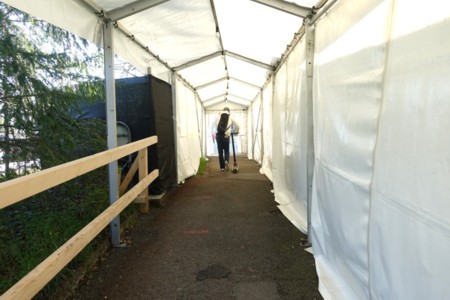
Entrance into the vaccination centre tent
She felt bad that she had asked but I replied: “You submitted the concern on the basis of the virus discussion going on esp. in the naturopathic / alternative circles. He is looking from a higher perspective. I would have been astonished if he gave another answer and put members into a conflict who want to obey the vaccination, or put them even against legal regulations in their countries. (He also argued against all criticism against the mobiles and radiation, though many scientists warn.) I am sure that by law-abiding, even if it is human law, the karma is not yours but that of the greater whole. Instead, if you go by other considerations – though they seem very right from the plane of mental understanding – it is from this plane only and might not be in accordance with the higher plane. I will wait as per the general development and, in case, take the vaccination, focused on the Plan of the Soul.” These thoughts further germinated in me.
In February, I took the decision to get myself vaccinated – not for my personal safety but because of perceiving the health, social and economic impacts of the pandemic. The impact is a collective matter / karma and I didn’t want to stay aloof but do the related experience through vaccination. On 21 April I could take the first dose in the vaccination centre of the university clinic of Berne (no choice between the variants, I got Pfizer/Biontech). In the afternoon and the following day, I felt groggy, for short moments also nauseous. On the second day especially, I felt like having inwardly a grey veil over my awareness and I had difficulties to concentrate and work with complex mental matters. The meditations were hazy. But since the third day, I felt stable again and didn’t witness any disturbing influences. This is now over a week back. I will take the second vaccination on 19 May.
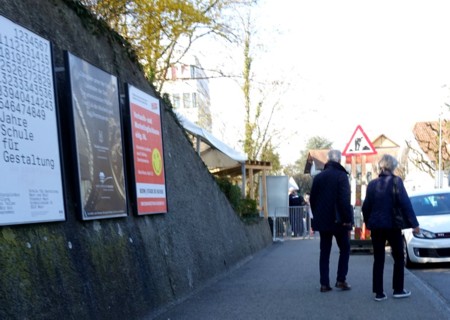
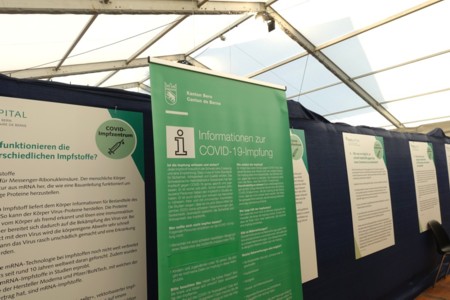
Information posters in the entrance area
As a reaction on the information of Sri Kumar, a friend this morning sent me some lines writing: “Good mediums of mine and other great people see that this injection stuff is made to disconnect somehow the person from its soul source. And we are going to see the results quite soon. Really, with all my respect, Master KPK is is not seeing clearly the deal and treat us as sheep when it comes to follow governments that are not for their people! Anyway, free will is at play here!” (It made me think of the urgent warnings in books about not to do any lumbar punctures so as not to disconnect from the soul and lose the memories of the past. I needed to get a lumbar puncture when in hospital with a brain bleeding 2.5 years ago. And I recovered perfectly well.)
I forwarded these and other remarks to Sri Kumar, and he replied: “It’s a suggestion, not a direction. Free Will prevails at all times. I do not prepare sheep. But there [are] sheep too. Every member can decide by himself or herself in all matters.”
I am now beyond the sphere of whether or not – I am willing to stand related personal consequences, as part of my path, of the Path of Experience. And I will continue to collect thrown-away hygiene masks in forests, meadows, or along the roadside to put them into the waste bins during my daily walks.
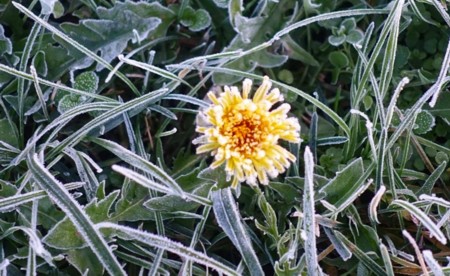
End of October, my young Indian friend wrote about unpleasant experiences at night. The illustrations are from a walk last weekend along the Aare river and in the municipality where I am living – not related to the content.
“These past days have been very suffocating because of my night problems and despite sleeping with camphor next to me (as Master KPK suggested) I still feel, sense and see a lot of unsettling things at night and the lack of sleep is taking a toll on my body. So maybe Masters are allowing this to happen so that I can learn something from it? I remember you telling me twice that there is a psychic pressure in our planet at the moment and a couple of friends ( who are on a spiritual path but not in Master’s tradition and are much older than me) messaged me to find out if I feel what they feel. They also have been experiencing panic attacks, depression, losing control over the body, not being able to work etc since last week. I don’t even feel like meditating – even healing energies feel like too much at the moment if you know what I mean. All this isn’t to complain, I just feel better when I let you know and you tell me it’s going to be fine.”
My answer: “I well know the experiences you mention, I had such night experiences – especially at the threshold of sleep when you would like to pass over, there the inner doors are also sometimes / with some people more open for unwanted entities / energies trying to come in.
Camphor is good for purifying the ambiance, the muscles, rheumatism… but not with sleep problems / relaxation.
Yes, Masters allow the suffering but also as a pressure/ kick to learn, as you wrote.
Please consider getting Valerian as tincture or as tablets. It has a very good effect on calming the nerves. I take it whenever I have problems to fall asleep (normally I very quickly fall asleep but then, when there has been much pressure during the previous day, wake up after 1-2 hs and don’t get back.) As I wrote previously, it is also very good from a spiritual viewpoint to strengthen the nerves in times of pressure. This is what I recommend you most – don’t take much, it is good with hot milk.
And, as said, honey, very much recommended also by the Master – if possible pure one – helps to calm down.
Be aware that living in or near a city with many people and their vibrations is seen as burdening – and that is why the Masters prefer to stay in high mountain areas. However, we are where we are as our training grounds. See that you get enough pure, fresh food and walk, if possible in nature / a park, when it is safe for you there.
Yes, when there is too much tension around it is a natural “brake” to keep you off from subtle experiences. If you know a good homeopath, please ask for something strengthening your system. As you probably know, also disbalance in minerals /vitamins can cause disturbances in sleep.
When it is getting very tense, I might ask, with your permission, xxx to do some energetic work. … May you be well!”
At one point, the correspondence with my young Indian friend touched the question of ethical issues in microdosing psycho-drugs, esp. Psilocybin. The illustrations are from a walk along the Aare river in the municipality where I am living – not related to the content.
My friend wrote: “I don’t remember if I told you this previously but I started researching on microdosing of Psilocybin to see if it can be used to treat psychological problems like postpartum. It’s a very exciting study and with a lot of luck I’ll probably be able to do a clinical trial to study its performance. Please let me know if you sense any ethical issues with the aim of this study.”
My answer: “As per Psilocybin / ‘Magic Mushrooms’: Microdosing might be an interesting field of research. Here in Switzerland a psychiatrist team officially got permission to experiment with microdosing LSD. (I had done self-experiments with LSD, about 10 trips in 1973-74, before starting meditation; for 3 years at that time, I also smoked a lot of hash – I felt attracted to the Hippie movement and ‘expansion of consciousness’.) It is difficult to understand the long-term impacts. Depression seems to be a problem related to missing soul contact. I do not clearly know about the subtle effects of psycho-drugs but it seems that they have effects of tearing apart subtle etheric veils.
The brain is the instrument for the soul to incarnate through, built by the Lords of Form (Lunar Pitris), and it took very long to develop the right forms for the souls to enter. When these forms are somehow affected, the expression cannot be stable or is seriously hampered. If microdosing helps to remove blockages must be studied in such experiments – ask for inner guidance the inner team of healers as per such experiments. I know from the trance work of my wife that she had success to a certain degree with treating depression – in the process, she is ‘taking the place of the soul’, triggering the soul contact of the patient who is not able to hold it him/herself); but in serious cases it needs treatment with psychopharmaka. It is certainly worthwhile researching if psilocybin opens new vistas. So I don’t see ethical issues as such but try to stay in inner contact with the processes initiated.”
She answered: “For a while, I had the feeling of the presence of an inner guide. It was not the / a Master, maybe an elder helper. In the Tibetan’s books it is described that elder disciples help the younger ones from inside; this reminds me of a message Master KPK sent us recently. He said that seniors help juniors. The way your wife has a team of inner doctors helping, I hope I’ll get a team of pharmacologists, clinical researchers, statisticians and neurologists to help me advance my research on psychedelics. I was repeatedly thinking of this ‘joke’ in my mind and then a thought came out of nowhere. It said, ‘Wisdom wasn’t given to Madam HPB for free. She had to take a very tough training before becoming capable of receiving all that wisdom’. This thought felt like a gentle slap in my face. I understood that I should first be worthy of guidance to receive it and this totally makes sense.”
Over the last months, we met several times via Skype as the steering committee for the “CVV Sharing” – five members to plan and organize this year’s meeting at spring equinox weekend.
Yesterday, Sunday evening, we had an extraordinary meeting where we wanted to discuss the impact of the corona virus and the latest anti-virus regulations – how to continue with next weekend’s meeting in Northern Germany. Our two dear friends from Denmark, team members, just had informed that they would not be able to come – Denmark had just closed down the borders to Germany. I thought of “ro-pla”, rolling planning. I had evaluated the dangers and was resolved to go in spite of difficulties. In the afternoon already, I had checked official German and Swiss websites and saw that the border to Germany was not closed – not yet.
During our Skype meeting, we had an interesting exchange. I told what I had experienced in my surrounding – what the situation was doing with the people and the heating up of the topic via mails, social media, newspaper. I told what I heard from my son, an officer of Swiss Army and ambulance man who might have to go this week for service at the Italian border supporting hospitals in emergency. One team member expressed that he feels it is a hype, that the fear and virulence of discussion is stronger than the effects of the virus. He shared some interesting thoughts from his perspective of being a spiritual astrologer – about the Pluto-Saturn conjunction in Capricorn and its impact on societies.
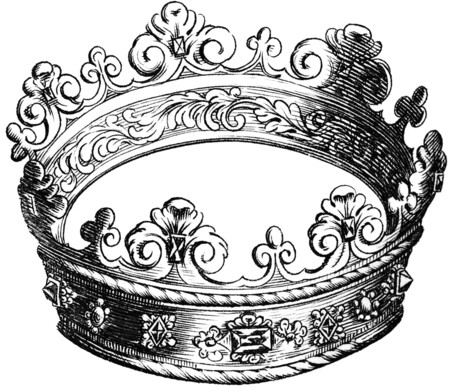
The other member, also a spiritual astrologer and in addition a profound symbologist, mathematician and IT specialist, said that he tries to understand the effect of the corona virus not by “what the virus is” but by observing how it expresses – its signature and symbolic characteristics. For him, it has to do with fire, it shows qualities of Leo, the royal sign, and it even carries the Latin name for “crown”.
Corona
Now the rulers of nations close the borders of their “kingdoms” – something some have dreamt of before – and people get locked up in their places. It affects the way we rule our lives. Environmentalists did not succeed in what the nearly invisible virus brought about in a few weeks – drastically cutting down flights and other travels.
Observing the statistics published about the fast spreading virus, he sees that this dynamism will for sure not be stopped in a matter of a few weeks – the graphics show a development intensity that will take months to calm down again, even with new and effective medicines on the markets….
Suddenly during the conversation my telephone started ringing. My youngest son just came back from Germany and my wife was driving him to his home. They told me that at 8 am next morning Germany will shut down the borders to Switzerland and other countries.
I realised that I cannot travel, will stay locked up. In the Skype meeting we discussed the new situation. My friends decided that they will try to keep up the group life. I could no more join them.
In the night, while I was sending out the invitations that the online study groups will continue this week with a special for equinox celebration, they communicated, “The CVV sharing is taking place. We think it’s important to meet in this situation for joint meditation and seek the vertical connection to the Master energy. The program will change because we have some cancellations… Our plea: Come to share! There is no better way to strengthen the immune system as social / spiritual contacts, group meditation, the testimony to Timeless Wisdom, Love… and humour! Let us remain aligned in love.”
I will join in spirit – and with our online groups.
P.S.: My friend mentioned above commented:
“Dear Ludger, the Latin word corona has so many meanings. One main is the surrounding, limiting circle, a Saturn symbolism. Once upon a time, the world power Rome crowned its slaves. Rome, the Lion capital of the Lion country Italy – a really heartful country, but also the first corona-infected in Europe! Our world is divided in rich and poor. Most of humanity lives in poverty. The apparently privileged people in Europe and all over the world are becoming slaves to the financial and economic systems. More and more we are loosing our creativity, our big Lion potential – the other side of the meaning: corona, the heavenly the Sun power. I hope we will return to that power and the main Lion gifts – giving and loving.”
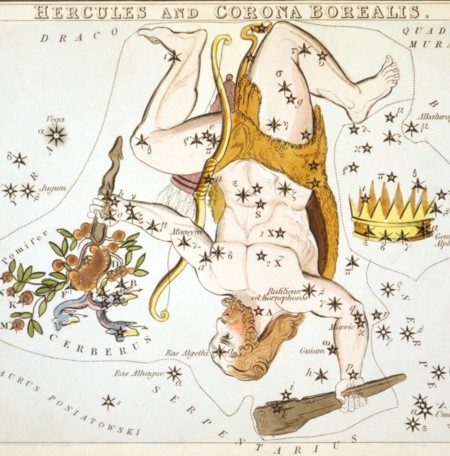
Topsyturvy – Hercules fighting with Cerberus, and the Northern Crown, the Corona Borealis
I normally only post articles written by me. This, however, is an exception – sharing an article of a friend. It is published on the site Radiyam, administered by her. Also in French. Any comments please to her contact address. She wrote in her e-mail: ” Here is a new article to put things in real perspective about the climate change. Too many information are incomplete or distorted. Truth must be heard. Thank you for dispatching it at all levels. With cordial greetings sylvie touranne geographer, life coach, homeopath
“The «Friday strikers», the grouped activists, the young and old alike who are moving around these issues, actually form huge layers of glamourous clouds across the planet. Another pollution. They unfortunately undermine any true action. And this is a pity. For, among them, are innovative individuals with creative ideas and solutions. Those are able to find the right ground to the effective changes on harmful habits.
Talks and comments of all those crowds are quite childish unfortunately. When they are not instrumentalised. Through (pseudo) scientific, economical, or governmental information. It is true that we could forgive the very young pupils their lack of discrimination. But they take ownership of the public road in anarchic ways. And this is more serious. As they do know naught of what it is about. Or so little. Quite far from the right of expression, the right of opinion, and that of gathering in groups.
So, let us be clear and let us start by so-called scientific utopias, relayed by the media in unfortunate «fake news»: struggle against the climate is not possible. To protect the climate is not possible. Lower the mean temperature is not possible. Those talks are an implausability with no scientific substantiation. For scientific measurements, statistics and resulting theories m do not take into account the the time required for realistic values.
Climate is not meteorology.
Climate is not only CO2 in the atmosphere.
Climate and planetary variations must be evaluated upon dozne of centuries, and millenaries.
Planet Earth climate has its source in the Sun evolution and its structure.
The Sun is the key to the climate cycle lived on the ground of Planet Earth.
The Sun is alwas the key when we speak about Life.
The Sun is always the key, when we speak about consciousness and illumination.
Those scientists who avoid the Sun datas and its actual cycle, are not in the stream of real truth.
We are now in a major threefold cycle: terrestrial, solar, galactic.
Which involves multiple changes. In all Life Kingdoms on Earth. And the basic universal law that applies is always the same: conscious advancement, rejuvenation, rebuilding can only operate after the destruction of old forms. What we are witnessing every day. Until we can adapt. The quicker the better.
What MUST CHANGE upon our planet, which plan stops at letter A, regards the environment that we modify by our acts and habits, to overcome. So then the activists are right to move. But with appropriated datas and information that suit such an engagement.
Environmental pollutions and their following disasters are the avoidable consequence of economical and industrial development of the nations. The risks involved are related to the ingorance of functionings, that must be better managed and assured.
But some have understood that they could easily use without restriction nor morality what Nature offers freely, and drain it the most possible: this is the environmental crime !
It exist internationally at all levels.
A gainful economy, so close to the big business of drugs, that reaches amounts around 200 billion dollars… Practices like wood industries (deforestation), pharma and agro-food industries, oil (continental and oceanic), bio technologic industries, waste industry. Benefits have no more limits. But above all, the actors of this criminality gather together very openly at the «must» international reunions, where hyper powers are packed to deliberate on possibilities of «raising the number of zeros» to their criminal practices and growing sales figures, regardless of the environmental impact. This is called the «Green Finance».
Environmental criminality is very mobile, for it follows the national laws, to bypass them easily. More, those organisations assign wherever possible the patenting of Nature’s products for private use. And therefore cut the access of those same products to the populations that live on the concerned territories. The well known examples are the deforestation in Indonesia (huge palm oil plantations) and Amazonia (fields of GMO soja damaging human and animal DNA), and perhaps one of the most serious, the monopolisation of thousands of water sources in a growing number of countries, to manufacture bottle waters, that let the populations without the main life resource. And we can add the «international logistics of waste», contaminated culture soils with pesticids and other chemicals, seed patents for single use, and housing land expropriation for the flourishing extraction of oil from bituminous shale gaz. All those industrial practices are supported by governments. In those conditions, environmental degradation is truly a crime, organised by economical, political, law and scientific actors.
As regarding the individuals, they are more aware of their personal impact and make efforts to change habits daily. But shouting in the street does not change anything so far.
The environmental international criminality (eco-crime) is a planetary open wound. A major harm with total impunity, that affects the general consciousness and creates victims everywhere. And Planet Earth rebells with its instruments: fires, storms, earthquakes.
The interdependence of those illicit activities needs the indispensable and continuous work of a supranational legal frame, concerning the massive violation of environmental laws, directly damaging human rights. The International Criminal Court (ICC) could well be more engaged, since Interpol (International Police Service) has a hunt down and detection department for those environemental mafias.
This is the major way to fight against environmental pollutions and illegal actions, to be removed worldwide.
As for the climate, it will change the main planetary water cycle, inviting us to change again our habits. Because after the repeated raise of temperatures, it will be cold.
It’s a complex matter – best told in story-form. It is not so easy to understand, and when you read it on the web, it is very probable that you quickly scan the text but not read, and when you read, you might just take it in with your cognitive brain, maybe quickly putting a “like” on “social” media but not letting it in. No time! the mind runs like crazy… Recent brain research showed that digital reading is good for cognitive reception but reading on paper is better for transformative knowledge, transforming one’s life. Enough foreword…
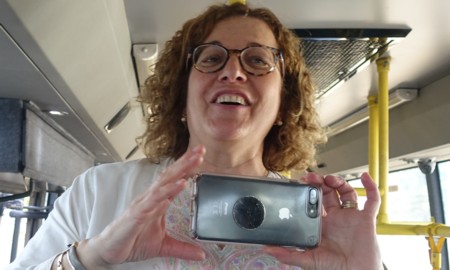
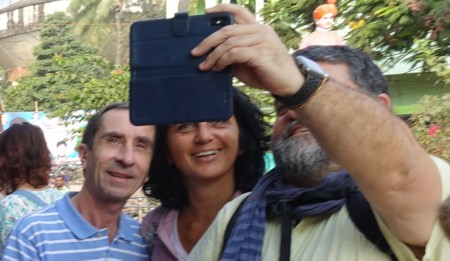
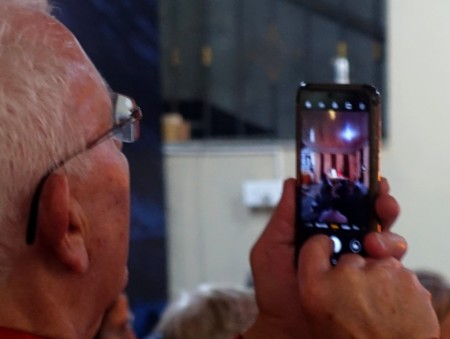
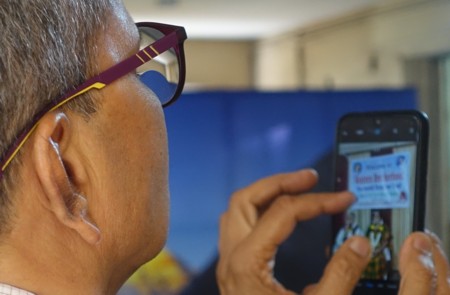
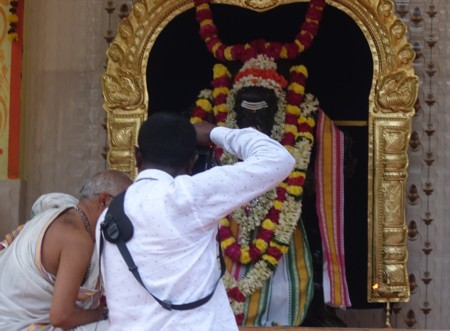
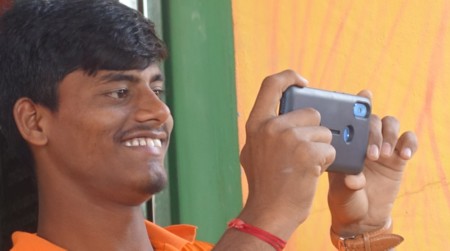
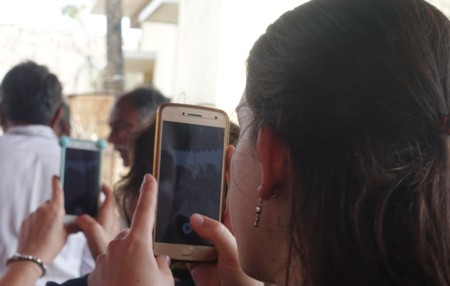
The pictures of mobiles in this article are no criticism but done with a smiling eye. I’m also photographing a lot – with a camera. In case of personality complaints, please let me know and I will exchange the photo….
The group travelling to Bangalore airport
An introduction
This is not a private story about an aspect aof my life, but I use this perspective as an intro for the main story, which comes later:
I stopped seeing TV around 9/11, in 2001, sometimes seeing a movie in a plane, very little YouTube. I prefer reading newspaper articles, going into what I read. I intensely follow what is going on in the world. Already as a child, I had very strong inner images which later led me to painting; when reading a book, I quickly “fell into it”. And when looking a crime story, the suspense frequently made me run out of the room.
Selfies in Pithapuram
In my former profession as head of web office of Swiss Red Cross, I was responsible for all digital communication instruments as per their content side – internet, intranet, central photo archives – until I was “set free” seven years ago, free for my way. There already, people used to run around with mobile. I felt, it would be too overwhelming for my perception, blurring my discrimination. As an excuse, I used to tell that my hearing was not good – it was only half true. I didn’t want to get into “digital morphine”, putting people’s inner side with hyperaction to sleep. Now they talk in the media about the need for digital detox, offering courses for managers about digital fasting.
During the last decade, mobiles made a triumphal march over the globe, entering into remotest corners. I could not escape, didn’t want to be a dinosaur refusing it. I’m extremely active with PC and, when travelling, with laptop. No quick photo publication – selected views, images cut-out and processed. Since some years, we have a family mobile, we just use it “immobile” at home, as a “modem” to enter into WhatsApp. My wife using it as a means for her trance therapy work, working remotely with people who don’t have a computer or don’t physically come. And me for interacting with family members and WTT. Since years, however, I’m studying the digital marketing tricks of big data business and follow the latest developments via a daily newsletter. So I came to see the big players as monsters, some of them massively manipulating, with a mask of innocence, elections and political decision. Making big money with little to no ethics. “Do no harm” of early Google is no longer at use.
No need for fear when reading the following passages, it will come to a good end of the story!
Fire ritual
In Europe, governments and data privacy protection offices are trying to fight the supranational Hydras, often without success. The big players are very powerful. Especially the Mark Zuckerberg Empire stands foremost in the manipulation game, from the very beginning, – denying it in public, putting on a smiling face. And everybody uses WhatsApp – in WTT it is used especially in India for bringing plenty of pictures and information “for free” to the members, who need to join to “follow”. You cannot escape when you want to follow.
Nobody thinks of what is being done with the data – things which are directly opposite to the principles the WTT stands for: Big scale image recognition, profiling people, targeting ads, delivering content individually tailored for the personality profile of the receiver to most effectively manipulate on a mass scale. Yesterday, the media reported: “Facebook policy chief Nick Clegg reaffirms the social network’s decision to continue allowing advertising with political content. Twitter and Google, however, have banned politically motivated ads on their platforms.” Not to speak of what China, the biggest player, does. Incredible “total immersion”, keeping over a billion people under central control – for the “well-being of the state”.
One of the latest developments is voice recognition based marketing, analysing all what is communicated via speech – for better targeting ads etc., combining mobile data with the behaviour portraits of the surfers.
Distribution of sewing machinges to unemployed women
About two years ago, while uploading photos to Google Photo, I saw a function for identifying friends. I wrote the name of a friend – and I got hundreds of photos with her in most intimous situations, at group lives, while travelling – often, I did not recognise her face at first sight, but Google did. And these were not pictures she had uploaded. Data protection, privacy? A joke. Digital profiling in a mass scale. Yesterday, the media reported that 3 billion photos were sucked off the web by a private Silicon Valley company with a big investor. We try to comply on WTT related websites with European data protection standards but these trends go directly against.
Ritual at a Ganesha statue at Tekkali Village
At the recent seminars in India – like at the last international group lives – the entire ongoing group communication was done via mobile and WhatsApp – when, where, what is happening – it is so practical, and all have a mobile. Except me, I think. I didn’t want to be washed away by an overkill of information, not only via this channel but by other people trying to contact me this way. They can do it via e-mail. The triage of relevant and irrelevant information needs time and energy and deviates the focus I’m trying to uphold. At the seminar, I told two friends to keep me updated. It worked fine. I even once spoke with my wife via mobile WhatsApp of a friend – my laptop didn’t get connection or only a very low one, for a week. (Later, I got a mobile internet connection from the group of WTT India for the communication activities, a great help.)
Already at December Call celebration in Bangalore, Master Kumar said:
“The teachings of every hierarchy member shall have to be related to. You have no more time for mobile, for silly messages. They are all silly messages from people with experience. There are very silly messages through WhatsApp. You are wasting your time and wasting others time. It is meant to send a simple communication, not to use it because it is free. If they charged 100 rupees for every message, everything would stop. Calls also have become free with WhatsApp. So you call to America and speak for 30-40-50 minutes. Sheer waste of time and energy. Instead why can you not relate to this which is the higher dimension relating to Hierarchy. Hierarchy is the highest dimension relating to humanity and we think we are following some kind of discipleship.”
Recently, a scientist wrote in a Swiss magazine: “When you want to do something effective against global warming, stop taking selfies” – all the infrastructure behind consumes tremendous amounts of energy. Especially the endless Netflix etc. stream entertainment – an easy way to anesthetize your brain.
An Indian group member at Tekkali photographing the group of Westerners
At the January WTT seminar in Visakhapatnam, things got more intense for me, utmost intensity. Most sublime teachings, multi-directional inputs from people, intense talks with key persons, developing ideas for future developments, for projects. At a question-answer session, I gave a strong word of warning to the group as per the use of WhatsApp etc. There was a good reply by Sri Kumar, here are my notes:
“In humanity there is always an abuse; abuse is common because there is ignorance. Men of knowledge are few, people are stuck by one side or the other. A roller-coaster situation, abuse is about to happen… Humanity is the only species which has discrimination. See what is relevant to us; whatever is relevant to us is not relevant to others. We might be in a huge jungle, we can’t change the whole jungle except by prayer. Immediately it will have an impact on us. It will take time from humanity.
There is some negative coming out of humanity, very few use discrimination. We see what is relevant and what is irrelevant. It is very well possible. That is why we need to grow with discriminative will. We get more guided by conscience, discriminative will.
At Tekkali Village
Whatever Ludger said is in every dimension of humanity, not only in internet – gold invented, misused, slowly balanced. In the 2nd half of last century, the use of fertilizers, they did great harm to the agriculture. Sometimes we learn through ignorance, through foolishness, we make experiments, experiments settle as wisdom. We keep learning by this example, … health is gone from humans and animals, we realise, slowly there is a direction in the production into another direction. Now they have realised that smoking has a very negative impact on health, still some are smoking, smoking; non-smokers were more affected by smoking. We need to change the planet to an understanding what is a right understanding. “I don’t use it” – not using is not a solution, right use is important.
The world offers many things, be discriminate, develop the conscience, don’t send messages of WhatsApp, when there is no relevance for you, don’t look at it. That is how we use discrimination, use meditation as means to calm down, to develop inner consciousness, the antaratma (inner self), that will help to eliminate certain activities in relation to us and to the group.
We don’t have to criticise, that is Aquarian. We get into the subtler side, it is Aquarian. Make an appropriate use of the right side and don’t get into the (wrong one). The more and more you are negative, judgemental about others – we don’t touch what is black – the more and more we discuss about it, we strengthen it. Don’t get into the path of ignorance, look for light everywhere and don’t get into darkness.
The black ones try to use the others to propagate them. The negativity in us is a deception. … We as students of goodwill see the light side of it, don’t criticise the dark side of it. … You slowly disassociate from people but do not entertain the negative side, if you entertain it it is in you. Be neutral to the negative and be attractive to the positive side. That is how we need to take to the positive side. Make a good use of the good side of the developments coming to us, it is contributing to human progress. In science there is open thinking, but the sciences are under the thumb of the barbarians on the planet who control the whole of humanity. We don’t have to deny the sciences; take the positive side of all the science. Let it be so with all of us.”
At Tekkali Village
A member from Spain introduced me to Microsoft Teams, explaining to me how he uses it for his course organisation and interaction, the structure set up by a friend. Chat and collaboration instruments, file sharing, and video calling. And it runs on PC/laptop/mobile without being bound to mobile. I found it thrilling, thought, “what’s the catch for Microsoft to give the basic version for free?” I know that Microsoft is a much more integer player when it comes to dealing with data. I had several discussions with IT specialists of WTT. It seems to be a way out of the challenge of using digital instruments for group work, interchange and collaboration. Of course, there are also other tools. Plenty of ideas rushed in. It will take time to evaluate and test. I started testing the app but: “Take to turtle speed, not the speed of a rabbit.”
Last year, I had a strong warning as per my health with a brain bleeding. I realised, I have to slow down, take away pressure. This is most needed, especially in the present time and with the present challenges. I’m daily walking for a while in nature, ponder and observe. Keeping longer times of silence to centre inside. The inner guidance will lead through the times of rough weather.
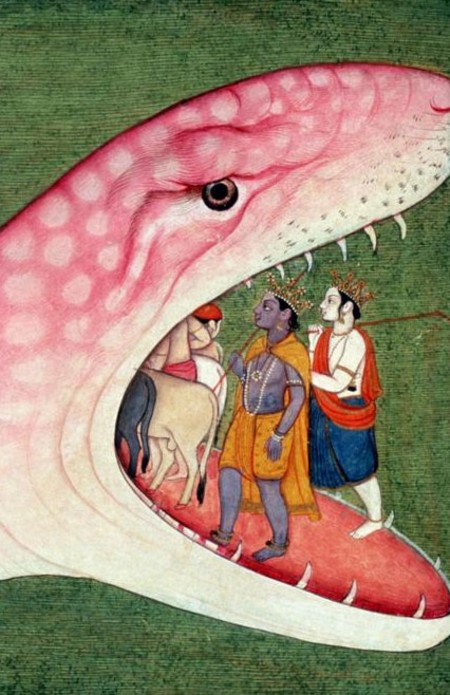
In all of this, I had to think of the story from Puranas of Aghasura, the enormous serpent-demon which wanted to devour Krishna and his friends. The cowherd boys innocently entered its mouth, mistaking it for a mountain cavern. After seeing this, Krishna then came to their rescue, killing Aghasura. In a way, the mobiles look like the many heads of a serpent devouring the attention. But help comes, when you turn inward and stay strongly aligned to the soul.
At irregular intervals, I share via a “Friends List” some “digital gifts” – things I have come across on the web over the last months. In time for Christmas – here are some digital gifts found in the last 5 months:
Best Christmas Campaigns 2019 – some commercials are really well done (only if you want to spend time…..)
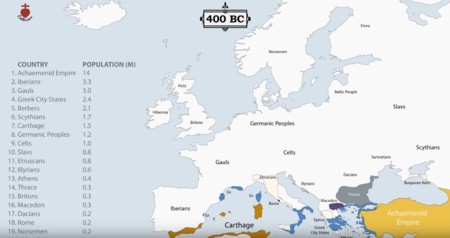
For every year, it shows – partly just for a split-second – the borders and populations of each country in Europe, northern Africa and Middle East. (Vassal states and colonies are not included in the count of a country’s population.)
The rise and fall of great empires – of the Romans, the Huns and Mongols, of Napoleon or the two world wars of last century – they all appear like the pulsating heart of a part of humanity. Behind all this flickering of states lie the destinies and sufferings of millions of people.
Keep in mind that from the larger perspective of the immortality of the soul, we all have gone through many incarnational experiences in the past leading us to where we are working out our lives now.