
After subscribing to the blog, you receive an e-mail with a link, please confirm it to be subscribed. In case your provider blocks the mailings, your address will be removed from the list.
You can unsubscribe by just entering your e-mail into the subscribe/unsubscribe field.
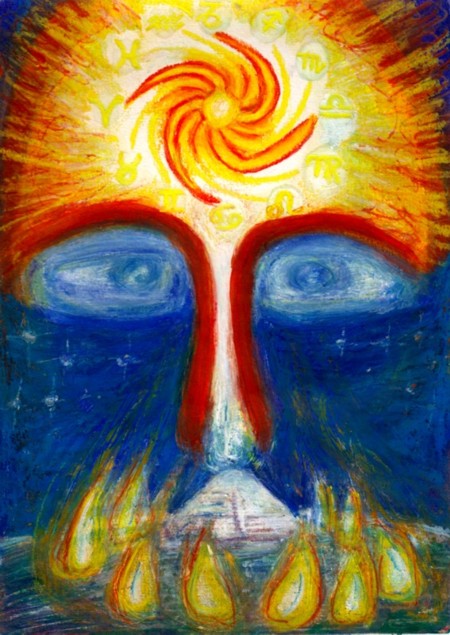
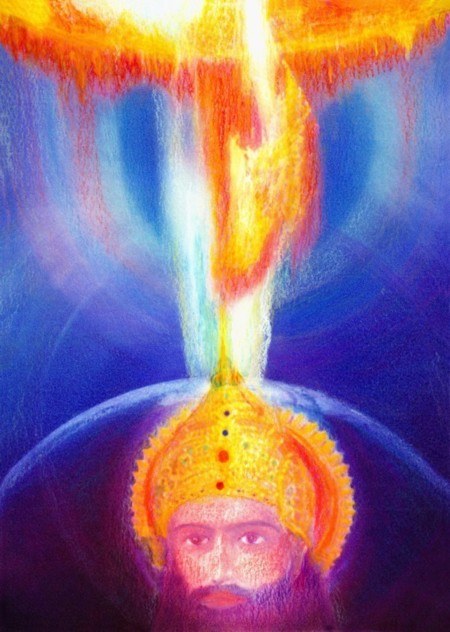
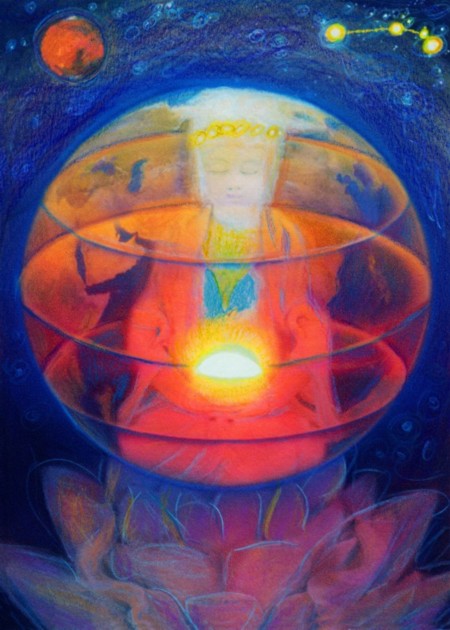
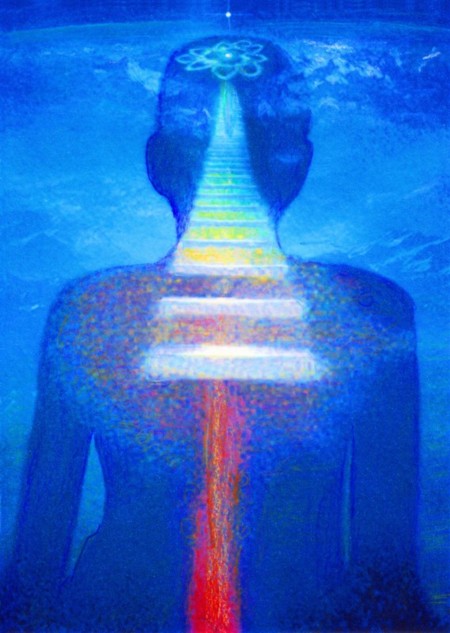
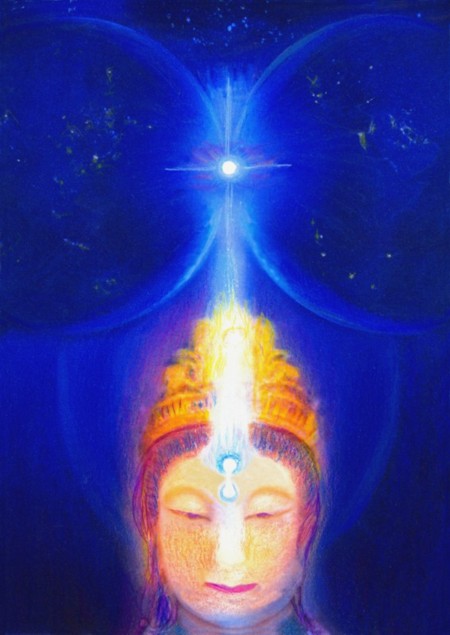
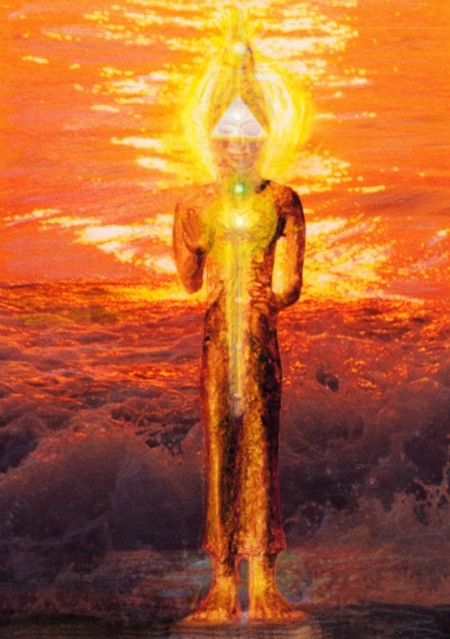
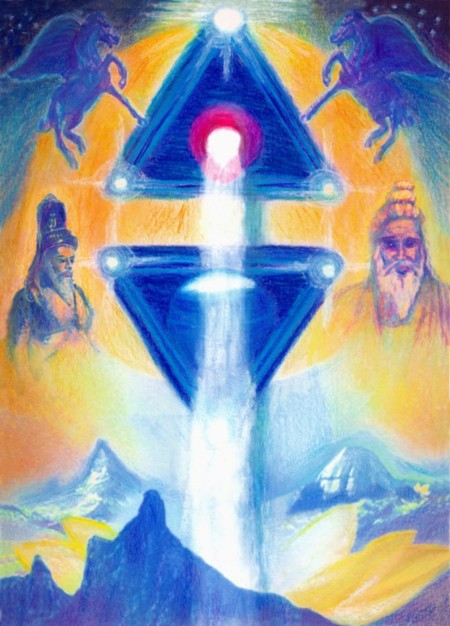
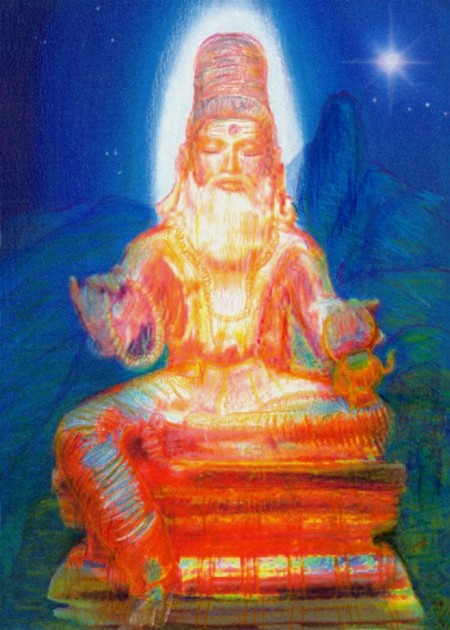
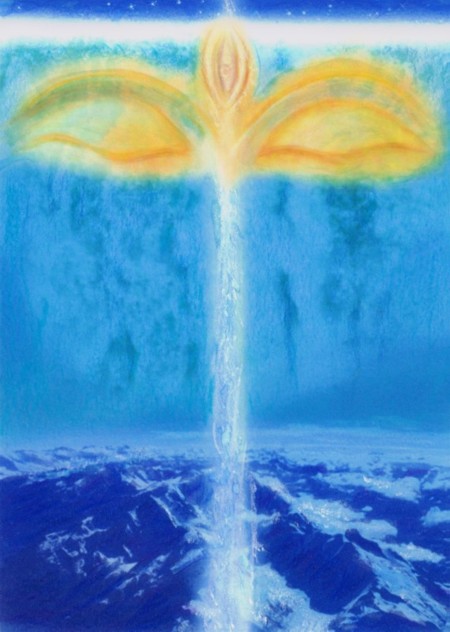
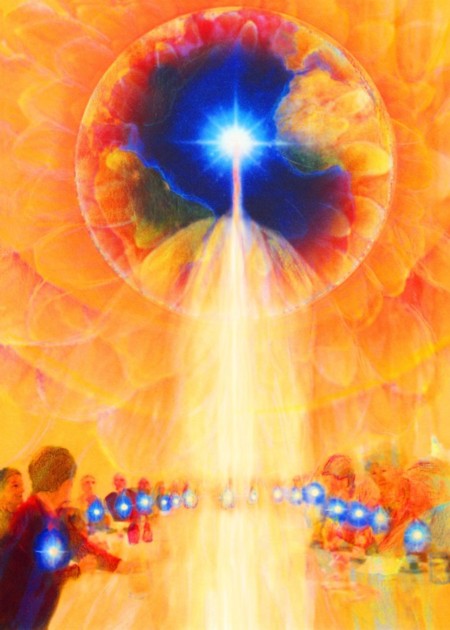
Shambala is the highest centre of enlightenment on earth. It is the seat of Sanat Kumara, the Lord of the Planet, and he presides over the evolution of planetary beings. Shambala is also called the thousand-petalled lotus of the earth and it has its counterpart in us as our thousand-petalled lotus, the Sahasrara or crown centre.
The inner path to Shambala is to visualise Shambala and connect with the lotus in the Sahasrara in our daily prayers. In doing so, we align ourselves with the super-self within us and link to the sound OM. Remembering Shambala daily strengthens our will to do good; our knowledge unfolds and our actions become more effective. Our will begins to change in a positive way. We become a citizen of the world in the true sense of the word.
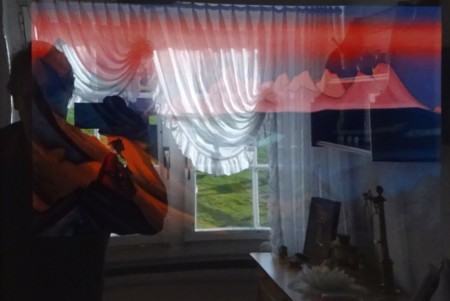
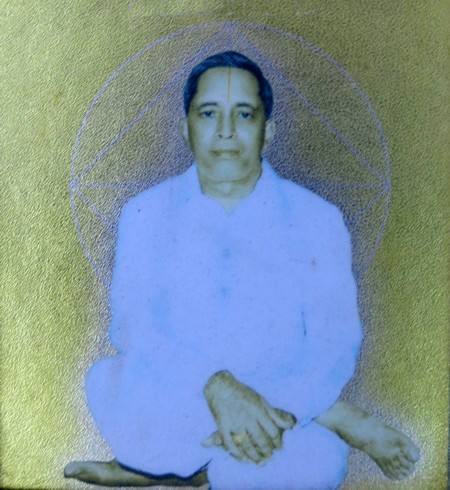
For the design of the painting, I placed two flight photos of the Alps and the Himalayas in the background. I designed the silhouette of the meditator based on a picture of Master MN. For the design of the inner path to Shambala, I reworked elements that I had already used in earlier pictures.
Yesterday, an Indian friend sent me a WhatsApp message remembering the passing of Master EK. In India, many people usually go by lunar dates. Yesterday was the full moon of Pisces, and the Master passed over on the full moon of Pisces 1984 – 17 March.
Over years, I had sent out a short remembrance of Master EK’s passing (and also of the passing of other great ones) to the WTT group mailing list and posted a blog article for 17 March. However, when I had shared the remembrance on Facebook, an Indian member remarked over two years that “We prefer relating to birthday, not death day”.
Master EK
We submitted this to Master KPK (Sri Kumar) last August, and he replied: “Death days need not be recollected as birthdays.” We agreed to discontinue messages regarding pass-over memorial days and that they would be no more listed in the Astro calendar. However, our decision was not further communicated. When an Indian member wrote concerning remembering Master CVV’s pass-over date, I prepared a communication and Sri Kumar answered: “Let it be so. We celebrate birthdays only”.
A friend reacted to the communication: “Interesting conversation and final choice. The Tibetan writes the new birthdays are the days of death, when the Soul begins a new adventure.”
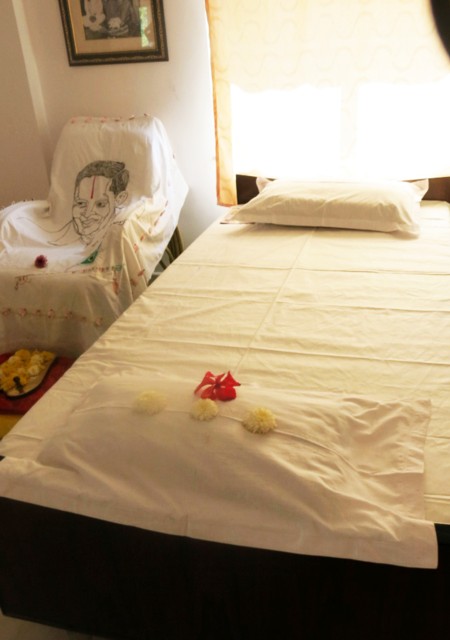
Master EK’s bed
The places where great ones lived, and also the objects they used have been magnetized by their presence. Therefore, they are respected by those who know about this energetic impregnation.
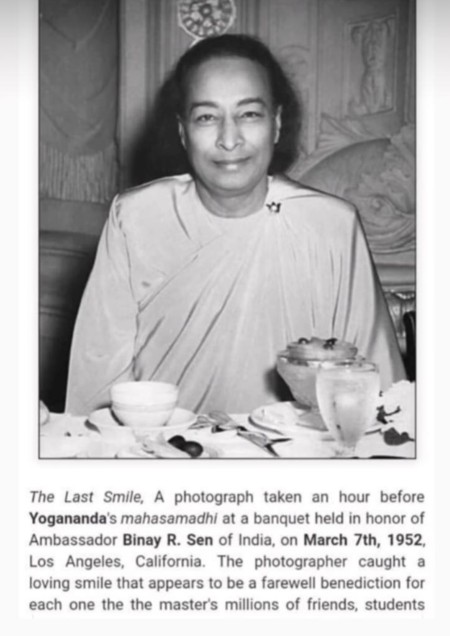
Initiates often chose the month of Pisces, or another date in a watery sign like Scorpio or Cancer for their passing – watery signs mark the end of a cycle, and Pisces marks the end of the annual cycle, leading to the beginning of the new year with Aries. Master MN, Paramahamsa Yogananda and also his teacher, Sri Yukteswar passed over in Pisces. A friend remarked that yesterday was Yogananda’s day of passing.
I noticed with some of my friends of Indian origin / with a Hindu background that they use(d) to follow a rhythm of remembrance days for their deceased fathers. So I asked a friend, and he explained: Each lunar month, they conduct a ritual – or let it be conducted by a priest at the same moon phase the father passed, and this they do for a year. It is considered that one month on earth corresponds to one day in the subtle world, and one year on earth to one month. With the prayers, they help the soul of the departed one to ascend to the higher world, of Devachan. Then, no more prayers and rituals are needed. However, for all the beings who passed over and for whom no prayers / rituals are done, there is a day of collective remembrance with rituals some days before the festival of Dusserah / Vijayadashami (if I remember correctly. It reminds me of the All Souls’ Day for the remembrance of departed ones observed in various Christian churches on 2 November, in Scorpio.
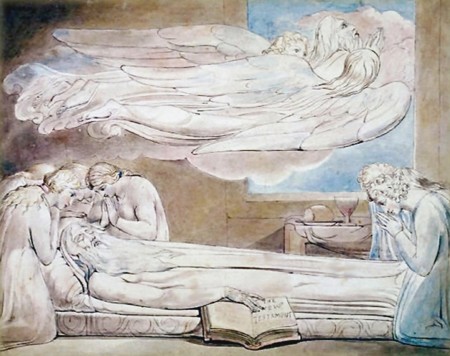
William Blake (1757-1827)
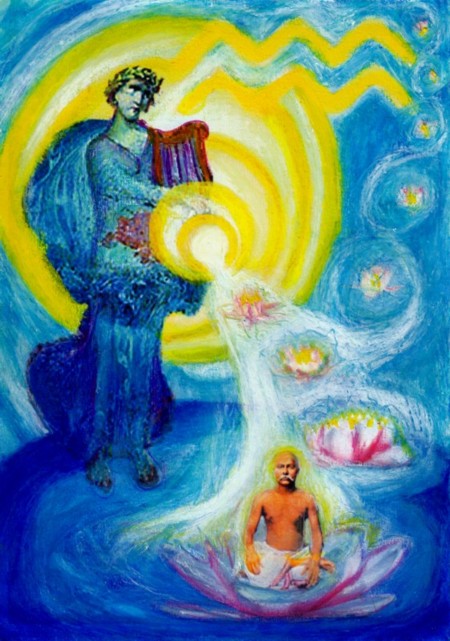
Anyhow, with the development of the golden etheric body, the illusion of death is slowly overcome in the Aquarian age. We don’t die but just depart from the physical body. Once the continuity of consciousness is not broken while departing, we experience deathlessness. And we can consciously continue our journey to another incarnation.
The Anima-Channel just published a video interview with Benjamin Schiller. Benjamin is a mathematician and an IT specialist, but also an astrologer and a mythologist. He has created smoon, a free app for the daily astro-data, and astrocloud, a powerful innovative astrological software.
Benjamin is a profound thinker living in Munich and he has published several books in German on mythology, astrology and symbolism. He is also a good friend with whom I can exchange in a humorous way.
In this interview, Joan de Bes and Cecilia Gonzales from the Anima team speak with Benjamin about his favourite topics: “The universe is a symbol and astrology is a clock – you always can see how the energy is flowing in the system.” “I don’t like making scientific people believe in astrology. But I guess that the universe, the world is not only existing and thrown away. It is much more. I believe in the idea that everything is a symbol…”
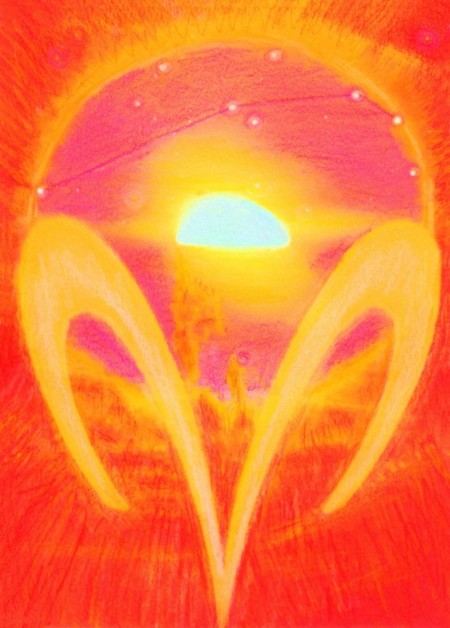
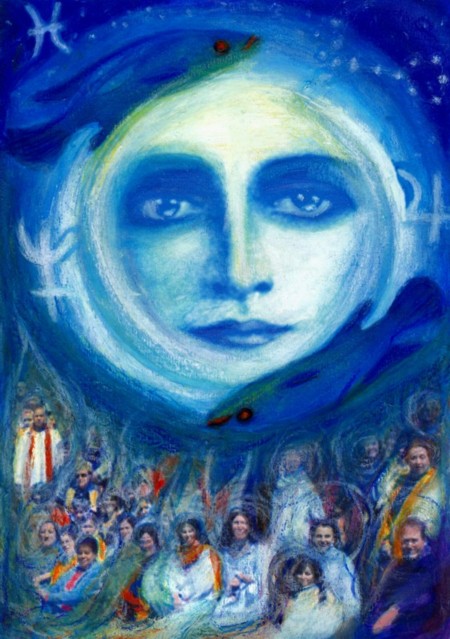
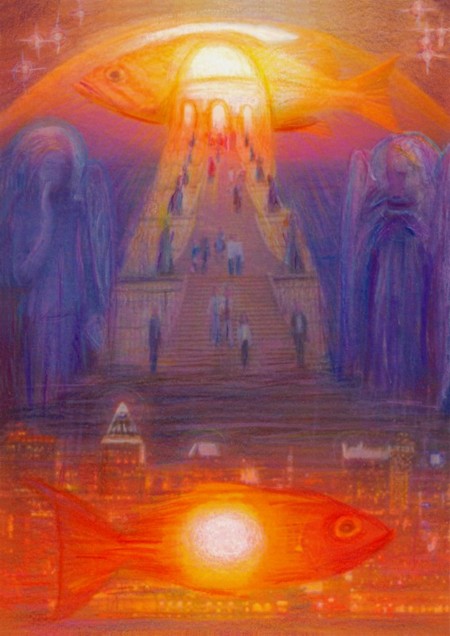
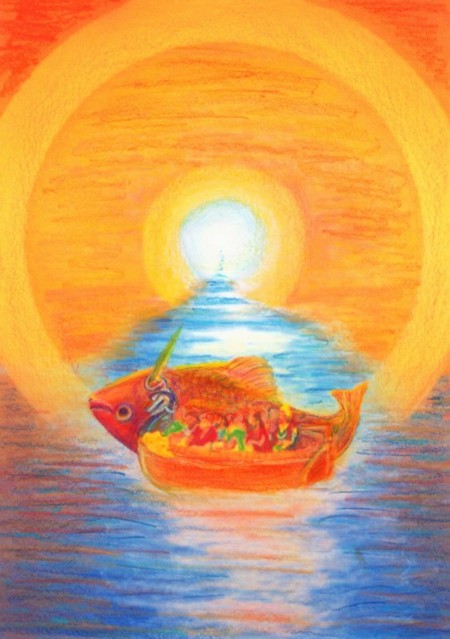
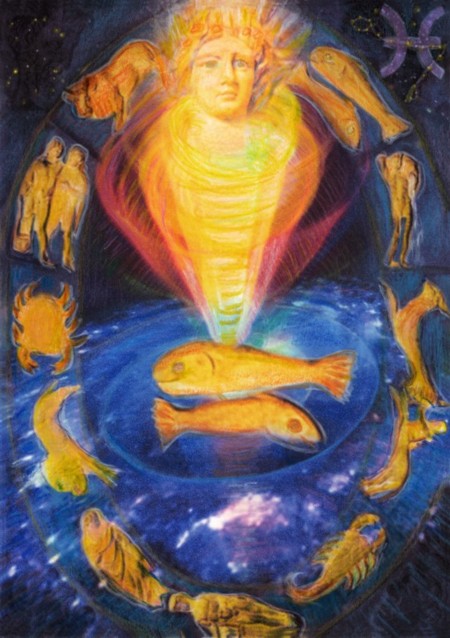
The message in the symbol of Pisces is that of synthesis which unites all opposites. The two fishes of Pisces move in opposite directions. They appear as two, but in reality they are one. Without opposites there is no creation. Pisces also stands for death and birth. Pisces contains the seed for the beginning of a new cycle. This new cycle happens in Aries (“all things new”). But the subtle beginning seeds are in Pisces. The cyclical movement of time is eternal.
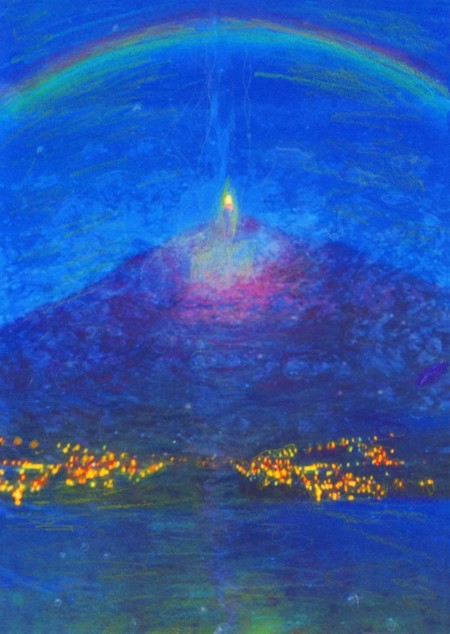
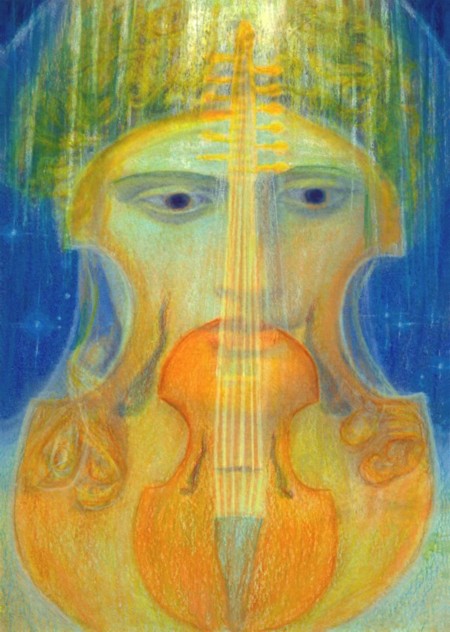
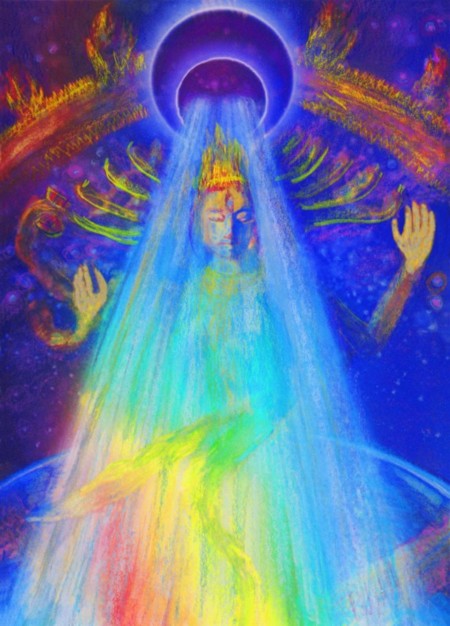
Today, the Sun enters Pisces. Pisces is a sign of synthesis that unites opposites. The two fishes of the symbol Pisces are swimming in opposite directions but forming a complementary unity. The two fishes can be thought of as spirit and matter. Spirit and matter are apparent opposites that together give rise to universal consciousness. This consciousness is the underlying current that balances the opposing forces and allows creation to exist.
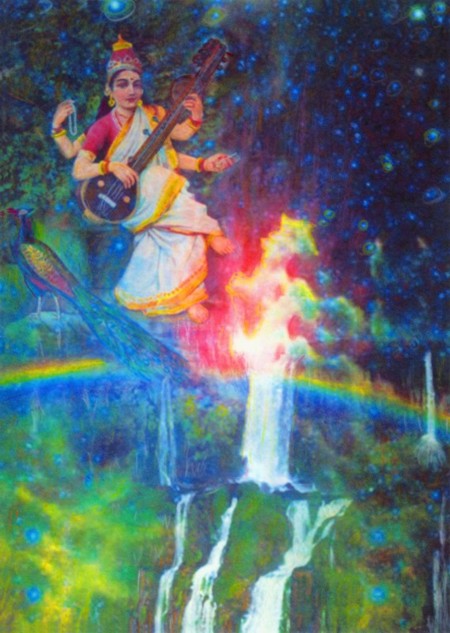
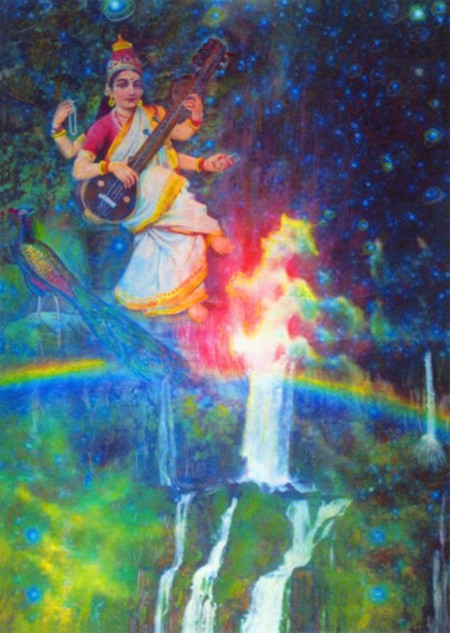
The flow of consciousness is called ‘the Word’. In the East, it is worshipped as the Mother of the World in the form of Saraswathi, Goddess of Knowledge and Wisdom. Saraswathi directs the movement of all things, which we can meditate as a circular flow of energies in the wheel of creation. It is a flow of light and sound through all seven planes of creation. Symbolically, this is represented by the seven-stringed musical instrument Vina, on which Saraswathi eternally plays her music, keeping the process of creation in harmony.
For the design of the picture I used elements of the NASA photo of a star nebula in the background. I integrated the photo of a rainbow over streams of the Iguazu waterfalls, seen from the Brazilian side. The colours of the rainbow symbolize the seven planes of creation. Above, I inserted a Saraswathi depiction by Raja Ravi Varma from 1894. Saraswathi is playing on a Vina, as a peacock with its multiple colours watches nearby.
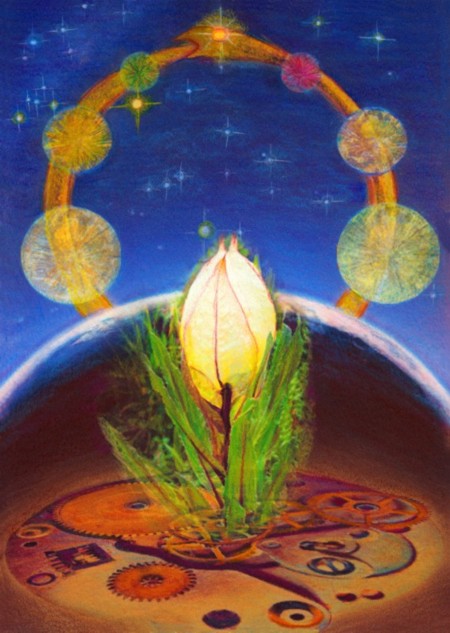
Aquarius is the month of magic. The word magic comes from Magus, the Latin word for priest or magician, and this is derived from Magha. Magha or Maagha is the Sanskrit name for the 11th Sun sign, Aquarius. Magic is to let something appear from out of seeming nothingness. The creation is ever manifesting from invisibility to visibility – a magical process. And the creation is also disappearing again from visibility to invisibility. It is like awakening and going to sleep again. All this happens on the basis of eternal existence.
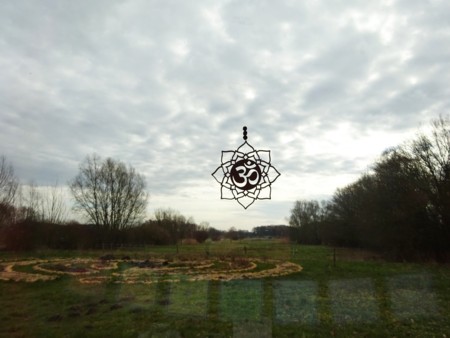
The creative manifestation of a painting is just like this process – the image manifests through the creative work, it is there for some time and it will disappear again after some time – the magic of manifestation and de-manifestation.
Beauty is an expression from the subtle planes. What artists express through their work is coming from their inner – via thoughts or intuitional impulses. Many times modern artists seek new expressions for their intentions going beyond traditional forms of perceiving beauty.
What we perceive as beauty in Nature is also coming from the subtle planes of Nature. Many people think the forms of Nature are accidental and produced by mere physical or biological processes. The wisdom teachings, however, understand that there are also other forces at work – a cosmic mind (called Mahat) and what you might call cosmic intuitional impulses. You do not physically see them but they are expressions of beauty beyond physical form. Artists using for their work inspiration or elements of beauty from Nature are in subtle interaction with these cosmic and not human expressions. There are many artists who tune up in their work to these realities. The Japanese art of Ikebana might be seen as an example of such subtle interaction.
Barbara Hübner: The Path is the Goal
Mid-December 2022, I had a Zoom exchange with a friend from Berlin – Barbara Hübner, better called Basia, since she is of Polish origin. I wanted to write some words in a blogpost but it took several weeks before finding time for these lines and giving some hints to her work.
Among other skills, she is an accomplished artist profoundly inspired by Japanese traditions (if you don’t know German, you can read the texts on her websites with an automatic translation). She sent me some pictures of her recent artwork. She mainly works with floral elements and materials such as bamboo, twigs, paper, metal and other compositions.
Barbara Hübner: Red Bamboo in a Bamboo Grove
The images touched me by their clearly structured arrangements and beauty. They radiate a ritualistic concentration on the essential but at the same time the joy of manifesting something sublime and uplifting.
Barbara Hübner: Veiling the Promise
I discovered more about her work on the web (here: Facebook). She calls one of her websites “Joy of Creating“. Using elements of nature, the artistic work magnifies the natural beauty and lifts the viewer up to subtle planes.
Part 5/5 On 14 January, the day before leaving, you could see Pongal fires in the streets of Visakhapatnam. Pongal is the South Indian harvest festival of the lunar winter solstice celebrated on 14th or 15 January. Old material is burnt as a symbol of leaving behind what is no longer needed in life.
The journey to India was also a process of detaching and disconnecting from what usually occupies me in everyday life, of leaving behind the usual surroundings for a while. This year, I was much less digitally active, partly intentionally, partly due to the internet connection difficulties with my laptop. This detachment is not possible when you stay continuously in digital contact with the “other world” back home.
My journeys to India always helped me to gain a distance and to get a new perspective, to reframe my way of viewing things and to see more clearly what to adjust in life. Sri Kumar once explained how the ambiance in India is spiritually charged by the very ancient presence of the Great Ones and, in spite of the surficial chaos, supports opening to the subtler dimensions much better than anywhere else.
The exchanges with other members during the journey showed me the very variant ways of understanding and interpreting situations, and at the same time to focus the underlying unity. You could see this in the attitudes towards situations on journeys or when speaking about the purpose of being together. I tried to mainly observe, listen, and where necessary inform and point out without intervening. Being aware of the purpose of a group living and acting accordingly is unifying the group. Some were very supportive in this, having the same attitude and feeling.
A little anecdote about different perspectives: In my talk during the “Fusion of East and West” meeting at the Guru Pooja, where most contributions were in Telugu, I spoke about the importance of English as the Aquarian language allowing overcoming language barriers and that therefore, the Hierarchy had chosen English as the means of wisdom dissemination and that Master Kumar had given learning English as a spiritual discipline for all members. When after returning I mentioned this in an exchange with a German head of group, she answered that the Indian brotherhood, by speaking Telugu at the Guru Poojas, allows inclusion of all the local members of lesser education who will not be able to understand English well. I understood.
The meetings this year were different from previous group livings insofar as Master Kumar was no more physically there to set and hold the frame. You could strongly feel his presence but other members had to act. Sri Joshi, the head of Bangalore group, beautifully explained that Master Kumar was like a father taking care of many things; and like in a family, when the father or the mother pass over, the children have to take over responsibility. You know what might happen when a the family is no more held together. Now, in WTT, there is a greater need for us to take care, look around to see what can be done, and to co-operate more with the purpose of the group, of the Plan.
Some in WTT are looking out for having another Master in this role of coordinating and holding together, for replacing the vacancy the passing of Master Kumar from the physical has created. A member wrote me, “Who is now the Master? There must be a Master in the center.” I tried to explain that the group is the Master and group units might take over greater responsibilities. I experienced this myself how the questions I had were solved through exchanges, and that myself am more in situations of explaining.
I observed that some were looking out for other interesting gurus and organisations. The “spiritual tourists” in the groups always easily start “flirting” with how well other teachers and organisations are – but not committing themselves here nor there. These are aspirants not yet having fixed themself on the path. But with those fixed on the path, there is also a greater need for coming together and to exchange.
In a talk, Guru Prasad, the son of Master Kumar, pointed out that normally seekers have very few close co-members with whom they can speak about what they experience and what occupies them internally. This is only possible with the ones who have a similar spiritual orientation. It takes time for seekers to open up more deeply. It also takes time to be able to dive deep into the wisdom teachings. And for this, longer group lives are very helpful. Therefore, the group lives in Visakhapatnam will continue in the future.
A personal experience: For different reasons, it was difficult to pack my luggage in Switzerland well ahead though I started early. I had to finalise it in the morning I departed. I was a bit in a hurry and had not carefully done the final luggage weighing and eliminating non-essential things. At the airport, I had about 6 kg overweight which would make 600 Swiss francs. The lady at the counter said I could put heavy things into the hand-baggage. With many people in the row behind me, I opened the suitcase, distributed some things to my co-travellers and took heavy things into the hand-baggage. There finally was no overweight fee but a bad feeling.
I had a number of gifts in the suitcase, but during the journey I received much more gifts – shawls, shirts, books and other items where I didn’t know what to do with them. I understand the importance for the givers to give. I didn’t want to be impolite and refuse, but under no circumstances I wanted to increase the baggage load. So each time a gift came I immediately passed it on to someone else wherever it was possible. Passing on also spreads joy.
In the end, I had again overweight. I radically eliminated things, gave or threw away and always thought, why do presents still need to be physical and not, as per the general trend in the Aquarian age, be more subtle. It was an intense piece of learning for me.
Part 4/5 This year was the 62nd Guru Pooja celebration. The tradition of celebrating a global Yoga Festival each year on 11th – 13th (or now, starting in the evening of 10th) was initiated by Master EK in 1962. Thereafter, it unfolded into a grand ritual with varied uplifting activities and participants from various parts of the globe and many parts of India. From 1984 on, when Master EK left his physical body, Master KPK continued to lead the celebrations.
The assembly hall – preparations going on at the stage
I was much interested to see how the celebrations would be, now after the passing of Master KPK last November. This year was my 21st physical participation and twice, during corona times, digitally. It was always an incredible event – participants were served food and accommodations free of cost, all activities were offered with love and free of price tags.
A projection screen and a little altar in a side row
On the altar, you can see pictures of many of the great Masters of Wisdom – a very synthetic event, where you can virtually perceive the subtle presence of the Great Ones. And since its activities, with the exception of “Fusion of East and West”, are normally in Telugu only, also the busy mind of us Westerners gets a better chance for calming down, not understanding the content by words but by observing and by tuning in.
Adventurous cooperation
Over many years, the Guru Pujas were conducted in Simhachalam near Visakhapatnam. Last summer already, Master KPK informed us that in 2023 this would no more be possible due to the hygienic situation there. They found a smaller but very beautiful site in Visakhapatnam, very close to Radhamadhavam- the WTT-temple – and the Retreat Center. And they had to find solutions for the many visitors coming from places outside Visakhapatnam. Sri Kumar said that the team is very experienced in organising the event but they have to adapt it to the new locality.
Poster with Masters of the Hierarchy
When we came to the compound in the afternoon of January 10th, I was thrilled to see how well this work was going on. It was less than an hour until the official start and many things needed to be finished. There was no haste but focused attention of the Indian helpers, and at 5 pm, with the start of the celebration, everything was ready.
The prayers were all conducted by Navaneetam ( Sri B.R.K. Raju), who has been the secretary of Sri Kumar for many years; he also coordinated the activities and gave a lecture. Many different members were integrated in the activities. The structure was familiar to all who regularly participate: Each day, there was a major ritual – on the first day a water ritual (Shiva Pooja), on the second day a fire ritual (Narayana homam) and on the third day the Sri Lalitha Sumuhika Pooja, the worship of the divine Mother aspect.
There were book presentations, lectures and musical presentations. There were small rituals for first feeding of children and introduction into writing, initiation into Gayatri mantram (Upanayanam). And of course, morning and evening prayer followed by lectures.
The whole area belongs to a huge event center, where there were also accommodations. At the same time, the site was fairly well protected from the outside traffic. There was a big dining hall for the Indian brothers and the group of Westerners had a spacious separate hall where non-spicy food was served. There were also several book stalls for wisdom books and tables for other offers like homoeo medicine. And the hall was beautifully decorated with huge posters, flower arrangements and little altars.
It was very nice to be together with other deeply spiritual people for 3 days and nights – and also have time for spontaneous sharing with other members. It was really a New Age festival, where joyfully the Yoga of Synthesis was lived. Thus, the Guru Poojas are a modern form of the ancient ritual of Satra Yaga. This spirit of group living has been kept vibrantly alive with this festival.
Meeting “Fusion of East and West”
After the Guru Poojas, the members from the West started departing. A time for last exchanges and then to say good-bye. Hopefully at some future group living.
Part 3/5 Murthy, the caretaker of the WTT retreat center, was already waiting for us at the airport when we arrived 30 December evening. He had organised a small bus, and soon we were driving through the night.
Relief in Visakhapatnam airport
Looking out of the window and seeing the traffic and the colourful lights along the roads, I tried to discover any changes: It was 3 years since my last visit, after a continuous annual series of regular visits since 2000 and then interrupted by corona. I was curious to discover what the visit would be like this time.
Early morning decorating the altar in Radhamadhavam
Due to the transition of Master Kumar on 1st of November, this was not a group life in Visakhapatnam but a gathering of members who wanted to stay together at the retreat center before the beginning of the Guru Pooja celebration from 10 January onward. Other members went on tours through South or North India or decided to come to the Guru Poojas only.
Video viewing of the January 2022 seminar with Master KPK
For those members from the West who wanted to stay in Visakhapatnam, the Indian brotherhood of Visakhapatnam had warmly invited us to come. They had prepared a 9-days program and we would join ongoing regular prayers and rituals at the WTT temple “Radhamadhavam”. I was very grateful for their offer and commitment, since this meant also quite some organisational effort from their side. It was a very profound time with many interactions and exchanges besides the regular daily rhythm.
Ceremony at Master EK Sundaravanam
1 January early morning there was the usual prayer meeting at “Master EK Sundaravanam”, a site with a statue of the Master maintained by members of the WTT at the beach road. It is impressive to see such a statue at such a prominent place, and to have there such an open-air prayer gathering with about 175 members – this would cause big eyes in the West, but not in India. It was the 28th Anniversary celebration of this site. Brother Sri Ch. Satyadev conducted the prayer and the Sri Lakshmi Narayana Pooja with Rudra Namakam mantrams, and after the prayer breakfast was served to the members who participated. Welcome greetings were exchanged, and then we strolled back to the retreat center.
In the evening, there was a small celebration after prayer for the inauguration of the Telugu calendar, together with the presentation of the star registration in the name of “Master KPK” on 7 November 2022.
Navaneetam giving a talk at the inauguration celebration
Guru Prasad
2 January morning after prayer, we had an interaction with Sri Guru Prasad. Sabine M. and me had prepared a number of questions which we submitted to him, esp. about how we can contribute to maintain and develop the East-West relation, how we can keep the door open for the next generation and what we can do, how can we strengthen cohesion, globalize service activities and what could be next steps. I appreciated the way he answered the questions. (I have no record of his answers.)
In the afternoon we went with a small group to the Planetary Healing Center. The center had been created in 1996 on the basis of plans given by Master KPK. In the last years there had not been an interest from the side of the owner in maintaining contact with the WTT and during my last visits the site seemed to have suffered somewhat and did not make a very well-kept impression. This time, however, it was in a better shape and there were people active to maintain the garden. Nature had recovered very well. We enjoyed very much being there, sitting in the center and singing OM for a while. Then we sat around the Maitreya statue and chanted the song of Lord Maitreya.
The Planetary Healing Center, entrance
Inside the Healing Center
The central stone
Meditating at the Maitreya statue
In the evening, we had an interaction with Sri Navaneetam. He told us about the developments in the Indian brotherhood.
Next morning and on other days, we saw the videos of last year’s seminar of Master KPK on “Simple Steps to Synthesis”. In the afternoon we visited Ramadri, the beautiful temple site “Hamsavanam” with a huge Hanuman statue, a number of little temples, a training center for enhancing professional skills of women and a “Goshala”, a cow care project with 37 cows. The site and its activities are maintained by a team of volunteers, organised by the Circle of Good Will, India.
Hanuman statue at Hamsavanam
Ramadri – Hamsavanam
On 4 January we made a longer excursion to Borra Caves and Anantagiri resort in a mountainous area.
Entrance of the Borra Caves, like going inside. And there is also a small cave within the cave, with a worship place
Cultural presentation at the Anantagiri resort
6 January, we visited the Balabhanu Vidyalayam School and the new Master EK Samskruthi Sadan service center. Some speeches were given, and then certificates for vocational trained women were distributed by WTT heads on this occasion. Also some flowers were planted and lunch was served to us as “prasad” (food gift after a ritual).
Balabhanu is a recognised school with classes from 1 – 10
At Samskruthi Sadan
7 January we visited the Sripada Srivallabha temple in Pithapuram, about 150 km from Visakhapatnam. We could not start in time in the morning but arrived only 10 minutes before the temple closed at noon. I nevertheless enjoyed being again at this important and energetic place, where I had been already 5 times before. Read more aboutthe mystery of Sripada and the avatars of Lord Dattatreya here. Afterwards, we went to the Kukkuteswara temple and later to the temple of Annavaram – I had reported about this temple several times before.
Statue of Sripada Srivallabha (1320 – 1352) at the temple at his birthplace
Statues of Dattatreya avatars at the Kukkuteswara temple
The travel group in front of the temple of Annavaram
9 January the group made a visit to the Simhachalam temple which we visited each time before the Guru Pujas conducted over many years in Simhachalam. Since it was no more possible to organise the Guru Pujas there, this year’s celebration was directly in Visakhapatnam, very close to Radhamadhavam and the retreat center.
At the temple of Simhachalam (no photos allowed inside)
The group meeting ended in the evening of the 9th with the prayer, a little celebration and dinner at Radhamadhavam. The ambiance over these days was good, the group experience intense, although the group cohesion was somewhat more challenging than in other years since it was not a normal group life, and therefore there were more fluctuations. But I enjoyed very much having more time for deeper exchanges. The program was very well organised by the Indian brotherhood and with much care. And being together again with other members from the West was like a big “family meeting”.
Guru Prasad had been very involved in making the group meeting run well and in supporting members with problems. I also had several conversations with him about issues concerning the development of the WTT.
During the celebration, Guru Prasad pointed out that such longer meetings are very precious. It needs time for profound exchanges which you cannot do with people not sharing the same focus and inner orientation. Especially the time of Capricorn and the energies of the Sun at the start of the ascending arc of the year are very supportive for deeper spiritual alignment.
Therefore, the January seminars and the Guru Pujas will be continued in the coming years, together with the May Call and December Call meetings in Bangalore, solstice and equinox meetings at Master Mountain and, from 2023 on, meditation meetings around Aquarius full moon at the Yoga Friends Society place in Kumbhakonam.