
erk admin

spacerCircle of Good Will - Blog

Archive for the ‘Communication and Interacting’ Category

Subliminal Messages against Obsessive Game Play

Thursday, March 15th, 2007

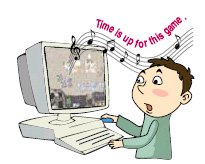
The Korea Times reports that the Korean venture start-up Xtive has developed an inaudible sound sequence, that is incorporated in games and tells gamers after a certain time to stop playing on their own. The messages are told 10,000 to 20,000 times per second,” Xtive President Yun Yun-hae said. “Game users can’t recognize the sounds. But their subconscious is aware of them and the chances are high they will quit playing. Tests tell us the sounds work.”

Korea Times says: “Experts point out roughly 10 to 20 percent of high school students can be categorized as Web junkies who need treatment. And many believe that is a conservative perspective.”

Xtive has applied for a patent for the phonogram and wants to use the technology in other sectors, too: “We can easily change the messages. In this sense, the potential for this technology is exponential.”

Many teenagers spend too much time playing computer games, not only in Korea – I have two of these at home… Sound is very powerful and is used in spiritual techniques, as you can read in Basics of Spiritual Life on The Power of Sound. However, using subliminal messages to manipulate people, even “for their good” infringes free will – even if the will isn’t that free with game addicts. If people voluntarily submit themselves to these influences, why not. But using them, pre-installed, in games or in other contexts – just imagine shops – is violating our human identity.
subliminal.jpg

The Pope’s Appeal to the Media: Upholding Truth, Protecting Dignity, Promoting Respect

Monday, March 12th, 2007

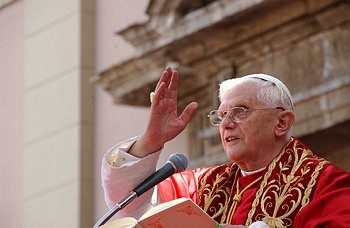
Last Friday the Catholic Church celebrated the World Social Communication Day. Pope Benedict XVI gave a media communication on Educating People to Truth, which can be underlined in the light of an understanding of general good will:

He pointed out: “While the print media struggles to maintain circulation, other forms of media such as radio, television and the internet are developing at an extraordinary rate. Against the backdrop of globalization, this ascendancy of the electronic media coincides with its increasing concentration in the hands of a few multinational conglomerates whose influence crosses all social and cultural boundaries.”

He further went on saying that internet too “has opened up a world of knowledge and learning that previously for many could only be accessed with difficulty, if at all.” “On the other hand, it is also readily apparent that much of what is transmitted in various forms to the homes of millions of families around the world is destructive.”

“The responsibility to introduce and educate children and young people into the ways of beauty, truth and goodness is,” he said, “a grave one. It can be supported by media conglomerates only to the extent that they promote fundamental human dignity, the true value of marriage and family life, and the positive achievements and goals of humanity. I appeal again to the leaders of the media industry to advise producers to safeguard the common good, to uphold the truth, to protect individual human dignity and promote respect for the needs of the family.”

prev58.jpg

“Data Protection”

Sunday, March 11th, 2007

When we met yesterday with the family of a friend on their stop-over, our friend reacted quite astonished when we told him that we don’t constrain our youngest son (14) to tell us where he is going. The friend said that he is clearly expecting his sons (16, 19) to inform him or his wife about their wherabouts, and that they have to come back latest at a pre-fixed time.

Of course, they are living in a big city in Northern Germany and we in a small suburb, and there are no serious dangers around. But there is something more about it. My wife answered him: “Unlike the older son, the younger one has a great urge for freedom. When he feels restricted, he shuts himself up on a subtle level. When he feels I am trusting him, he experiences I am supporting him, and he keeps open towards me. For me this openness also in the subtle is more important than trying to check upon him. And up to now nothing has happened.”

Our son doesn’t like telling us what he is doing. When we ask him, he answers “data protection”. And when he wants to know something particular from my wife or me, we retort: “data protection”.

dataprotection.jpg

Communication or Riding a Bicycle

Sunday, March 4th, 2007

Yesterday a friend came for a visit to clarify some misunderstandings. My wife has developed a way of visualising communication processes and blockages, which proved to be very helpful.

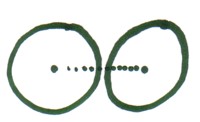
kom1.jpgThis shows two individuals.

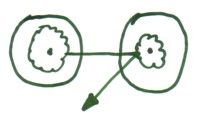
When you want to communicate something, you want to reach the other, so that he/she can take it inside:

kom2.jpg

You give something, a thought, a feeling etc., then you have to let go.

kom3.jpg

For a living exchange, the other has to take it up. He/she lets it in, thinks about it, creates associations, and then gives something back, also letting it go, giving it free.

kom4.jpg

Thus a flow can come about, a mutual exchange, enriching both.

kom51.jpg

You feel the other has understood you and you have come in touch with the being of the other. It is a movement like a lying eight, the sign of infinity.

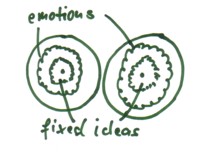
Often however the communication is blocked. There are emotions and fixed ideas, within you, within the other, or within both:

kom6.jpg kom6a.jpg

They are obstructing the free flow, you and the other feel frustrated, hurt, irritated. Often you don’t understand what has happened, create your own ideas about it, which mostly aren’t the same than those of the other. Both sides might start building up walls, rejecting what comes from the other side.

kom7.jpg

In this situation you have to know clearly what you really want, what is your need. You have to communicate it in a clear way, not roundabout. And you have to work through the “roundabout-messages” of the other trying to understand his/her original intention. Thus you have to work through the layers of thoughts, fixed ideas and emotional reactions.

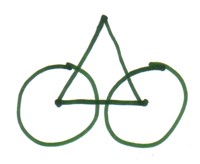
When you realise what you have in common, it creates a triangle between both of you, meeting at the higher meeting point, which is above the emotional and mental: The higher self or the soul. This releases the blockage.

kom8.jpg

I call this “to ride a bicycle”.

This blog-post has been translated into Spanish, together with some other posts of this series.

Manager Efficiency and Killing the Dragon

Sunday, February 25th, 2007

In an article about work efficiency of managers in the Swiss-German newspaper “Der Bund“, Heike Bruch, professor of Leadership and Human Resources Management at the University of St. Gallen, Switzerland, stated that their research has shown: “Normally a manager just works seven minutes running.” Only one out of ten managers has enough energy and focus to do effective work.

Often when difficult decisions have to be made they tend to do substitute acts. Many lose themselves in daily business and as a consequence their focus is suffering. They entertain many interactions with co-workers and customers instead of concentrating on long-term or strategic tasks. They prefer working like fire extinguishers. Although they often have the choice of setting their priorities, many find it difficult to do so. The very efficient ones mostly show a predilection for one or two projects on which they focus with all their will-power and leave other things aside.

At St. Gallen university they have done energy profiling for different sections or whole enterprises: There is a direct correlation between the measured energy level in an enterprise and its economic success. When the energy level is very low, a short term strategy is “killing the dragon”, basing on the fact that an external menace releases energies. If an enterprise is in a crises, the heads do well to show to the employees how serious the situation is. If all are pulling into the same direction, a turnaround can come about. But “killing the dragon” doesn’t work as a long-term strategy. For this leadership and innovation are needed on all levels, not only at the top.

dragon.jpg

Killing the Dragon – Scene on the wall of the Münster at Basel, Switzerland.

In spirituality the dragon is a symbol of wisdom or energy enchained in matter. Killing the dragon means, overcoming the conditioning of personality to get back into contact with the soul. From there the energy will flow in. Through a re-alignment of our lives towards higher goals we get energy and inspiration. In management language this is taking to the “leadership” of the soul and the “innovation” of a re-oriented direction of life. As per the symbol of the dragon see the Lunar Messenger on “The Mystery of the Serpent“.

The problem of not being able to focus on one thing for a longer time or getting lost in daily business has to do with an overactive mind. It is an experience that people used to regularly exposing themselves daily to periods of silence by meditating calm down the “overdrive” of mental activity.

We are the Donner Party

Saturday, February 24th, 2007

A friend from Reno, Nevada, US, sent me a copy of a little article on the lessons learned from the “Donner Party.” The Donner’s were a German family who helped organize a wagon train to travel to California 150 years ago. Of the 90 souls who set out to go West about half of them died in the Sierra Nevada Mountains at a place that is called Donner Lake today. The story of the Donner tragedy is very familiar in the Western USA. Some of the party, in order to survive starvation, ate the remains of those who had died.

Frank Mullen, author of the book “The Donner Party Chronicles”, writes: “They were like us because we make the same mistakes. Nothing has really changed. They are us in every way. Their hopes and dreams. Their desire to be heroic. Their ‘watch out for number one’ attitude. In a sense we haven’t learned anything from history. I think we seldom do. We make the same mistakes. We allow the same divisions of class, race, national origin, and wealth to keep us apart. We act the same way, except maybe in a big flood like the one we had in Reno last year, where we saw homeless people filling sand bags beside casinos bosses downtown. But you see it in most cases of adversity in general life and in politics especially, where people blame each other instead of working together.”

“It’s really a human story. And when you see the human personalities in the Donner Party, when you see how people reacted to adversity, you realize you know people like Donner, Reed, Breen, and the others. We really know these people because they haven’t changed much in 150 years. … You see this with environmental problems and what to do with the homeless… Prejudices tend to lump people together and say, ‘Let’s get rid of all of them.’ But there’s something wrong with the logic of that. It doesn’t work.”

Read
the article if you have time.

mongolia.JPG

Gobi Desert

Learning from Animal Nature

Saturday, February 17th, 2007

Last week an article in the Swiss newspaper Der Bund about “What managers can learn together in a zoo” presented the trainer Lorenz Nufer who uses animals as metaphers and mirrors for managers. In the zoo they study different forms of behaviour and organisation: Wolves have extreme forms of hierarchy and baboons have a lot of conflicts, where you can study how they solve them. Enterprises are not just like zoos, but the way man and gorilla hordes are showing off resembles a lot. Watching animals helps to get a distanced view on one’s own behaviour. Discussing about behaviour forms of animals helps getting blocked forms of communication go again. Behaviour-oriented learning can leave deep traces, but you have to deal with it in the right way and not just like a funny experience. A transfer has to be done in order to get to a deeper understanding. The event of an excursion into a zoo is only an instrument and not a solution by itself.

Many executives react on increased challenges according to the motto “try harder”, and they make increased efforts, which are neither useful for the individual nor for the organisation. Bot the persons concerned don’t get out of that pattern. With an exercise which they cannot solve alone they can be empowered to realise that they have to look for help and not to go on trying by themselves. Those who have really experienced the need for help are likely not to repeat the old patterns.

In spirituality animals are also often used as examples to illustrate the behaviour of man or his different faculties. So the mind is normally compared to a monkey jumping around and very difficult to be controlled. In the Book of Rituals Dr. Krishnamacharya writes: “Since man has crossed the consciousness of all the living beings on this earth during his course of evolution his consciousness contains the association (Vasanas) of all the animals in his behaviour. This is the only possible explanation of the animal behaviour of man.”

Affe
Apes playing in an Indian temple.

Silent Loudspeakers and the Expression of Silence

Saturday, November 25th, 2006

Yesterday morning I took some pictures from an installation with loudspeakers at the entrance of the Kunsthalle Berne (Art Gallery) of Pavel Büchler, a Czech born artist living in UK:

I was fascinated by the “silent loudspeakers”, overlooking a noisy square. On the website of the art gallery I then read about the artist:

“Summing up his own practice as “making nothing happen”, he is committed to the catalytic nature of art – its potential to draw attention to the obvious and revealing it as ultimately strange. His subtle interventions and wry texts are concerned with revealing the accepted and everyday as ultimately bizarre.”

“Concerned with the distortions of language, he gives a critical attention to the gaps in communication, fascinated as he is with the limits of the communicative properties of visual language. He often addresses the question of the legitimacy of communication in addition to its ephemeral and long-lasting nature.”

So the artist is searching along the threshold of the spiritual, which is “beyond the communication”, of the word, which is beyond sound, beyond form, even beyond manifestation, which is also called the “soundless sound”, or, in relation to communication, the “communicationless communication”. You might read our Basics of Spiritual Life on Working with Sound (PDF).

By the way, the exposition of Pavel Büchler is called: absentmindedwindowgazing. When the mind is “absent”, by wide awake, there is a chance of perceiving glimses of the suble worlds.

Wikiversity – a new virtual University about to start

Thursday, August 10th, 2006

At the annual conference of the free online encyclopedia Wikipedia, Wikimania, just going on at Harvard Law School, the president of the Wikimedia Foundation announced the new project Wikiversity, a free platform for all kinds of educational materials and learning groups. He said that the virtual university will already start this month, at first in three languages, with more languages to follow.

This fascinating international group project will allows people all over the world to have access to education materials and to co-operate – if not a government blocks the access, as it is being done by China with the wikipedia sites. But there is hope that the flow of knowledge finds a way also to penetrate through the great internet-wall.

Nonviolent Communication

Saturday, April 29th, 2006

Yesterday evening I finally finished reading the book “Nonviolent Communication – A Language of Life” by Marshall B. Rosenberg. I was fascinated by the very human and compassionate approach towards solving conflicts and towards understanding one’s own real needs and that of others. The method had helped me in handling conflicts with my sons (15/13 yrs), especially with my younger one. (Last week in Berlin, my friends had a mug with a picture of one of the Simpsons saying “The I haven’t done it boy”, reminding me of the many little conflicts about computer sharing or “littering” at home…)

It had taken over 10 years from the first contact with Nonviolent Communication until now: I remember having heart about it when doing the German translation of the book “Spiritual Politics – Changing the World from the Inside Out“, by Corinne McLaughlin and Gordon Davidson in 1996 (for which I hadn’t found a publisher however, in spite of intense search). Then I got some insights in 97/98 at a conflict resolution training course of the Swiss Red Cross, where I was at that time head of a psychosocial couseling centre for migrants and refugees.

The book even came to me in 99, when at an international conference in Geneva a participant from Los Angeles gave it to me. My wife later started reading it and was enthusiastic about it, applying the concepts in her dealing with our chidren and neighborhood help. 6 months ago she went to a training of the Centre for Nonviolent Communication in Basel and even organised a course with a CNVC-trainer in a neighbor village. She tried to do it again the last weeks, but two days ago they had to cancel it because of too few registrations.

We had quite some discussions at home about the nonviolent way of dealing with conflicts, and I had to realise that very often I took me quite some time to understand my behaviour in the little daily conflicts with the children and finding a more intelligent attitude in seeing what are the hidden needs behind a situation. I hope my eyes have been sharpened by reading the book, which for me is a very practical approach of applying spiritual principles in everyday life.