erk admin

spacerCircle of Good Will - Blog

5th December: International Volunteer Day

December 2nd, 2006

The 5th of December is appointed by the UN as the International Volunteer Day. It is meant to offer an opportunity for volunteer organisations and individual volunteers to make visible their contributions – at local, national and international levels. Volunteer work is an indispensible part of society and of great importance for a good functioning of communities. However, its importance is often not well recognised.

In Switzerland a number of organisations has joined since several years to a volunteer’s forum. They are issuing a volunteer card with which people can document their activities and might get a better position with job applictions.

Volunteer work is an expression of good will and very important for spiritual development. You might like to read the Good Will in Action on the Value of Service (PDF).

See also our posts on The Future of Volunteer Work and Recruitment and Good Will Co-Operation.

Beauty of the Moment

December 2nd, 2006

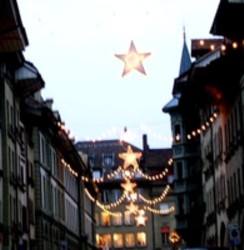
Yesterday morning before work I made a short detour through the old town of Berne in order to look for a subject for the Christmas picture of our newsletter. In the last days they had installed the Christmas illuminations in the streets and I was looking for a subject with a 5-pointed star, because of the subject of the Lunar Messenger of Capricorn (to be published around Dec. 20th). It is about “The Secret of the Dawn” – the awakening of self-consciousness, the 5th principle of man, and the symbol is the 5-pointed star.

At first I took some shots of illuminations in the lower old town, then I went to the cathedral. There I saw that the road next to the church was decorated with nice large 5-pointed stars. While some workers started preparing the stands for the Christmas market, I used one of their lorries as a “tripod” for my digicam, and also some walls. However there wasn’t the “shot” I was looking for. Then I made a few shots from the middle of the road – and yes, there it was: The stars looked like descending from the sky. In the afternoon at home I could cut out from one shot just the right part. Though it was quite a number of photos, only one proved to have hit:

You can click on the photo to send it as a Christmas card.

We pass by so many situations without realising the difference between the normal and the extraordinary. Messenger of the higher world often reveal in a second, the door might close again right away. People were passing over the street on their way to work, looking downward to the ground. May some also look up and see.

A Touching Story about Appreciation

November 29th, 2006

Today I got an e-mail from a friend forwarding a nice story in German about the power of appreciation and recognition. It seemed that it was translated from English, so I “googled” it out and found several versions of the story, which is said to be true (by “truth or fiction”). So here it is:

ALL GOOD THINGS
By Sister Helen P. Mrosla
He was in the first third grade class I taught at Saint Mary’s School in Morris, Minn. All 34 of my students were dear to me, but Mark Eklund was one in a million. Very neat in appearance, but had that happy-to-be-alive attitude that made even his occasional mischievousness delightful.

Mark talked incessantly. I had to remind him again and again that talking without permission was not acceptable. What impressed me so much, though, was his sincere response every time I had to correct him for misbehaving – “Thank you for correcting me, Sister!” I didn’t know what to make of it at first, but before long I became accustomed to hearing it many times a day.

One morning my patience was growing thin when Mark talked once too often, and then I made a novice teacher’s mistake. I looked at Mark and said, If you say one more word, I am going to tape your mouth shut!” It wasn’t ten seconds later when Chuck blurted out, “Mark is talking again.” I hadn’t asked any of the students to help me watch Mark, but since I had stated the punishment in front of the class, I had to act on it. I remember the scene as if it had occurred this morning. I walked to my desk, very deliberately opened my drawer and took out a roll of masking tape. Without saying a word, I proceeded to Mark’s desk, tore off two pieces of tape and made a big X with them over his mouth. I then returned to the front of the room.

As I glanced at Mark to see how he was doing, he winked at me. That did it! I started laughing. The class cheered as I walked back to Mark’s desk, removed the tape, and shrugged my shoulders. His first words were, “Thank you for correcting me, Sister.” At the end of the year, I was asked to teach junior-high math. The years flew by, and before I knew it Mark was in my classroom again. He was more handsome than ever and just as polite. Since he had to listen carefully to my instruction in the “new math,” he did not talk as much in ninth grade as he had in third.

One Friday, things just didn’t feel right. We had worked hard on a new concept all week, and I sensed that the students were frowning, frustrated with themselves and edgy with one another. I had to stop this crankiness before it got out of hand. So I asked them to list the names of the other students in the room on two sheets of paper, leaving a space between each name. Then I told them to think of the nicest thing they could say about each of their classmates and write it down. It took the remainder of the class period to finish their assignment, and as the students left the room, each one handed me the papers. Charlie smiled. Mark said, “Thank you for teaching me, Sister. Have a good weekend.”

That Saturday, I wrote down the name of each student on a separate sheet of paper, and I listed what everyone else had said about that individual. On Monday I gave each student his or her list Before long, entire class was smiling. “Really?” I heard whispered. “I never knew that I� meant anything to anyone!” “I didn’t know others liked me so much.” No one ever mentioned those papers in class again.

I never knew if they discussed them after class or with their parents, but it didn’t matter. The exercise had accomplished its purpose. The students were happy with themselves and one another again.

That group of students moved on. Several years later, after I returned from vacation, my parents met me at the airport. As we were driving home, Mother asked me the usual questions about the trip, the weather, my experiences in general. There was a lull in the conversation. Mother gave Dad a sideways glance and simply says, “Dad?” My father cleared his throat as he usually did before something important. “The Eklunds called last night,” he began “Really?” I said. “I haven’t heard from them in years. I wonder how Mark is.”

Dad responded quietly. “Mark was killed in Vietnam,” he said. “The funeral is tomorrow, and his parents would like it if you could attend.”

To this day I can still point to the exact spot on I-494 where Dad told me about Mark. I had never seen a serviceman in a military coffin before. Mark looked so handsome, so mature. All I could think at that moment was, “Mark, I would give all the masking tape in the world if only you would talk to me.”

The church was packed with Mark’s friends Chuck’s sister sang “The Battle Hymn of the Republic.” Why did it have to rain on the day of the funeral? It was difficult enough at the graveside. The pastor said the usual prayers, and the bugler played taps. One by one those who loved Mark took a last walk by the coffin and sprinkled it with holy water. I was the last one to bless the coffin. As I stood there, one of the soldiers who acted as pallbearer came up to me. Were you Mark’s math teacher?” he asked. I nodded as I continued to stare at the coffin. “Mark talked about you a lot,” he said.

After the funeral, most of Mark’s former classmates headed to Chuck’s farmhouse for lunch. Mark’s mother and father were there, obviously waiting for me. “We want to show you something, his father said, taking a wallet out of his pocket. “They found this on Mark when he was killed. We thought you might recognize it.”

Opening the billfold, he carefully removed two worn pieces of notebook paper that had obviously been taped, folded and refolded many times. I knew without looking that the papers were the ones on which I had listed all the good things each of Mark’s classmates had said about him. “Thank you so much for doing that,” Mark’s mother said. “As you can see, Mark treasured it.”

Mark’s classmates started to gather around us. Charlie smiled rather sheepishly and said, “I still have my list. I keep it in the top drawer of my desk at home.” Chuck’s wife said, “Chuck asked me to put his in our wedding album.” ”I have mine too,” Marilyn said. “It’s in my diary.”

Then Vicki, another classmate, reached into her pocketbook, took out her wallet and showed her worn and frazzled list to the group. I carry this with me at all times,” Vicki said without batting an eyelash. “I think we all saved our lists.” That’s when I finally sat down and cried. I cried for Mark and for all his friends who would never see him again.

The density of people in society is so thick that we forget that life will end one day. And we don’t know when that one day will be. So please, tell the people you love and care for, that they are special and important. Tell them, before it is too late.


Islam Bans Female Genital Mutilation

November 28th, 2006

I yesterday read a press release by the German organisation “Target Human Rights” about a conference they had organized at the Al Azhar University in Cairo about the delicate topic of female genital mutilation (FGM). This is a crime against women practised in many African countries, regardless of religion and nationality.

For two days internationally renowned scholars and doctors discussed the topic and came to the result on November 23rd: “Female genital mutilation is a punishable crime and offends against the highest values of Islam”. Before that scholars had discussed the different theological dimensions and agreed that genital mutilation has no roots in the Islam. Then doctors had presented insights into the horrors of the mutilation practice.
At the end of the conference the Great Mufti of Al Azhar, the highest authority for legal decisions, gave a decision which equals a Fatwa, a binding legal expertise. It says that the lawmakers are asked to declare this cruel deplorable custom as a crime, which has nothing to do with Islam.
This decision is a theological sensation, for every day about 8000 girls especially in the countries of the Sahel influenced by the Islam. Hopefully this decision will help strengthening the fight for eradicating this monstrous habit.

Empowering People

November 25th, 2006

Yesterday evening I participated in the staff information and party of the Swiss Red Cross. At the information session two interesting projects were presented, which expressed creative new ways of dealing with social problems.

One was about the program called RailFair, done together with the Swiss Railways SBB and the SECO, the Swiss State Secretariat for Economic Affairs. The idea is to form volunteers – young or jobless people – to become railway assistents accompanying trains or giving their presence on stations to avoid violence and vandalism, without getting involved into violence themselves or becoming “deputy sheriffs”. The Red Cross does conflict training courses (Chili) with them and supports work integration measures with jobless people, and they learn to develop courage. People feel more secure in the trains and the stations where these “Grands frères” (great brothers) as they are called are present. They serve as role models.

The other inspiring project was about basic health promotion in Krygystan, a former Sowjet republic in Central Asia, where the health system has been eroding and the state of health especially in the rural areas had become very delicate after the collapse of the communist system. The project, initiated by the Swiss Red Cross and financed by the Swiss department of foreign affairs EDA is encouraging the village people to form health committees and organise their needs. People are supported with counseling, but they had to realise that they have to take care themselves of the situation. So they started to do sanitary instalments, cultivate herbs or fruits, make preventions against alcoolism, restore hospitals. This project has motivated the government to introduce it now in the whole country.

Both projects are exemplary for empowering people to solve problems.

Silent Loudspeakers and the Expression of Silence

November 25th, 2006

Yesterday morning I took some pictures from an installation with loudspeakers at the entrance of the Kunsthalle Berne (Art Gallery) of Pavel Büchler, a Czech born artist living in UK:

I was fascinated by the “silent loudspeakers”, overlooking a noisy square. On the website of the art gallery I then read about the artist:

“Summing up his own practice as “making nothing happen”, he is committed to the catalytic nature of art – its potential to draw attention to the obvious and revealing it as ultimately strange. His subtle interventions and wry texts are concerned with revealing the accepted and everyday as ultimately bizarre.”

“Concerned with the distortions of language, he gives a critical attention to the gaps in communication, fascinated as he is with the limits of the communicative properties of visual language. He often addresses the question of the legitimacy of communication in addition to its ephemeral and long-lasting nature.”

So the artist is searching along the threshold of the spiritual, which is “beyond the communication”, of the word, which is beyond sound, beyond form, even beyond manifestation, which is also called the “soundless sound”, or, in relation to communication, the “communicationless communication”. You might read our Basics of Spiritual Life on Working with Sound (PDF).

By the way, the exposition of Pavel Büchler is called: absentmindedwindowgazing. When the mind is “absent”, by wide awake, there is a chance of perceiving glimses of the suble worlds.

Wabi-Sabi: Beauty in Simplicity

November 22nd, 2006

Today I got the latest newsletter of “The Soul Journey“, from friends in the States, this time on “Wabi-Sabi”:

“Beauty in simplicity – that’s what wabi-sabi is. In Japanese, wabi means humble and sabi suggests the presence of beauty in the natural progression of time. In short, wabi-sabi can be seen as an aesthetic appreciation of all things, no matter how humble or simple. Or it can be seen as connecting with the essence or soul of all things, especially in their lack of adornment.
Soulful wabi-sabi is about appreciating the form that naturally occurs such as in the weathering of wood, the shape of landscapes, the colors of rocks or flowers, the flight of a bird, and other natural appearances. The wabi-sabi mindset also uses recycled materials, often in ways that are creative and unique, for waste is contrary to this aesthetic approach. Hand-crafted items are also present in a wabi-sabi environment, because of their frequently found soulful characteristics.
When the form is appreciated for what it is without the compulsion of changing it, then we can be at ease in our environment. It also encourages us to create comfort and to enjoy the experiences of our senses. It has something to say to us about simplicity and clutter as well. Simplicity has a Zen way of evoking the soul within us all since it shows the soul of things when we do not surround ourselves with excess. There is now a movement in house design based on this wabi-sabi idea. It is more than a fad since it reflects a growing soul consciousness among people.
Wabi-sabi is also about appreciating time, as having something to enjoy and value in each moment. When we do not try to cram as much as possible into the shortest amount of time, we can perhaps savour the riches, the beauty and the insights that each moment offers. This is when we can access soul naturally and spontaneously.
Let the ordinary speak to you in new ways, revealing its soul, and evoking yours. Remind yourself to live in the moment, open to inspiration and the joy of being present to your life and soul.”

Another e-mail from a German friend brought a link to a German website on the great Russian artist Nicholas Roerich (the site of the Roerich Museum in New York), where you find a short Quicktime movie about the pictures of Roerich. Roerich is for me really an example of Wabi-Sabi, beauty in simplicity

Ideas of World’s Most Brilliant Scientists for the Future

November 21st, 2006

For its 50th birthday, the science magazine New Scientist has asked over 70 of the world’s most brilliant scientists for their ideas what will be the biggest breakthrough of the next 50 years. As to be expected, the answers show the specialities and disciplines of the scientists -and are often marked by the materialistic paradigm of today.

The oceanologist Daniel Pauly, gave an interesting reply reflecting a thought from the wisdom teachings which say that humanity will become more and more sensitive of all forms of life:

“In light of the time span considered here, I think the most important development for the oceans would be a device that could detect, amplify and transmit to us the emotions and fleeting, inarticulate “thoughts” of animals in such a form as to evoke analogous emotions and thoughts in human brains. This would first work with primates, then mammals in general, then the other vertebrates including fish. This would cause, obviously, a global revulsion at eating flesh of all kinds, and we would all become vegetarians.”

A vegetarian diet has to do with good will, for this way we contribute to reduce violence towards the animal kingdom. You might want to read our booklet “Ideas and Recipes for a Lacto-Vegetarian Diet“.

A Good Sense of Humour

November 21st, 2006

I yesterday read an interview with Jean-Daniel Gerber, director of the Swiss State Secretariat for Economic Affairs in the “NZZ Executive“, which made me heartily laught. Mr. Gerber has a beautiful sense of humour.

Q: Which formation would you make up for if you could? A: Astrology, to give a scientific basis for the economic prognostics.

Q: How many e-mails are you answering per week? A: About 53.4. And in a good mood 2 more.

Q: From which failure did you learn most? A: When I once applied for the role of the donkey in a nativity play and was rejected as unqualified.

Q: Your favorite film? A: Kodak.

And he also shows a good sense of right values in life:

Q: As a citizen, what bothers you most? A: That politics is given priority to expertise.

Q: What is your professional example? A: Jimmy Carter, who after his failed presidentship reached the real height of his career with the Carter Institute for Human Rights.

Q: Which qualities with you collegues do you estimate most? A: When they prevent me from my own stupidity.

Recruitment and Good Will Co-Operation

November 18th, 2006

Yesterday evening I was discussing with my wife the difficulty, how people can find access to and a place in voluntary work of good will, especially in a spiritually motivated work: A short time ago I had heard from two persons who, due to different reasons, had withdrawn from publication projects with which I am co-operating. And two months ago the person who had helped me translating the monthly Lunar Messenger into English had withdrawn due to work overload with other professional and private commitments, so that I am doing these translations myself again – though not “living” in the English language. And for the person who also two months ago had withdrawn from the Spanish proof-reading, again due to work-overload, quickly another person had stepped in. Recently in my team at the office a web-developer had resigned from the job, so that I’m now searching a replacement.

In professional life you just publish an advertisement, if you are looking for new collaborators. In good-will work it doesn’t work like that. People come to help when they see a function where they could find self-unfoldment (see the blogpost on The Future of Volunteer Work.). Like with an apprenticeship it needs quite a time and monitoring before people can be charged with more responsible work, for example for translation or in publishing. It needs skills, flexibility and readiness to co-operate in a rhythmic, persistent manner. For a spiritually motivated individual it is quite a step to start working. And it is more demanding working in a group. People often drop out after an enthusiatic start, because they meet difficulties or they suddenly have other priorities.
You need to develop such a co-operation and commitment to a voluntary work, that a qualitatively high standing result is produced, and this takes time. I observed it with the Paracelsus Journal or the Vaisakh Newsletter, both projects of the WTT with which we are co-operating. It is the experience that people are attracted to such a co-operation through the magnetism of spiritual wisdom. In-spiration is the best and lasting power for such a commitment and self-commitment.

By the way: The WTT movement started today 35 years ago, on 18th November 1971. It grew in slow bur sure steps out of the underlying spiritual seeds. It has given inspiration and a platform for many a spiritually inspired activity of good will.