

When does Compassion Lead to Action?
March 29th, 2007We all get frequently confronted with news pictures or situations about people in need, with an open or hidden appeal to help. Where do you act? Where do you withdraw? Where does a “compassion fatigue” set in?
In their new blog “VoxBlog online debates“, AlertNet (the humanitarian branch of Reuters press agency: alerting humanitarians to emergencies) writes:
“Reading your morning paper, two articles catch your eye. One is about a new study that finds almost 4 million people have died in war-torn Democratic Republic of Congo. The other tells the story of “little Mary”, a 12-year-old Ugandan girl whose lips were cut off by rebel fighters. Which story makes you react?”
They take up the discussion from an interesting article by Paul Slovic in “Foreign Policy“. A short extract:
“A recent study I conducted with Deborah Small of the University of Pennsylvania and George Loewenstein of Carnegie Mellon University found that donations to aid a starving 7-year-old child in Africa declined sharply when her image was accompanied by a statistical summary of the millions of needy children like her in other African countries. The numbers appeared to interfere with people’s feelings of compassion toward the young victim.
Other recent research shows similar results. Two Israeli psychologists asked people to contribute to a costly life-saving treatment. They could offer that contribution to a group of eight sick children, or to an individual child selected from the group. The target amount needed to save the child (or children) was the same in both cases. Contributions to individual group members far outweighed the contributions to the entire group… When writer Annie Dillard was struggling to comprehend the mass human tragedies that the world ignores, she asked, “At what number do other individuals blur for me?” In other words, when does “compassion fatigue” set in? Our research suggests that the “blurring” of individuals may begin as early as the number two.”
(Paul Slovic studies risk and decision-making and is professor of psychology at the University of Oregon. )
When I’m being flooded by calls for help or donations, I sometimes ask myself, where does compassion lead me – or others – to action? With certain themes I have a clear decision, but there remains a blurring area, where to help – and do it. Beyond the individual decision there remains a general impulse of good will, even though physical action is only possible in certain situations.
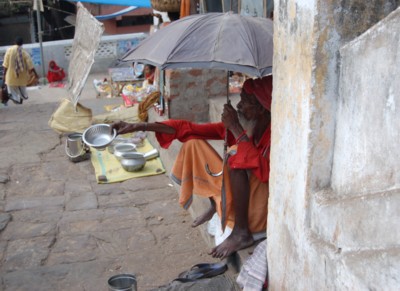
A swami begging in front of a temple in Simhachalam, India.