April 3rd, 2007
There are many theories how the Great Pyramid of Giza (Cheops) has been constructed, but it is still a mystery. The French architect Jean-Pierre Houdin has now presented a totally new theory with the help of a 3D computer simulation, that a ramp had been built mainly inside the pyramid. He asked Dassault Systèmes to help him realise a demo of the reconstruction. They now have online a fascinating journey through time and space in real-time 3D. You need however install a plugin for you browser. Spiegel.de online has some photos of the presentation. You can also download a pdf about Jean-Pierre Houdins project.

Dassault Systems
The pyramidal structure contains many spiritual principles which help reorganising our energy patterns.
Posted in Games, Videos, Powerpoints, Science and Technology | 1 Comment »
April 1st, 2007
The last days I had several experiences in e-mail conversations where the first impression I got from a situation modified with further clarification. My impulse to react on the first impression was not wrong, but only showed a partial aspect. The answers I got enlarged the picture and made me put things into another order or context.
I cannot go into details because of the nature of the topics, just in one case where I wrote a blogpost on “A Case of Spiritual Confusion“.
Yesterday the person “skyped” me again, and when talking to him he turned out to be a seeker who had had some times ago certain psychic experiences and who is on the way of working out his path. He thought of himself as an advanced person, after 5 years of search, though it seemed to me it was still in its infancy. He reminded me of my erroneous searching some 20, 30 years ago. I still feel myself very much a beginner, having to learn a lot.
He was quite open, reflective and trying to overcome traditional ideologies through his own way of understanding. These are promising qualities with the potential of a good growth.
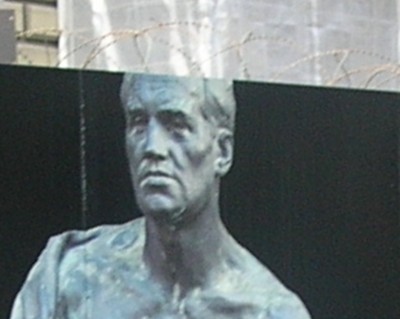
Barbed wires in the head are blocking new ways of thinking. Figure on the hoarding for the renovation of the Swiss Federal House.
Posted in Meditative Thoughts | No Comments »
March 31st, 2007
NASA just reports that its New Horizons spacecraft made its closest approach to Jupiter on its ultimate journey to Pluto. This flyby gave scientists a unique opportunity to study Jupiter from both space- and ground-based telescopes including the Chandra X-ray Observatory. There are auroras bigger than our entire planet: “Jupiter’s polar regions are crackling with electricity,” says Randy Gladstone of the research team, “and this sets the stage for non-stop auroras.”
Nasa
A bizarre six-sided feature encircling the north pole of Saturn near 78 degrees north latitude has been observed by the visual and infrared mapping spectrometer on NASA’s Cassini spacecraft. This image is one of the first clear images ever taken of the north polar region as seen from a unique polar perspective.
Nasa
“We’ve never seen anything like it on any other planet,” says atmospheric scientist Kevin Baines of the Jet Propulsion Laboratory. “Saturn’s thick atmosphere where circularly-shaped waves and convective cells dominate is perhaps the last place you’d expect to see such a six-sided geometric figure.” The hexagon is twice as wide as Earth encircling Saturn’s north pole. Here you see an infrared photo of the structure, which might be explained by geometric shapes like triangles and hexagons forming in water when rotated at a high speed, as Nature reports.
In the same way the geometric patterns of the energy vortexes in the etheric body of man called the chakras might be explained. They form to 4, 6, 10, 12, 16 and more petalled patterns governing the energies structuring the body. And the Jupiter photo reminds you that the etheric head and base centre of man correspond to the north and south pole of the planet, and are electro-magnetic phenomena like the auroras on Jupiter.
See also the beautiful pictures of A. Lauterwasser created by water exposed to sounds. And the blogpost on “Saturn – Seen from New Perspectives“.
Posted in Nature and Man, Science and Technology | No Comments »
March 30th, 2007
Yesterday I was at an Office 2007 and Sharepoint launch event of a Microsoft partner agency, for my job. At first there were high-flying slogans about a colourful future with “wow”-effect by a Microsoft official (“Empower the people with the right tools and softwares and there is nothing they cannot do…”), decorated with video-clips (WMF streaming), which didn’t run that well as the promised future. After a presentation of functionalities (the best presentations are not much usefull when you forget that beamers have other colour resolutions than laptop screens, and a big part of the texts wasn’t readable) and a practical example of complex group co-ordination, there was a fascinating talk about “Increasing Productivity in Information Work” by a collaboration researcher:
The number of people who don’t collaborate face to face has been tremendously increasing during the last few years, and they had done researches on the impact of these changes on new ways of collaboration at distance. I don’t want to go into details, only 2-3 thoughts:
A few years ago everyone was happy with more features available in a program, today the difficulty is to sort out and reduce the complexity to what is really relevant to the people. This sorting-out is mostly done with our head and not by the softwares available.
Most workers in our society are brain workers, but this is nowhere noted in the assets of an enterprise. A major part of our business activities isn’t organised along the needs of creative work, but of a work environment structured differently, in old patterns. In the knowledge work 90% is not visible and only 10% physically visible work.
For the tremendous changes going on in society new forms of collaboration are needed. I was thinking of the collaboration not only at work, but also in the different good-will activities I’m in. Our monthly Lunar Messenger for example, a small project, involves people not only here in Switzerland, but also in Germany (the French translation), Mexico and the US. I’m working in other projects involving also Belgian, Spanish, Argentinian co-workers. It needs quite a lot of co-ordination and brainwork, but the outcome is fascinating, and all are working for free. All this is a group collaboration going on at distance. So also “Good Will in Action” on Cooperation.
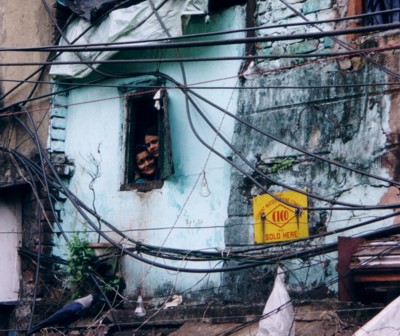
In collaboration good networking is important. Cables, Bhutan
Posted in Games, Videos, Powerpoints, Science and Technology, Social | 2 Comments »
March 29th, 2007
We all get frequently confronted with news pictures or situations about people in need, with an open or hidden appeal to help. Where do you act? Where do you withdraw? Where does a “compassion fatigue” set in?
In their new blog “VoxBlog online debates“, AlertNet (the humanitarian branch of Reuters press agency: alerting humanitarians to emergencies) writes:
“Reading your morning paper, two articles catch your eye. One is about a new study that finds almost 4 million people have died in war-torn Democratic Republic of Congo. The other tells the story of “little Mary”, a 12-year-old Ugandan girl whose lips were cut off by rebel fighters. Which story makes you react?”
They take up the discussion from an interesting article by Paul Slovic in “Foreign Policy“. A short extract:
“A recent study I conducted with Deborah Small of the University of Pennsylvania and George Loewenstein of Carnegie Mellon University found that donations to aid a starving 7-year-old child in Africa declined sharply when her image was accompanied by a statistical summary of the millions of needy children like her in other African countries. The numbers appeared to interfere with people’s feelings of compassion toward the young victim.
Other recent research shows similar results. Two Israeli psychologists asked people to contribute to a costly life-saving treatment. They could offer that contribution to a group of eight sick children, or to an individual child selected from the group. The target amount needed to save the child (or children) was the same in both cases. Contributions to individual group members far outweighed the contributions to the entire group… When writer Annie Dillard was struggling to comprehend the mass human tragedies that the world ignores, she asked, “At what number do other individuals blur for me?” In other words, when does “compassion fatigue” set in? Our research suggests that the “blurring” of individuals may begin as early as the number two.”
(Paul Slovic studies risk and decision-making and is professor of psychology at the University of Oregon. )
When I’m being flooded by calls for help or donations, I sometimes ask myself, where does compassion lead me – or others – to action? With certain themes I have a clear decision, but there remains a blurring area, where to help – and do it. Beyond the individual decision there remains a general impulse of good will, even though physical action is only possible in certain situations.
A swami begging in front of a temple in Simhachalam, India.
Posted in Good Will, Social | 1 Comment »
March 29th, 2007
Today one year ago I set up the blog software and started blogging from March 31st, 2006 on. Looking back I’m astonished about the evolution it has taken, the multi-facetted spectrum of blogposts. The idea however, is still the same: Creating links between everyday experiences / information and the experiences / information from the teachings of eternal wisdom. This is for me a very interersting dialogue – and it seems for blog visitors, too 🙂
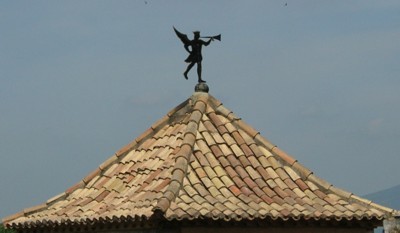
Little angel trumpeting over the city – the inspiring genius of this blog? Girona, Spain, July 06
Posted in Experiences, General | No Comments »
March 27th, 2007
A friend from California sent me the following text:
“Here is a good example of people using their spiritual heart and will and taking positive action where it is needed. The Salaam Shalom Educational Foundation has key programs underway with amazing leaders and participants dedicated to making a difference for Palestinian and Israeli children and their families. Indeed, their work touches all of our lives. Any work focusing on right human relations reverberates throughout the network.
I have met and gotten to know some of the founding and supportive members of this foundation. I have great respect and admiration for what they have accomplished in a short period of time, and the long range goals they are systematically working towards. They are truly inspired, and inspiring.”
In their newsletter they report about conflict resolution camps or programs for cultivating and selling Palestinian olive oil to help farmers.
On their website it says: “Peace isn’t something just to believe in, it is something to work for, and we are teaching children in the Middle East how to do it.”
Posted in Good Will | No Comments »
March 27th, 2007
After many years I yesterday wrote again a letter to the editor, to the Swiss NZZ. There was an article by U.J. Wenzel about “The more or less thinking hull – Is the internet the medium of unification?” The author wrote about Teilhard de Chardin’s “quixotic vision” of the noosphere – the total of a global sphere of human thought, with an evolution towards an ever greater integration, some kind of a supra-mental plane. (I was fascinated by Teilhard de Chardin’s thoughts during my study of philosophy some 30 years ago.)
Wenzel said that some “enthusiasts” see in their phantasies the internet with its covering of the earth as an expression of such a “collective consciousness” – while for him it is more like a filthy film of pornographic and violence glorifying pictures. Chats are full of gossip, blogs repeat thoughts of others, and the web spills over with copy-paste replicas… For him the trend goes towards plagiarizing the plagiarisms.
Isn’t the filth in the web just a reflection of the state of the mind, mainly of the masses? Like in society, there are many spheres, many different forms of expression.
From a spiritual point of view the evolution of consciousness is a very slow process, going on over eons. However, in the present time the speed of life has lead to an ever-increasing inter-linking in the world. The dangers of this development are countered by a tremendous upsurge of new initiatives and efforts. Especially the web, for example with its growing open-source communities, is part of this trend.
We are living in a dualistic, or more precise: multi-faceted world. Seeing meta-trends beyond the range of an intellectual mind however needs a broadenend awareness.
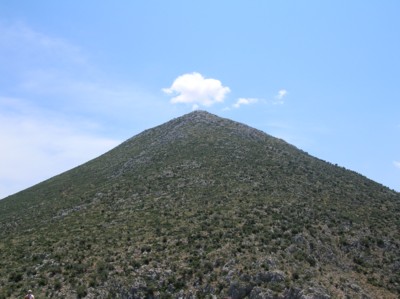
A long way up to higher evolution: Cloud over a mountain near Mykene, Greece
Posted in Science and Technology, Social | No Comments »
March 25th, 2007
Though I’m more interested in journeys into inner space than stories about visits from outer space (by the way, what is outer and what is inner?), I found this interesting:
The media reported that Geipan, the French UAP (unidentified aerospace phenomena) research and information group has opened its archives on March 22nd, after 30 years of collating sightings and field investigations. Geipan (Groupe d’études et d’information sur les phénomènes aérospatiaux non-identifiés) is a national agency belonging to the CNES – Centre national d’études spatiales.
Most of their observations are normal phenomena, like thunderbolds and clouds, but among the over 1 600 observed cases with about 6000 reports, there is quite a number (about 28%) which cannot be explained and remain enigmatical. Here is a French description of some cases.
In Paris, at the Cité des Sciences et de l’Industrie they have an exposition until July 07 – Alone in Space – From Fiction to Reality. At the entrance of the site there is an alien with whom you can make an intergalactic conversation, you can ask questions – a funny game.
Posted in Nature and Man, Science and Technology | No Comments »
March 25th, 2007
I yesterday read an interview (PDF) with Anne-Sophie Mutter, one of the world’s most celebrated violinists, in the Swiss newspaper “Der Bund“. Some of her statements caught my eye, for they reflect a deep spiritual attitude:
“I’m incredibly disciplined, but only when I feel like it. However, I feel nearly incessantly like doing music.”
Real discipline in music like in spiritual matters isn’t something imposed from outside, but an urge from inside.
(Speaking about her two Stradivaris:) “The sound is the combination of many things. The violins are strongly marked by the musicians who have played them. A violinist leaves part of his soul in the instrument. … The way of playing changes the violin, the violin with its past contributes to the formation of sound of the respective string player.”
In spirituality you come to know that psychic energies leave traces on the surroundings like deposits and charge the objects with certain qualities. So you can magnetise something for making it more suitable.
“Music is a divine gift. Composers are a gift of God to all of us, listeners and performers.”
“Very early I have understood that I can make a difference. I support many social projects. After all, this social vein has to do with the fact that I wanted to become musician in order to be able to improve and to change things on a small scale. … When I organise a charity concert together with friends and can support my girls’ project in Romania with 400 000 Euro, I walk home on wings and think, my life makes sense, because – besides having an incredible joy playing music – I’m able to help people who out of their own accord aren’t able to lift themsselves out of the quagmire.”
This is the real impulse of doing good-will work, for the benefit of others. You can do it, b e it on a big or on a small scale, provided that you have the right motive.
“The silence during the concert is what finally turns an evening into magic. The silence of together merging into the music. The greatest compliment of a listener to a musician is that he forgets everything around him – caughing, reading – he is simple totally captivated.”
At first sight this might seem strange that silence is creating the magic and not the music. But when you listen to music with rapt attention, your personality merges into the experience of music, lifting you out of your body consciousness. It is a deeply spiritual experience, which is cultivated through meditation. Also the musician can experience this silence during his play. “True musicians attune to the musical symphony of Nature through silence and reproduce the music. Such music remains – not obliterated by nature and time.” says K. Parvathi Kumar in his booklet “On Silence“.
Statue of a musician at the wall of the “Chinese Temple” in the garden of the Sanssouci Castle near Berlin.
Posted in Art, Culture and Beauty, Good Will | No Comments »



 Nasa
Nasa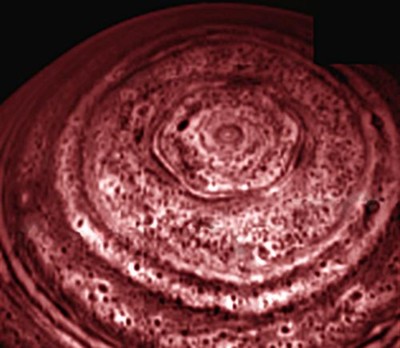 Nasa
Nasa