
erk admin

spacerCircle of Good Will - Blog

UNEP Campaign to Plant a Billion Trees

May 1st, 2007

I yesterday came across the wibsite of the United Nations Environment Programme (UNEP). Last November they have launched a worldwide “Plant for the Planet: Billion Tree Campaign“. People, communities, business and industry, civil society organizations and governments are encouraged to enter tree planting pledges online and help planting at least one billion trees worldwide during 2007.

plant_logo_english.gif

At the moment there are already 10,549,705 trees planted and pledges given for 810,485,520 trees. “We have but a short time to avert damaging and economically debilitating climate change. The goods and services provided by forests are worth billions if not trillions of dollars to the global economy. Forests are natural and economically important ‘sinks’, sequestrating carbon from the atmosphere and locking it away in trunks and branches. Globally, forest cover is at least one-third less than what it once was. It is time to reverse the trends, it is time to act” says Achim Steiner, UNEP executive director.

Al Gore writes in Earth in the Balance: “The symbolism – and the substantive significance – of planting a tree has universal power in every culture and every society on Earth, and it is a way for individual men, women and children to participate in creating solutions for the environmental crisis.”

Many nations and individuals have joined the initiative, also artists, and on the UNEP-website you find instructions how to plant trees or animation videos (wmv) and more material. They have also beautiful sayings on “Trees and Humanity“. Here are some:

“If you are thinking a year ahead, sow a seed.
If you are thinking ten years ahead, plant a tree.”
Chinese poet, 500 BC

“He who plants a tree loves others beside himself.”
English proverb

“They are beautiful in their peace; they are wise in their silence. They will stand after we are dust.
They teach us, and we tend them.”
Galeain ip Altiem MacDunelmor

“A society grows great when old men plant trees whose shade they know they shall never sit in.”
Greek proverb

“Even if I knew that tomorrow the world would go to pieces, I would still plant my apple tree.”
Martin Luther

“To me, nature is sacred; trees are my temples and forests are my cathedrals.”
Mikhail Gorbachev

“Trees are poems that Earth writes upon the sky. We fell them down and turn them into paper, that we may record our emptiness.”
Kahlil Gibran

“The forest is a peculiar organism of unlimited kindness and benevolence that makes no demands for its sustenance and extends generously the products of its life and activity; it affords protection to all beings.”
Buddhist Sutra

“If what I say resonates with you, it is merely because we are both branches on the same tree.”
W. B. Yeats
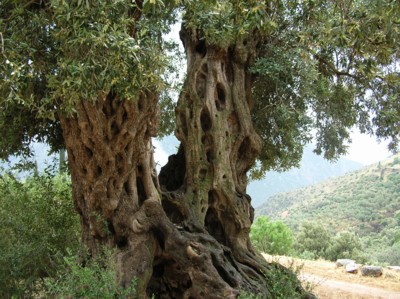
greece05_delphi_0731.jpg
Old Olive Tree in Delphi, Greece

“Woman” – Images and Verses

April 30th, 2007

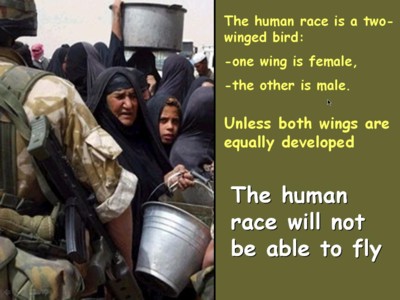
A friend from Belgium sent me today a beautiful powerpoint presentation entitled “Woman“, with colored images and verses of women, for women, and men, throughout the world. There is a quote of former UN president B. Boutros Ghali: “Now, more than ever, the cause of women is the cause of mankind.” Here you can see it as pdf, but without music.

I found it also on the website of WUNRN, Women’s UN Report Program & Network, an NGO dedicated to women’s rights. For a spiritual perspective ou might also like to read the Lunar Messenger on Woman and Man.

woman1.jpg

Chris Jordan: A Slow-Motion Apycalypse in Progress

April 28th, 2007

Chris Jordan was a successful lawyer in Seattle, USA. Then he decided to resign and work as a photographer. Today, he is a thriving artist with a great number of expositions. He and his wife made a deep transformation of their basis of life – the outcome is documented in most impressive photo series about the accumulated detritus of our consumption. Here are some excerpts from an interview, and also from his website:

“My spirit was dying inside, and I knew it, but I was afraid to make the leap into photography full-time because of the possibility of failing. The thing that finally got me going was a new kind of fear that crept up behind me over a period of several years: it was the fear of not living my life. This fear was motivating – it kind of pushed me forward.”

Today he is portraying American mass consumption: “The pervasiveness of our consumerism holds a seductive kind of mob mentality. Collectively we are committing a vast and unsustainable act of taking, but we each are anonymous and no one is in charge or accountable for the consequences. I fear that in this process we are doing irreparable harm to our planet and to our individual spirits.

As an American consumer myself, I am in no position to finger wag; but I do know that when we reflect on a difficult question in the absence of an answer, our attention can turn inward, and in that space may exist the possibility of some evolution of thought or action. So my hope is that these photographs can serve as portals to a kind of cultural self-inquiry. It may not be the most comfortable terrain, but I have heard it said that in risking self-awareness, at least we know that we are awake.”

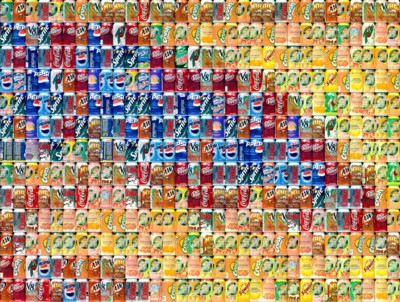
“This new series looks at contemporary American culture through the austere lens of statistics. Each image portrays a specific quantity of something: fifteen million sheets of office paper (five minutes of paper use); 106,000 aluminum cans (thirty seconds of can consumption) and so on. My hope is that images representing these quantities might have a different effect than the raw numbers alone, such as we find daily in articles and books.”

“As with any large artwork, their scale carries a vital part of their substance which is lost in these little web images. Hopefully the JPEGs displayed here might be enough to arouse your curiosity to attend an exhibition, or to arrange one if you are in a position to do so.”

His photo series carry titles like: “Intolerable Beauty: Portraits of American Mass Consumption” – “In Katrina’s Wake: Portraits of Loss from an Unnatural Disaster” – “Running the Numbers – An American Self-Portrait”. The pictures are showing “a slow-motion apocalypse in progress”. Have a look at the website of Chris Jordan. His pictures are now also exhibited at the Q2 Gallery in Second Life.

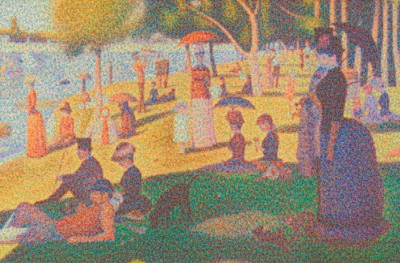
Cans Seurat, 2007
Depicts 106,000 aluminum cans, the number used in the US every thirty seconds: cansseurat1.jpg

Partial zoom:
cansseurat2.jpg

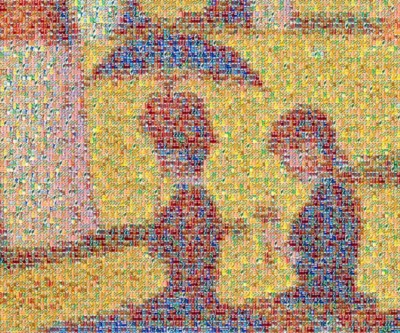
Detail at actual size:
cansseurat3.jpg

Thanks, Chris, for the permission of reproduction.

Greening the Desert

April 28th, 2007

I just came across a fascinating YouTube-video on the permaculture project “Greening the Desert” (you can also see the video in a better quality from here). In this story, Geoff Lawton talks about re-greening the deserts of Jordan. By applying the principles of permaculture, the Jordanians managed to salvage a heavily salted environment and turn it into a green oasis. Geoff Lawton lives and teaches permaculture at his farm near The Channon, a small community in Australia.

permaculture.jpg

See also our blogpost “From Wasteland to Paradise“.

Couch Surfing

April 26th, 2007

There are innumerable ways of bringing good will into daily life. One interesting initiative is “Couch Surfing“, an online community that has started 1999 in Montreal and now has over 200.000 members in over 215 countries. They are trying to network people who like traveling with others who offer on a free basis a city tour, a common meal or even a possibility to stay over night (“Couch Surfing”). They say about their work:

“CouchSurfing seeks to internationally network people and places, create educational exchanges, raise collective consciousness, spread tolerance and facilitate cultural understanding.

As a community we strive to do our individual and collective parts to create world a better place, and we believe that the surfing of couches is a mean to accomplish this goal.

CouchSurfing is not about the furniture, not just about finding free accommodations around the world; it’s about making connections worldwide. We make the world a better place by opening our homes, our hearts, and our lives. We open our minds and welcome the knowledge that cultural exchange makes available. We create deep and meaningful connections that cross oceans, continents and cultures. CouchSurfing wants to change not only the way we travel, but how we relate to the world!”

Another way of couch surfing:
couch.JPG

A Celestial Jewel

April 25th, 2007

A friend sent me the photo of a beautiful celestial object in form of a red square, from the site World Science. They write: “The im­age was com­piled with da­ta in in­fra­red light from the Cal­i­for­nia In­sti­tute of Tech­nol­o­gy’s Hale Tel­e­scope at Pal­o­mar Ob­serv­a­to­ry, and the Keck-2 Tel­e­scope atop Mauna Kea, Ha­waii. A star at the cen­ter, named MWC 922, is spil­ling out twin cones of out­flow­ing winds and may be about to ex­plode as a su­per­no­va, re­search­ers say.”

Such pictures inspire awe in view of the sublime nature of cosmic expressions.

redsquare.jpg
(Image cour­te­sy Pe­ter Tut­hill, Pal­o­mar/Keck)

Nordic Links with the Ancient Mythology and Language

April 24th, 2007

A friend from Sweden sent me the following lines as a comment to the blogpost “Finding our Common Origin – Sanskrit and Kikongo Wisdom Teachings“:

“Also here in the North we have strong links with the ancient mythology and language. Madame Blavatsky writes in the Secret Doctrine that the Norse mythology is older than the Vedas, and that Egypt was colonised by emigrants from India. The Nile (“the Blue”) got its name from a river in India, just as today we find York in England and New York in the USA.

Some few examples: Not far from there I live here in Sweden there are some mountains with a unique geology, not found anywhere else, with intriguing names like “Omberg” (OM), “Hunneberg” (Dogmountain), “Halleberg” (Halla is an abode of a god as in Shambhala/Shamballa), and “Kinnekulle” there “Ki” is pronunced as Chi or Qi (life force). There is also “the quiet (or serene) mountain” – Lugnås. Berg/ås/kulle all mean mountain. We also have a holy cow named “Audhumbla”, which is the Vedic “Vach” and the Egyptian “Hathor”.

Karl means man, or great man. The Great Bear is called Karlavagnen, or the wagon of Karl. The worldtree is Ask which in English is Ash, and may have been Ash in ancient Swedish. Maybe to farfetched, but Kailash may be related.

In the end of time, the world will disappear and with that evil creatures, and a new more beautiful world will appear. The highest god Odin, who is one-eyed, will then also disappear and his son Balder will be the new highest god, just as Sanat Kumara, “the old man”, will stay with us until the end of time. The two Ravens which inform Odin about the world are called Hugin and Munin.

But also the new world will disappear, and yet another is to follow, and so on.

A legend here says that you can be teleported between Kinnekulle and Omberg. Monks at a monastery located at Omberg watched an area at Kinnekulle for centuries, and did not let in visitors. They were said to go forth and back by teleportation (some twenty or thirty kilometers, I think). This area was closed until recently. I visited it with a friend, but no teleportation occurred 🙂

The Nordic mythology has a preference over the mythologies of the rest of Europe as it is not mixed up with a lot of different influences, as e.g. Hellenistic and Egyptian mythologies.

The symbols and the legends move with us. There is an old temple for Isis worship in England, and the vikings frequently went to the English islands. May there have been a movement from the North to the East to the West, and the circle symbolically closed there, in that English Isis temple? And from Egypt other circles have appeared, towards the American continents and deep down into Africa. Today we can unwind our own past footsteps through easy global communication over the internet.”

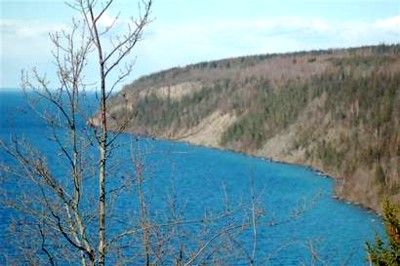
omberg.jpg
Omberg and the lake Vättern, Sweden

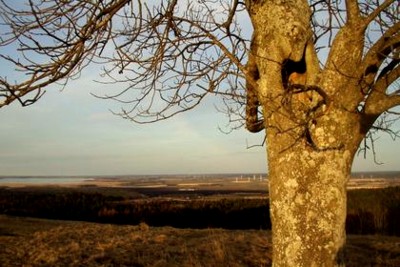
omberg2.jpg
A view from the Omberg

Transmutation to Brilliancy (3)

April 23rd, 2007

Our friend, a healing practitioner, whom we visited last weekend, has been involved with Qi-Gong since 1990 with Master Zhi Chang-Li. He had come to Europe in 1988 in order to spread here the teaching of Qi-Gong. Our friend told us that in the beginning of his teachings the Master still was hesitating a lot what to give out to the people seeking instructions and what not. For in the traditional teaching a teacher formed just one student, who had to undergo a very severe and long training. It is not possible to impart the teachings through mere teaching, but through intense integration into life. Master Li had been in a process of learning since his early youth, also during the times of the cultural revolution, when all spiritual tradition were violently suppressed in China.

One little story our friend told from Master Li was about how students were tested that they were mastering the life-giving energy Chi: They were brought to the snowy mountains and clad in wet towels to stay out there over night. Next morning the teacher was looking, not only if the student was having warm, but also how much snow around him he could get melted through the heat he had created in his inner…

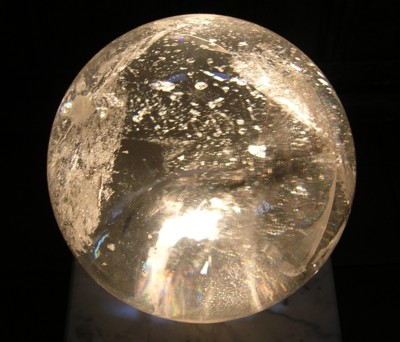
I don’t want to retell here the stories about the life of Master Li our friend reported to us. What impressed me most was that through incredible hardships and strict training a process of deep transformation took place. Thus the wisdom slowly shone forth and found a living expression. It is like with carbon dusk being transformed under extreme pressure to a diamond. Chemically carbon and diamond have the same substance, but only through transmutation the brilliance is gained.

kugel.JPG

Little Events of Teaching Practical Wisdom (2)

April 23rd, 2007

Over two decades ago my friend had invited Master EK to his house in Munich to give lectures to interested persons. He was deeply touched by the freshness and naturalness with which the master was expressing spirituality in all aspects of life.

Once they were walking through some shoppings streets in the centre of Munich, when a derelict person came along, obviously being under the influence of alcool. Someone of the people accompanying the master expressed his disgust about the dosser, but the master simply replied: “He is God, too.”

* * * * * * *

My friend had a beautiful old Art Nouveau villa in Munich, where the seminars with Master EK were going on. A lady remarked to the master: “Such a big house, just for one person.” The master only replied: “He is sharing it with others.”

* * * * * * *

In the assembly hall where the lectures were taking place everybody was chitchatting or preparing something, so that nobody noticed the master entering the room. He went to his place and starting intonating the mantram with which he used to begin his lectures. Everybody rushed to their places. The master started his lesson speaking about discipline.

My friend said the master was absolutely right reminding the people of getting into attention, but he might have felt that he was strict in his words. For in the evening, in a small round, the master was joking and playing magical tricks, as if he wanted to express: Look, everything has its time, there is not just only discipline, and I’m not a rigid fellow.

* * * * * * *

The master was fond of cooking, and he loved preparing delicious meals for the whole group. He was doing it full of joy. In this he was throwing away some vegetables which weren’t totally fresh any longer. Someone mentioned that he is wasting the materials. He remarked it, continued his work, but the joyful expression was away. He didn’t say anything, but it was as if he wanted to express that criticising is like tossing away joy.

* * * * * * *

My friend had planned to organise more seminars with Master EK near Munich on specific topics, but the master surprisingly passed over in March 84, so that all further plans had to be cancelled. The work, however, went on a few years later with Master KPK, whom Master EK had prepared for continuing his impulse.

eklingam.JPG
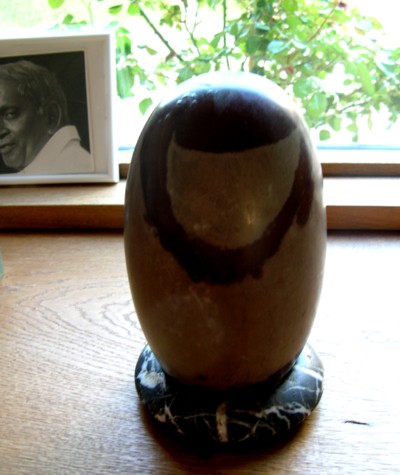
Lingam stone with a picture of Master EK

A friend from Argentina translated this blog-post into Spanish (PDF).

Talks and Crystals (1)

April 23rd, 2007

Last weekend my wife and I were visiting friends who live in a small village in Alsace, France, at the feet of the Vosges Mountains. She is a healing practitioner, he is a psychologist, and both are since long years on the spiritual path. He is dealing with crystals as a hobby.

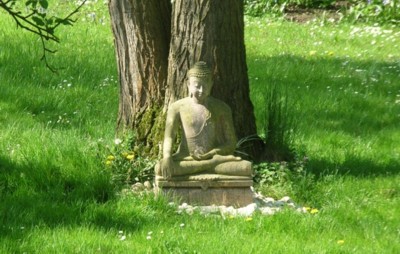
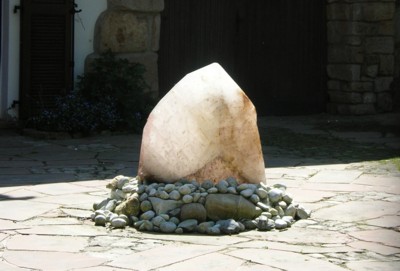
Entering the courtyard of the old, but beautifully renovated farmhouse you see a big quartz crystal standing in the centre, and another, huge amethyst is lying a bit aside and radiating its violet light in the sun. A haven of peace, where in the garden a Buddha statue is meditating under an old tree.

buddha2.JPG

We had some inspiring talks, and both were telling a few stories of encounters with their spiritual teachers. I’d like to give some of these in the following 2 blog-posts.

I wondered how my friend gets these beautiful crystals – and there were quite many more inside. He told me that in the course of the years he has created contacts with different mines and crystal dealers world-wide. They have visited several mines in North and South America and have travelled through India, from where they have exquisite statues and lingams (oval-shaped stones used for rituals worshipping the creative force of the universe).

When somebody wants to buy a special crystal of a certain size, he rings up his contact persons and they send him photographs of crystals at disposal. Then they get shipped over to Europe.

Each crystal radiates a special quality. These transparent stones represent the advanced states of man’s consciousness: When he has gone through processes of inner purification, he starts reflecting the light of the inner sun. Maybe that’s the reason why we are so much fascinated by these gifts of nature.

kristall.JPG