erk admin

spacerCircle of Good Will - Blog

No Right to Suicide

May 12th, 2007

A friend wrote me that she just experienced a shock, because a close family member had tried to commit suicide. Normally a suicide or an attempt is a cry deep from the soul, which is not finding the right way through life, not knowing how to find a good solution to face the tasks it has been committed to solve in this life.

From a spiritual point of view, there is the knowledge, and sometimes also the experience, that we as inner beings are immortal, and death does not exist, only for the body. So there is no end to our work, even if we commit suicide. It is important to understand that when someone commits suicide, he doesn’t solve the problem, but will be confronted with more problems in the future – the present ones and the problem of having gone away too early.

Inner research says that those who commit suicide land for a while in a state of a clouded consciousness, which is very incomfortable. Later on they have to face all the consequences of their doing. For life does not belong to us, we belong to Life. It is not our decision to enter into life, nor is it up to us to decide when the time for passing comes. Transgressing the rules of the “play” has its consequences.

You might like to read the text from Good Will in Action on Dying and Deathlessness.

fire.jpg
A painting from a Swedish friend

Focussing Attention in the Media and in Meditation

May 12th, 2007

Two days ago I got the newsletter of Alertnet, a humanitarian news network of Reuters Foundation. Alertnet is aiming at keeping relief professionals and the wider public up-to-date on humanitarian crises around the globe. In the newsletter there was a link to the World Press Tracker, that shows which emergencies the media limelight grabs and which are “forgotten” by the press:

emergencies.jpg
(c) Alertnet

You can select different conflicts and time sections and see how much these areas are captures by the media, like Iraq or Afghan turmoil, Israeli-Palestinian conflict, Lebanon crisis, AIDS pandemic, Bird flu, Somalia troubles, Kashmir dispute, Sri Lanka conflict, Darfur conflict … Out of a database of 10 000 media sources they have selected 108 English-language print publications from Europe North and Latin America Africa the Middle East and Asia. So it is a selective view, but nevertheless an impressive synthesis.

Grabbing the attention of the media is important for the flow of money and often decides on whether or not people react on a crisis. There is quite a business around the craving for attention. And the media are mirrors, instrumental for attracting and directing the attention.

Attention and focus are most essential for directing the focus of our life. Easily we get side-tracked from our genuine purpose by distractive influences. Ads, main-stream opinion, belief systems, only to mention a few. But the most important is one’s own mind. In any meditative practice it is most vital to learn focusing ones energies of attention, expressed through our thoughts. The power of habit is very strong, but with a regular training and attention to your motives you will grow in inner awareness.

eye.jpg
Picture of the “eye of divine attention”, from a fountain in Berne, which formerly was the facade of a house.

A Child Appealing to the UN to Save the Future

May 8th, 2007

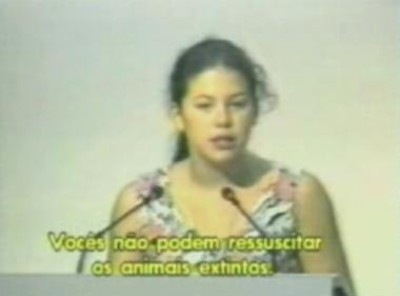
I just got a from a Californian friend a link to a fascinating videotape with Portuguese subtitles of a child eloquently appealing to adults, delegates of the United Nations Environmental Conference to act upon what we teach children in kindergarten: to share, to clean up our mess, to care about others. My friend wrote:

“Three 12/13 year old children have dared to form an environmental children’s organization to be the change they hope to see in the world. Looking into children’s eyes and seeing 7 generations hence we can re-examine our values today, and change our habits. As Marshall Rosenberg observed, things we do habitually are not necessarily natural. We sometimes assume that and confuse the two.”

child.jpg

“Losing my future is not like losing an election or a few points on the stock market.”

The White Lotus

May 8th, 2007

Today, 8th May, is not only the annual World Red Cross Red Crescent Day (the birthday of Henry Dunant, the founder of the Red Cross, this year’s motto: “Together for Humanity”), but also a more silent commemoration day, the White Lotus Day, the day of the passing of Helena P. Blavatsky (HPB) on May 8, 1891.

One year ago, I wrote already a blogpost about it, mentioning the little booklet I published two years ago: “H.P.B. – Trailblazer for the Aquarian Age” (free download). There is also an inspiring talk by K. Parvathi Kumar on The White Lotus.

The Lotus symbolises the life of man and also that of the Kosmos. The symbol stands for the principle of unfoldment and it is recommended for meditation. If you follow the right steps, the inner energy centres called chakras (: wheels) transform into lotuses. You might read more about it in the Lunar Messenger on Chakras and Lotuses.

white_lotus.jpg
Cover of the book The White Lotus, by K. Parvathi Kumar

HPB has let quite an impact in my life. In the 80ies I was fascinated over several years by the title of her opus magnus, The Secret Doctrine, without buying it. When I finally got it (5 volumes, nothing for casual reading), I had a dive through it, without understanding much. In the 90ies I studied the volumes for a second, and in the last years for the third time. (now in English). I like reading a little passage every morning after meditation, its great panorama of life opens up the view, before entering into the daily hustle and bustle. One sentence from this morning’s reading, Vol. I, Cosmogenesis, p. 56:

“No man is conscious of more than that portion of his knowledge that happens to have been recalled to his mind at any particular time, yet such is the poverty of languages that we have no term to distinguish the knowledge not actively thought of, from knowledge we are unable to recall to memory. To forget is synonymous with not to remember. How much greater must be the difficulty of finding terms to describe, and to distinguish between, abstract metaphysical facts or differences?”

hpb.jpg
Helena P. Blavastky (1831.1891)

Mental Divisions and Barriers

May 7th, 2007

Yesterday we were reconnoitering a spot for the Pentecost scouts’ camp of our son. They got the o.k. from a farmer to do the camp on a beautiful place called Angel’s meadow, in a forest on a hill. Since they wanted to place the kitchen tent in the forest to protect it from bad weather, they had asked the local authority to whom the forest belongs. The map showed stripes of about 10-15 m width going through the forest, and each stripe belongs to another owner. The owner of the nearest stripe refused the kitchen tent, the second allowed it. Now we had to see where there was a convenient spot. In the thick forest you just discover here and there a plug – and finally, wet from the rain, we located a spot for the tent. You think you are in nature, but is is full of mentally fixed divisions.

The same theme in a different setting:

When I was yesterday deleting old e-mails, I re-found a link about a website on Indo-European languages, which an Indian friend had sent me some months ago (fascinating how this big language group of several hundred languages has similar roots – the wisdom teachings trace the origins far more back than contemporary science).

The author of the site is a 25 year old American lady, Jennifer, who is an English Language Assistant near Annecy, France. In her blog she mentioned that she was just about to leave, because she was jobless at the moment, wasn’t allowed to work, since she didn’t have the permission, and that (yesterday) she would return back to the States. Permissions fix barriers, something so common, that we don’t even think about it and take these mental conceptions for natural.

I dropped her a note in a post. I was astonished about the parallels between her situation and that of a friend in the US. Her situation is reversed to that of Jennifer, and she also left a comment in Jennifers blog. She is studying Linguistics and Creative Writing and working as an assistant at the University of St. Cloud (and she had been helping for a while translating the Lunar Messenger). She might have to leave the US because of having just a student permission. Again mentally fixed barriers of the legal regulations.

There is so much regulation in every part of life that you forget that life as a whole is a unity, that our concrete mind is crystalising and segmenting. On the spiritual path you learn to come out of this fragmentation and at the same time live in it and learn to handle it in an intelligent way, changing thus ways of behaving.

books.JPG
The concrete mind – a storehouse of knowledge, of analysing and dividing

Teasing the Stronger Ones

May 5th, 2007

A friend sent me a video yesterday of a monkey teasing two little tiger cubs. The video is posted on several platforms, here you find one. It is named “Monkey with a death wish”, but somehow the monkey seems to be clearly calculating the risk and balancing it against the fun of winning. For each time the monkey somehow succeeds in cheekily escaping the tigers – cleverness gains over power. Enjoy.

ape.jpg

Beltane – Midpoint of Spring

May 5th, 2007

Today is Beltane day, the astronomical midpoint between the vernal equinox and the summer solstice.

beltane.jpg

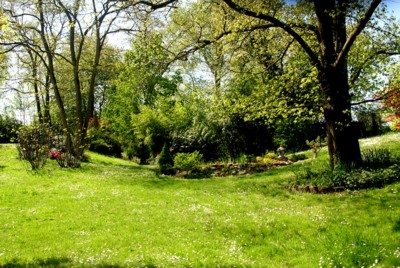
The astronomical date for this point can vary from year to year. Beltane was celebrated by the Celts around the 1st of May or the nearest full moon. It is the time of fertility, when nature displays its full beauty of spring to bring about new life.

You find more information about the annual rhythms on the website of Archaeoastronomy, where they have a countdown of the annual equinoxes, solstices and cross-quarters.

You might read in the Letters on Spiritual Astrology on Taurus about the Radiance of Beauty: “The beauty of the flower lies in the totality, not in a part of it. Beauty is caught nowhere in the form, but reflects through it.”

spring.JPG

Good Will Networking and Perseverance

May 4th, 2007

In the last weeks I had been working on compiling the elements for the Annual Report of the World Teacher Trust (WTT). Groups and individuals from different countries of the West, which feel related with this movement, have sent reports, about group livings (seminars) and about their good-will activities in different fields of social service activities as well as their spiritual work. The report is mostly in English, some contributions also in the local languages of the groups.

I have been doing the co-ordination and editing now since five years. Though it is quite some work, I like it. It is very inspiring to see the manifold good-will initiatives. In the course of the years several substantial activities have arisen out of the spiritual impulse of the WTT and our teacher, Dr. K. P. Kumar.

What fascinates me with this movement is that the focus on practice arises out of a deep spiritual impulse, and in general there is a hearty relation in the network of people. For me the annual report is an occasion to keep in contact with a number of persons. So it is a good networking instrument. It will be circulated to the groups and interested individuals in the course of May, but not in public. People committed to good work in silence don’t want their names to go out.

The report also makes me think of how difficult it is for many to establish a good balance between the different fields of life: Professional work for maintaining the living, family life, social contacts to keep good exchanges, then, for those who walk the spiritual path, maintaining a regular rhythm of inner work, plus some kind of a service activity. The report is for me a good testimony how people grow when they work with these essentials.

I come across others who lose themselves in fancies, in books and in imagining about sublime topics. Interested in many things they fail to focus on the essential and to go into depth. Respecting the basics is most important to gain a stable foundation. And building the foundation often takes years of perseverance.

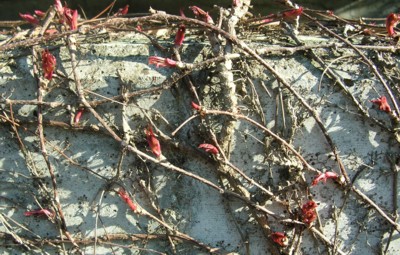
wall.jpg
The network of sprouting life

UNEP Campaign to Plant a Billion Trees

May 1st, 2007

I yesterday came across the wibsite of the United Nations Environment Programme (UNEP). Last November they have launched a worldwide “Plant for the Planet: Billion Tree Campaign“. People, communities, business and industry, civil society organizations and governments are encouraged to enter tree planting pledges online and help planting at least one billion trees worldwide during 2007.

plant_logo_english.gif

At the moment there are already 10,549,705 trees planted and pledges given for 810,485,520 trees. “We have but a short time to avert damaging and economically debilitating climate change. The goods and services provided by forests are worth billions if not trillions of dollars to the global economy. Forests are natural and economically important ‘sinks’, sequestrating carbon from the atmosphere and locking it away in trunks and branches. Globally, forest cover is at least one-third less than what it once was. It is time to reverse the trends, it is time to act” says Achim Steiner, UNEP executive director.

Al Gore writes in Earth in the Balance: “The symbolism – and the substantive significance – of planting a tree has universal power in every culture and every society on Earth, and it is a way for individual men, women and children to participate in creating solutions for the environmental crisis.”

Many nations and individuals have joined the initiative, also artists, and on the UNEP-website you find instructions how to plant trees or animation videos (wmv) and more material. They have also beautiful sayings on “Trees and Humanity“. Here are some:

“If you are thinking a year ahead, sow a seed.
If you are thinking ten years ahead, plant a tree.”
Chinese poet, 500 BC

“He who plants a tree loves others beside himself.”
English proverb

“They are beautiful in their peace; they are wise in their silence. They will stand after we are dust.
They teach us, and we tend them.”
Galeain ip Altiem MacDunelmor

“A society grows great when old men plant trees whose shade they know they shall never sit in.”
Greek proverb

“Even if I knew that tomorrow the world would go to pieces, I would still plant my apple tree.”
Martin Luther

“To me, nature is sacred; trees are my temples and forests are my cathedrals.”
Mikhail Gorbachev

“Trees are poems that Earth writes upon the sky. We fell them down and turn them into paper, that we may record our emptiness.”
Kahlil Gibran

“The forest is a peculiar organism of unlimited kindness and benevolence that makes no demands for its sustenance and extends generously the products of its life and activity; it affords protection to all beings.”
Buddhist Sutra

“If what I say resonates with you, it is merely because we are both branches on the same tree.”
W. B. Yeats

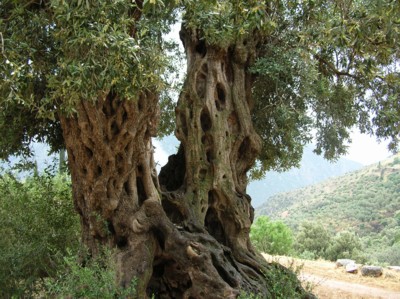
greece05_delphi_0731.jpg
Old Olive Tree in Delphi, Greece
“Woman” – Images and Verses

April 30th, 2007

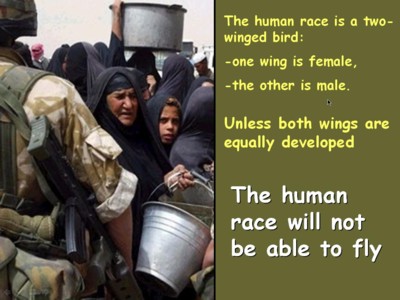
A friend from Belgium sent me today a beautiful powerpoint presentation entitled “Woman“, with colored images and verses of women, for women, and men, throughout the world. There is a quote of former UN president B. Boutros Ghali: “Now, more than ever, the cause of women is the cause of mankind.” Here you can see it as pdf, but without music.

I found it also on the website of WUNRN, Women’s UN Report Program & Network, an NGO dedicated to women’s rights. For a spiritual perspective ou might also like to read the Lunar Messenger on Woman and Man.

woman1.jpg