
erk admin

spacerCircle of Good Will - Blog

Rhythm – A Red Rag?

April 26th, 2008

Yesterday evening we had another of our public evening themes meeting on Basics of Spiritual Life. Already beforehand some friends told us that this evening they won’t have time. So just a few stalwarts came. There was an elderly, distinguished Dutchman, whose curiosity had been attracted by the announcement in the newspaper. He asked some questions and followed with attention.

The topic of my talk was “Routine, Rhythm, Ritual” – you can find the English powerpoint presentation here, or if you prefer a PDF without animation, it’s here.

Rhythm is a red rag for some. A friend first said to my wife, she wouldn’t come, for she didn’t want to get a headache hearing about rhythm and feeling that she doesn’t get into it. She nevertheless came. Afterwards she said she was happy that she changed her mind, for the topic was quite different from what she expected, and she felt inspired.

Indeed, sticking to a self-chosen rhythm isn’t easy for many. Most people don’t organize well their day-to-day lives, they let themselves guide by the outside. The outer life generates so many programs for engagements which drive us away from the inner life.

However, rhythmical living gives you energy, and rhythm in spiritual exercises causes inner transformation.

When we try to take up a new rhythm, we much more often fail than succeed, because the power of the old rhythm opposes us. The ability to follow our own decisions is frequently tested. That’s very normal, and there is no reason to be worried about it. The impulse for change comes from the inner, without an outer compulsion. Nobody can do the rhythm for you.


A violet flower expressing the 7th ray of order, rhythm and ritual. Photo taken in the botanical garden of the Elfenau, 2008.

Cosmic Collisions

April 25th, 2008

Yesterday 59 new images of colliding galaxies taken by the NASA/ESA Hubble Space Telescope have been published to mark the 18th anniversary of the telescope’s launch. They have also published a special site with the pictures and other information.

“This is the largest collection of Hubble images ever released to the public simultaneously” it says on the European homepage of the Hubble Information Centre.

“Interacting galaxies are found throughout the Universe, sometimes as dramatic collisions that trigger bursts of star formation, on other occasions as stealthy mergers that result in new galaxies…. Our own Milky Way contains the debris of the many smaller galaxies it has encountered and devoured in the past, and it is currently absorbing the Sagittarius dwarf elliptical galaxy.”

You can download the images of the cosmic collisions, and also see them in a beautiful video.

So the next time you are flying through the galaxies, pay attention not to get involved in a galaxy crash!


Credit: NASA, ESA, the Hubble Heritage Team (Click on picture to enlarge)

LOHAS – Getting Waterproof Towards Advertising

April 23rd, 2008

This week I read in the Swiss magazine “MK – Marketing und Kommunikation” an article about “LOHAS continue to be on the rise”. I never heard about LOHAS, a marketing target group, before. Wikipedia describes it as “an acronym for Lifestyles of Health and Sustainability that refers to a demographic defining a particular market segment related to sustainable living, “green” ecological initiatives, and generally composed of a relatively upscale and well-educated population segment.” Another variety is LOVOS, “an acronym for Lifestyles of Voluntary Simplicity which are oriented to health and sustainability, and are critical of consumption and consumerism.”

Oh, I thought, now they have a scheme into which they can put me in their profiling. For I discover elements of LOHAS lifestyle as well as LOVOS. The MK article describes the LOHAS that they are very web-affine, have priorities in environmental questions, social responsibility and awareness. Trustworthiness is very important to them and they don’t easily believe what marketeers say, but orient more with the opinion of family and friends. When they are convinced, they stay with a product, and with an enterprise that sells it. If the enterprise, however, behaves irresponsible, they won’t buy it. And the percentage of LOHAS is increasing.

The article started with the lines: “Change of values. The central task of marketing lies in defining, creating, conveying and transmitting values. What happens, however, when the values in the society change and new lifestyles are forming?” Poor marketeers, hurry up to orient towards deeper values. It seems their claiming of “defining, creating, conveying and transmitting values” is an empty effort, when the society doesn’t behave the way they would like it to have, and the marketeers are running behind.

Hopefully people will come to the point of orienting more towards the real needs and not get caught by the desires foamed by marketing strategies, like it is still often the case. May they get more and more waterproof towards the temptations of the guild of market criers.


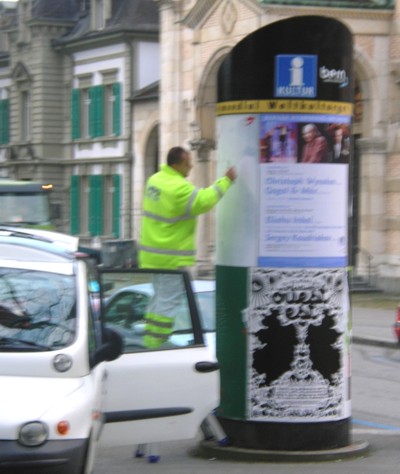
Putting posters on an advertising pillar

How Much Food We Need to Still Our Hunger

April 23rd, 2008

Today I got an e-mail from a Canadian friends with pictures about what people eat during a week’s time in different countries of the world and how much money they spend.

I googled it and found that the pictures are from a photo gallery from time.com: “What the World Eats – What’s on family dinner tables in 15 different homes around the Globe?” The photos are from the book “Hungry Planet” by Peter Menzel. It’s worthwhile having a look at it! They show us a mirror image of our lifestyle and the global imbalances.

Though the photos can be found on many blogs, the author writes they are copyright protected, and so I don’t produce them here. The photo below is from an Indian friend.

Taking to Engagement

April 20th, 2008

Last week I saw an article in the latest number of a German web-marketing journal about measuring user engagement on websites. The question which occupies the marketeers is: How to get people into an engagement, for example on a website, and start to do something.

The marketing specialist agree that it is most important to incite engagement, but it seems to be quite difficult to measure it: If you can quantify engagement, then you can put a price tag on it and benchmark the reactions you get, invest in raising the level of engagement and the like.

A comment in a blogpost by “Scobleizer” (Robert Scoble, the ex-Microsoft “evangelist”) from 2006 entitled: New audience metrics needed: Engagement, lists, what engagement is about and what might be measured:

1. Reactions (they heard you)
2. Learning (they understood and retained)
3. Transfer (they took in the information and can apply)
4. Results (they use the learning to achieve a goal)

There is a lot of discussion about this topic on the web, but these simple lines very well hit the point of engagement, also in the context of wisdom teachings – though measuring is more than strange in this context: Many people hear something about the inner path (point 1), some get interested and start reading about it (point 2), and this for a longer time.

A few of these transfer it into a practice (point 3) and start training themselves. Of these few again a small group really commits itself to continuous engagement, taking up a regular schedule, combined with some kind of service activities and diving into a deeper understanding of the teachings with studies.

Many quit their initial engagement half way through or get lost in some side-track or the other. In the Eastern scriptures it says, out of 1000 one person changes from one level to the other – from hearing to getting interested, to starting practice, to getting into engagement. So it is 1000 x 1000 x 1000.

The percentage of those who set upon a focused spiritual journey along the guiding lines seems to be very low (marketeers would be very much frustrated…), and hopefully it scores a bit higher. But it also says that the goal of a spiritual teacher is reached, when he finds a fistful who really apply and reach the goal and take up the torch of teaching themselves.

Have a look at “Basics of Spiritual Life” on “The Teacher-Student Principle“.


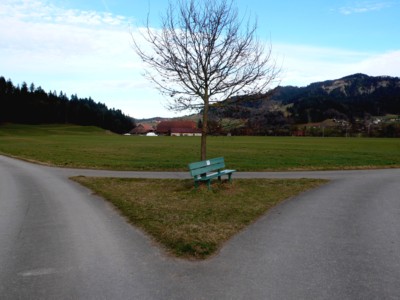
Which way to take with engagement – turn to commitment, or pass on, or stay undetermined?

CharityFocus – An Innovative Volunteer Initiative

April 19th, 2008

Through a link on the Kalliopeia site I found CharityFocus.org, an innovative volunteer initiative:

“CharityFocus is an experiment in the joy of giving. Our services enable inspired people to contribute in meaningful ways to the world around them. Together, we hope to ‘be the change we wish to see in the world’.”

The organisation is fully volunteer-run. they aim to “act in concert to create service opportunities for each other and to support each other’s service journeys.”

They have some very interesting service approaches:

  • They provide technical help for small nonprofit organizations (NPOs) to develop a web-presence.
  • They inspire people to create inspiring content, such as writing success stories of nonprofit organisations, creating videos about something uplifting, providing photos for good stories, writing songs or realising some kind of art to make the world a better place.
  • They motivate people to do acts of kindness or make somebody smile (they have created Smile Cards…)
  • They guide people to set up local event activities, either alone or in partnership with other NPOs.

In order to help other service related NPOs to realise websites themselves, they have developed CFSites, an instrument to help the nonprofits to get on the web more quickly.

They have collectively designed hundreds of free websites for nonprofits and allowed some thousand sites to be created with their CFSites tool.

The CharityFocus project clearly shows that intelligent service is more than just a good intention, but requires skills and group work. Then you do efficient good will work with an attitude of professional quality, with a dedicated focus.

The Humming Sound of the Earth

April 18th, 2008

A friend sent me a link to an article on Live Science called: “Earth’s Hum Sounds More Mysterious Than Ever“, by Charles Q. Choi. He writes:

“Earth gives off a relentless hum of countless notes completely imperceptible to the human ear, like a giant, exceptionally quiet symphony, but the origin of this sound remains a mystery. Now unexpected powerful tunes have been discovered in this hum. These new findings could shed light on the source of this enigma.

The planet emanates a constant rumble far below the limits of human hearing, even when the ground isn’t shaking from an earthquake. … Now oscillations have been discovered making up the hum that, oddly, are shaped roughly like rings. Imagine, if you will, rumbles that twist in circles in rock across the upper echelons of the planet, almost like dozens of lazy hurricanes.”

In the Eastern scriptures the humming sound of creation is called OM, which causes all creation to happen. Intonating this sound in the right way transforms the matter of our body and makes it more receptible to the light of the soul. The OM we sing is an utterance of the underlying continuum of the vibration of existence. This is also called the soundless sound or the Voice of Silence. Have a look at the Lunar Messenger on “The Power of OM“.


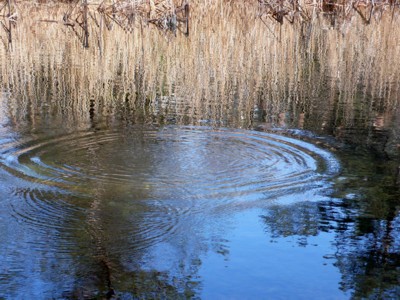
Rings on the waters of a pond. Photo from last Sunday’s excursion

The Battle of Reputation and Discrimination

April 18th, 2008

I read today an article about a meeting of German newspaper publishers on April 16, where they spoke about the interaction between print and web. Norbert Bolz, professor of the TU Berlin said to the publishers that the battle going on in the internet is the battle of reputation: People are confronted with a tremendous amount of information which they cannot assimilate, and the newspapers help them to orient: “They decide what is important and unimportant. Nothing is more important in the 21st century than discrimination.”

What gives the guideline of discrimination? Who decides about what is important and what can be left away?

The situation is the same on the spiritual path: there is so much information around, that people get irritated by this and easily get lost in sideways. Some therefore prefer staying in belief systems they somehow have outgrown, like those of the mainstream churches.

Orientation by reputation might be helpful, if the authorities are farsighted and knowledgeable. Otherwise it is dangerous – the blind following the blind man.

Who are the authorities, what determines the right kind of reputation and who is creating it? In the case of orientation on the path into the subtle worlds the mainstream is of no avail, for they blind out the inner dimension of reality. The media as such seem to be ignorant of the signposts to the path of light. The same is true with the academic persons. They cultivate the intellect, but not the heart, the doorway to the higher worlds.

Discrimination is a quality of the soul, of the Buddhic plane of light. He who is centred in the soul knows how to discriminate, and more so if you have learned it from an enlightened teacher. In India there is a saying that the one who has found a wise teacher who has realised what he is teaching is really blessed.

You might want to have a look at our powerpoint presentation The Importance of a Teacher on the Path, from the series on Meditation – Experiment and Experience. It is also available as a PDF file, though not animated. There is also the number from Basics of Spiritual Life on “The Teacher-Student Principle“.


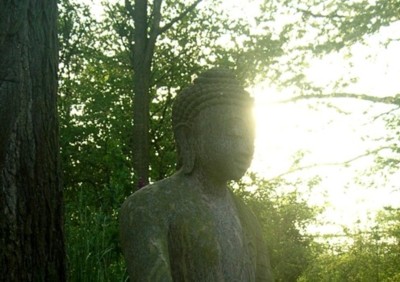
Picture of a Buddha statue at sunset. I took it last year in the garden of the friend.

Kalliopeia or Supporting the Oneness of Life

April 13th, 2008

Some days ago I came across the website of the Kalliopeia Foundation, a private philanthropic foundation, located in San Rafael, California. (Kalliopeia or Kalliope is one of the Muses of ancient Greece, the goddess of music, song and dance. They chose this name as a symbol “of the intuitions and faculties centered in the higher self which call on us “to remember.”).

Kalliopeia is giving grants to support a cultural shift towards a recognition of oneness of life within diversity: “Kalliopeia Foundation contributes to the evolution of communities and cultures that honor the unity at the heart of life’s rich diversity.” They “support projects which bring together the voices of those who are inspired to create, express and define an emerging consciousness of oneness through many areas of human endeavor”.

They have very inspiring principles and areas of sponsorship:
“Kalliopeia supports projects that contribute to a growing awareness of what unifies, rather than divides, all people. Through our grantmaking programs we support the work of people committed to holistic personal, community and planetary transformation and healing based on the recognition that we are at the core one humanity, expressing itself through myriad ways and forms.

We are particularly interested in projects that help to deepen our understanding of what it means for humanity to live in harmony with the whole of life. Central to this question is the need to evolve local to global systems of living that are founded upon a recognition of the oneness at the core of life and what that means in terms of how we live, both individually and collectively.”

You find interesting projects when looking at the page with the organisations they sponsored. One of the projects they supported with grants is the Kosmos Journal (“An Integral Approach To Global Awakening” – ” KOSMOS is an ancient Greek term meaning the harmony and beauty of the universe wherein all parts have their place within the Whole”).

An Argentinian friend living in Spain yesterday sent me a link to this journal writing: “I know the people and they are well-intended seekers, to my humble understanding.” I also saw that a lady whom I met 8 years ago at a seminar is working for the journal … A small world.


A forest cosmos of anemones

Silence, Speech and Sound

April 12th, 2008

Yesterday we had another public evening theme, this time about “Silence, Speech and Sound”. Sacred sounds and certain kinds of music are very effective means of inner transformation and also for energizing the space around us. Speech and sound can have an uplifting effect, but can also be destructive and painful. It depends on the way we use them.

We were a small group only, but there was an inspiring atmosphere. First I presented a powerpoint show with many photos related to sound (in German, it will be translated in the next weeks), also available as a PDF-file. After a pause my wife guided a meditation with an introduction into the Gayatri Mantram (an ancient sound formula, “The Light of the Thee Worlds”) and experiencing silence. The rhythm of mantric singing enlivens the experience of silence afterwards. It is somehow refreshing and makes us come again more in line with our higher self.

You might read the blopost on “The Power of Sacred Sounds” or the or the Basics of Spiritual Life on “Working with Sound“.


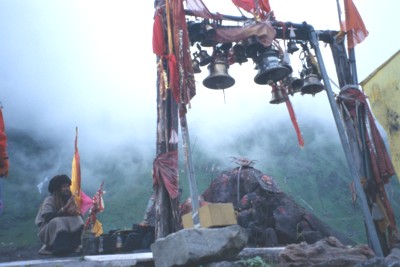
A hermit in the Himalayas, photo of a friend