
erk admin

spacerCircle of Good Will - Blog

Journey to India 24-25, 8: Pilgrimage to Places of Lord Dattatreya – 7

February 4th, 2025

Journey Part 1, 2, 3, 4, 5, 6, 7, 8, 9, 10, 11, Summary: Srisailam: Temples and nearby places

In the evening of the 2th, we meditated at GhantaMatam, a small and mystic place with several small stupa temples and lingams inside where one could go and meditate or do rituals. (See photos at Google Maps.)

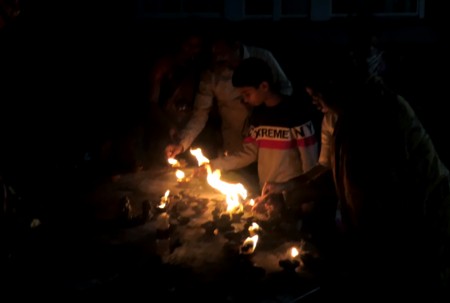
Next morning, 29th December, December Call Day and 11th descending moon phase. Raju and taxi driver Raju picked us up early morning. For the meditation, we went again to the place where we had meditated the evening before, GhantaMatam. When the meditation ended, we noticed that directly next to us a special water ritual started. A couple conducts this ritual each 14th descending moon phase at this place, with 108 little Shiva lingams formed out of the excretes from the floor of a cobra cave. The lingams are arranged in the form of a lingam and the trident of Shiva. On top of each lingam, there was some camphor which was lighted towards the end of the ritual.

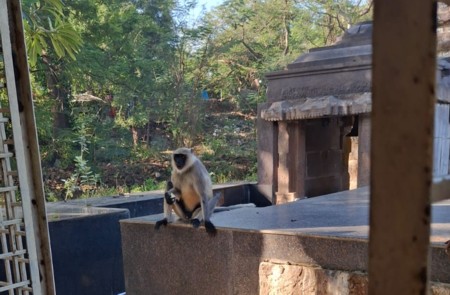
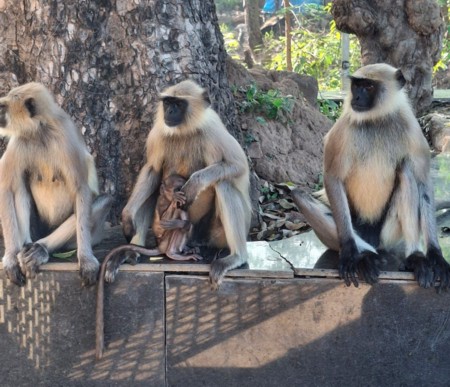
Rhythmic mantra chanting started, Raju later joined in. We slowly became part of the ritual team. It grew with more people joining. A group of monkeys larger than the other widely spread monkeys also joined, coming down from the trees and surrounding the little temple. Raju explained that these monkeys help keeping the smaller monkeys away. They are also sometimes trained by humans to protect temple sites from the other monkeys.

A monkey in front of a small temple
Monkeys watching the ritual

The ritual went on for over two hours. The day advanced from darkness to dawn and full daylight, shining through huge old trees. Some women were preparing food at an open fire by the trees, and the different stupas with lingams around – a magic ambiance. Our plans for going again to the Srisailam main temple early morning changed. We went there later in the morning.

At the temple, there were again large crowds. The queue was slowly progressing. A family with two little girls, maybe 7 and 9 years old, and with a younger boy jumping around and teasing the girls. Our guide Raju started speaking to them in Telugu about the importance of the temple. The girls were fascinated by his talk and we were together like in a space outside the queue. Beautiful moments. The girls were much interested in what Raju was telling and it was fascinating to see their brilliant eyes. How they were hanging at his lips a long time, and alter also the parents. We were slowly progressing and after the main temple, we were going to the different temples in the inner court, and we were all the while together with this family. And in the courtyard there was an old Audumbara tree at the place where Narasimha Saraswati had meditated before he went to the Kadali Vana cave for his centuries-long meditation.

There were lying some Audumbara seeds on the ground. I opened one and showed it to the girls. And the seed looked like powder, but I told them that this is not powder, but it is a potential tree or even many trees might grow from it. They were much astonished about it.

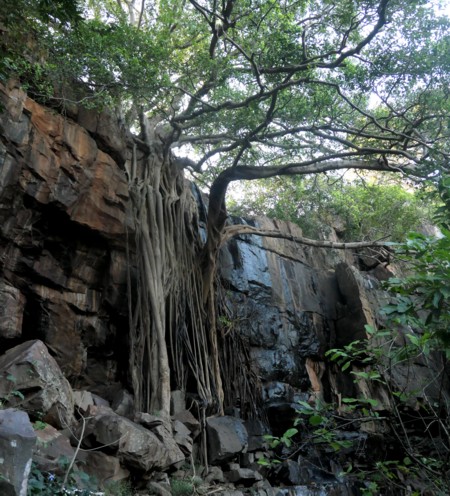
Later in the day we went to Paladhara-Panchadhara situatet some kilometers outside Srisailam, a place where way down into a valley there was a waterfall coming down and there were many visitors going to this waterfall. It was a beautiful place about which Master Kumar had told that Lord Maitreya and also Adi Shankaracharya had meditated. A little temple was standing there. We did our evening prayer behind the temple so that the other visitors would not see us.

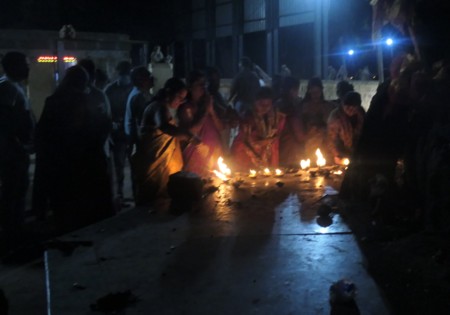
Afterwards, we went to the nearby Hatakeswaram Temple, an old place where already Rishi Agastya is said to meditated on his way to the South. When we arrived there, people were just lighting candles.

Raju explained that at this place the pilgrims had come out of the forest on their pilgrimage to Srisailam and entered again the forest. They had walked barefooted through the jungle and over long distances as part of their spiritual discipline. And they also returned that way through the forest of today’s tiger reserve. It was dangerous, but the pilgrims just focused on their pilgrimage.

Monkeys playing at Hakateswaram temple

The next morning, 30 December, we went again to the little temple at the outskirts of Srisailam related to Master KPK’s earlier lief to say goodbye and from there start our return journey back to Hyderabad.

Statue of Narada, the cosmic musicians, at the entrance of Srisailam

We had a beautiful evening with the members of Hyderabad group and then, in the morning of 31 December 24, a taxi brought us to the airport, flying to Vishakhapatnam for the WTT group living of members from the West. Thus ended our beautiful tour to places related to Lord Dattatreya.

Journey to India 24-25, 7: Pilgrimage to Places of Lord Dattatreya – 6

February 4th, 2025

Journey Part 1, 2, 3, 4, 5, 6, 7, 8, 9, 10, 11, Summary: Srisailam: Mallikarjuna Swamy temple, Aka Mahadevi Caves

For 27 Dec. evening, the date of our arrival to Srisailam, we had tickets for the darshan (“view”) of the main temple of Srisailam, the Sri Mallikarjuna Swamy temple and the Lingam in the center via fast line (no photos allowed). It took, nevertheless, about two hours to get in.

We left our shoes in the taxi at some distance and slowly proceeded into the innermost of the main temple, and finally arrived at the Mallikarjuna Lingam. The lingam in the center is one of the 12 Jyotir Lingams in India, lingams of highest spiritual light.

In the Sripada Srivallabha Charitamrutam, it says that there have been anchored very sublime energies. The grandfather of Sripada, Bapanarya, conducted intense rituals and anchored the solar energy at Srisailam and in some other places. And when Swami Samarth left his body in Samadhi in Akkalkot, his energies entered into the Mallikarjuna lingam in Srisailam. We tuned into these energies.

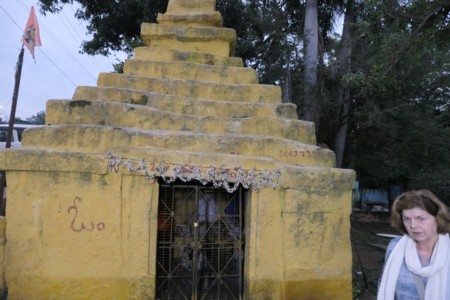
The next morning we went for meditation to a little pyramidal temple at the outskirts of Srisailam, where Master Kumar had told to have meditated for long times three lives ago. To meditate there was a special experience. We were three times meditating / contemplating at this place.

Directly next to it, there was a huge statue of Virabhadra, and we saw several other statues of Virabhadra. Raju told us more about the symbolism.

Later we took the rope way down to the Krishna River for a boat ride to the Akka Mahadevi caves.

Rope way down to the Patalaganga reservoir
Astrological and chiromantic consultation at the rope way landing point

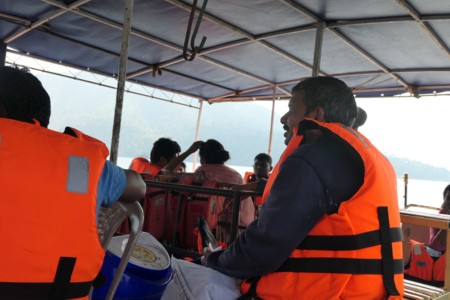
We were about 30 persons on the boat. Raju started speaking to the people in Telugu about the life of Akka Mahadevi.

The story he had told us before the evening before. Soon nearly all passengers were listening to him in rapt attention. He also mentioned that at the opposite side, some kilometers behind a few hills, there was the plantain forest where Narasimha Saraswati, the second incarnation of Dattatreya, had meditated for 300. He had been there between the 15th and 18th century. And the end he transformed into Swami Samarth. Swami Samarth, as an age-old incarnation, had wandered naked through India for about 100 years unrecognized. Slowly, from the mid-19th century on, certain traces of his wanderings were discovered until he stayed in Akkalkot the last 22 years of his life. At present, it is very difficult to get to Kadali Vana, the forest cave where the transformation had taken place, the plantain tree forest.

And when Raju mentioned that here was the man that had translated the Sripada Srivallabha Charitamrutam to German as prophesied in the book, all the people in the boat wanted to hear from me the story.

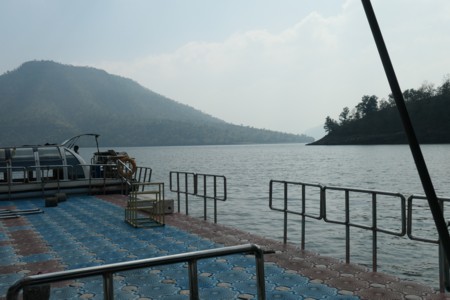
The boat pontoon near the Akka Mahadevi caves. At the right side the forest area where there is Kadali Vana

The boat stopped at a pontoon from where we walked approximately 200 meters uphill and arrived at the Akka Mahadevi cave. A huge natural rock plate forms the roof over the place before the entrance.

Approaching the cave
View from the terrace of the cave
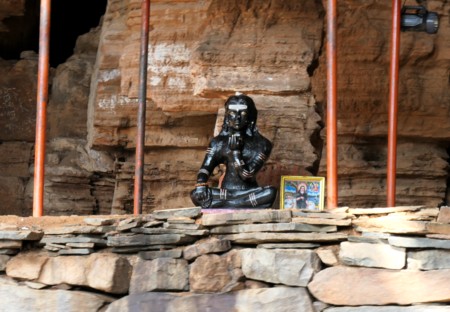
Statue of Akka Mahadevi at the entrance

We climbed in together with guides who helped me holding lamps. One by one we went through a narrow entrance. From inside, some bats were coming out. At the end of the small tunnel there was the cave room in which a natural lingam had been formed over time by dripping water.

Raju later explained that this lingam has the symbolic function of the uvula in the human throat. With yogis in high states of spiritual awareness, special secretions are secreted from the uvula enabling the initiates to stay for months without food and even drink. This is what Akka Mahadevi had done at this place. She is one of the very few known Shiva devotees who had wandered around and meditated “digambara”, naked, meaning, having her long hair and the directions of the sky as the only garments – a very mystic place.

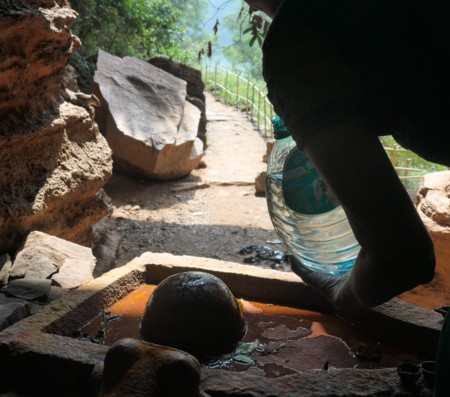
Back at the entrance of the cave, Raju started singing ‘OM Namah Shivaya, Shivaya Namah OM’, pouring water over a lingam from a water bottle . All people present joined in and we stood in the magic of the ritual.

The spontaneous water ritual at the entrance of the cave
A striped squirrel joining the ritual, eating some fruit
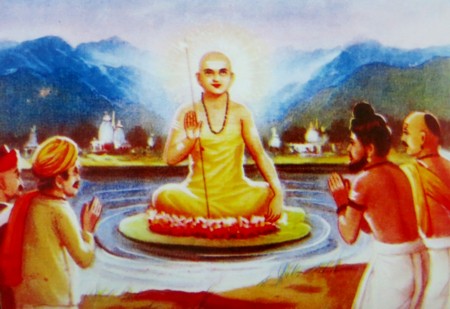
Picture of Akka Mahadevi at the entrance

Later, we returned to the starting place of the boat journey. Many people were waiting at the little rope way, so we decided to take a tuk-tuk to go uphill. About 12 people sat pressed together in the tuk-tuk slowly climbing up the hill, shaking along the muddy road.

Journey to India 24-25, 6: Pilgrimage to Places of Lord Dattatreya – 5

February 3rd, 2025

Journey Part 1, 2, 3, 4, 5, 6, 7, 8, 9, 10, 11: Srisailam – Arrival

In Divya Kalanjali, Hyderabad, we had a day of rest. We meditated and exchanged with the group and prepared for the journey to Srisailam. Vasishta had arranged for a taxi driver, Raju. He would stay for the 4 days of the journey with us. In Srisailam, another Raju (Kailasa Raju), a member of the WTT group Divya Kalanjali, would be our guide – he was already in Srisailam for a 9 days retreat. Vasishta told us the tour would take about 5 hours and gave us some warnings for the tour.

Srisailam would be the close of our pilgrimage to places of Lord Dattatreya:
In the Sripada Srivallabha Charitamrutam book, there are a number of references to the importance of this place. Sripada mentions that his grandfather, Sri Bapanarya, had earlier channelled the energy of the Sun and a group of other stars with a special ritual into the Shiva linga at the main temple in Srisailam called Sri Saila Mallikarjuna lingam and made it a powerful deity in that area. (chap. 3)
He further says that after retracing his incarnation as Sripada Srivallabha, he will be born as Sri Narasimha Saraswati and afterwards will remain for 300 years in deep Samadhi in the Kadali Vana (literally, forest of plantain trees; a cave located in the interior of a dense forest called Nallamala at the foot of the hill of Srisailam, Andhra Pradesh). After that, would live in Prajnapura (Akkalkot) with the name of Swami Samarth.
And when he relinquishes that body, he would transfer His life force to a banyan tree and merge his divine soul in the Mallikarjuna Shiva linga at Srisailam. (chap. 10)

Narasimha Saraswati on a raft on the way to Kadali Vana

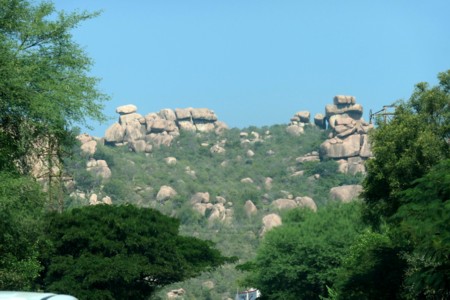
From Hyderabad we drove through areas which looked familiar to me – I later came to know that it was the same way to the December Call celebration 2000 with Master Kumar, where I participated with my family on my first journey to India in the context of WTT. Along the way, there were often huge strange rock formations with small rocks lying on big rocks in very spectacular ways, like play building blocks of giants.

Strange formation along the way.

Memories of the group journey with brother Navaneetam to Srisailam in 2007 came up (I hadn’t experienced much but spend most of the time in bed with vomiting, being now careful not to have the same experience again….)

Entry to the tiger reserve

Later, we entered the area of the Nagarjunsagar-Srisailam Tiger Reserve (Amrabad Tiger Reserve) surrounding Srisailam, driving a longer way through the forests.

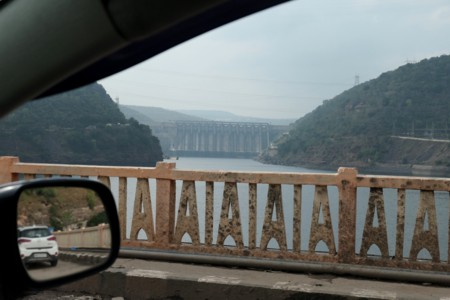
Short before Srisailam: The dam of the Patala Ganga Reservoir and power stations

Short before Srisailam, our taxi stopped at the parking of Sri Sakshi Ganapathi Swamy Temple where Raju joined our group. He was our guide for the next days in Srisailam. We felt like meeting an old friend – he is a very nice and knowledgeable person with profound knowledge not only about the area.. We quickly made friends. It felt like meeting an old comrade.

He first took us into the Ganesha temple, explaining that the form of Ganesha is worshipped as taking note of all and everything who comes. It was a special beginning of our visit to Srisailam.

Raju joins our travel group

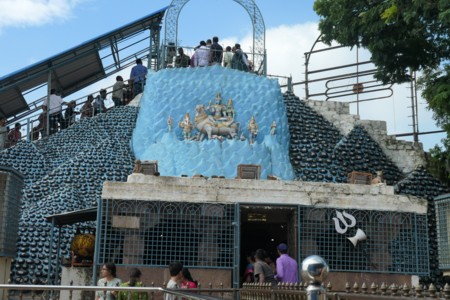
Then we went to the Srisaila Sikhara Dharsanam, a temple at a viewpoint towards Srisailam

Shiva and Parvathi surrounded by a mountain of Shiva lingams. On the top, there is the viewpoint.
You are suppose to see through the horns of Nandi, Shiva’s bull/vehicle towards the temple of Mallikarjuna Shivalingam in Srisailam.
View from the top through a symbolic structure of a Shiva Lingam towards Srisailam

The temple town is located in a hilly area where in the surrounding valleys a series of dams has created huge lakes of the Krishna River. The lake below Srisailam is called Patala Ganga, the Ganges of the underworlds.

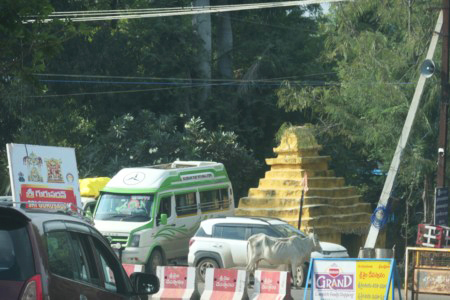
Traffic at a roundabout at the entry to Srisailam – the little yellow temple has a specific importance, more about it later.

Raju brought us to an ashram of the tradition of Sivananda Murthi (1928 – 2015), (more) who was a friend of Master Kumar and he came a number of times to group lives of WTT in Visakhapatnam, where I had seen him. The ashram is a very pure place with only least commercial aspects. There were a few ashram members taking care of the pilgrims. We were only asked at the end to pay a nominal sum for the stay. The food was offered with free donations. The meals were pure, the members were very kind and attentive. And we were given simple, clear rooms, clean rooms.

Our travel group with ashram members from the kitchen

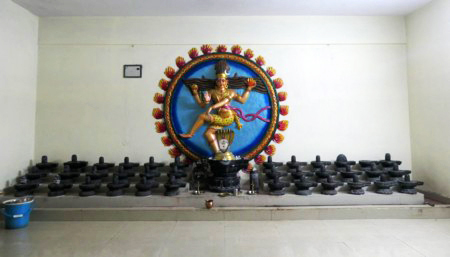
We had our morning prayers early morning in a prayer hall where the ashramites and other guests assembled later. In the hall there, there were about 38 black Shiva lingams and yonis surrounding a huge clear rock crystal lingam. A beautiful and calm meditation ambiance.

Shiva surrounded by lingams and a central rock crystal lingam

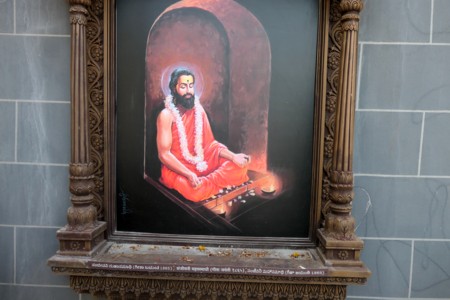
In the hall, there was also an image of the founder of this spiritual lineage who had lives for over 1000 years, from 3100 – 2044 BCE – for rationalists a legend, for advanced yogis a science.

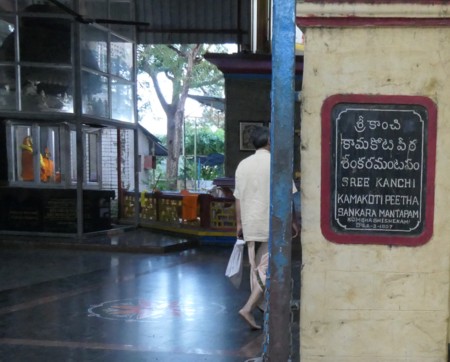
Raju stayed in another ashram, the Sri Kanchi Kamakoti Peetham of the Shankaracharya movement near the Srisailam main temple. He later took us there showing that an underground brooklet is running under the central Sri Mallikarjuna Swamy temple, other little temples and the Peetham – only few people are perceiving this.

Raju at the entrance of the Peetham

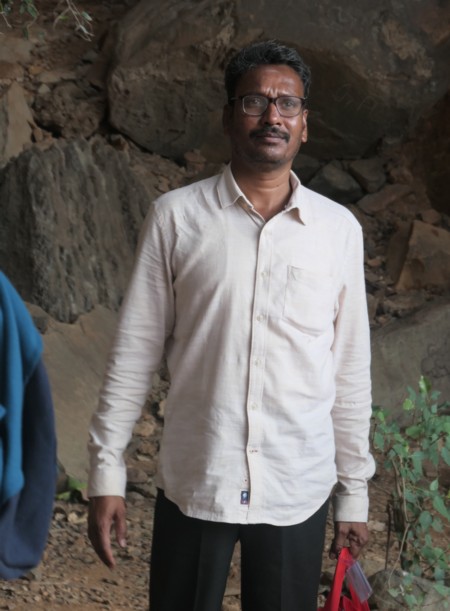
The taxi driver Raju (“Raju Taxi”) stayed at our disposal the whole time, picking us up and bringing us to the places we visited. He formed a soft and helpful part of the travel group.

Raju, our taxi driver, at the Akka Mahadevi cave

Journey to India 24-25, 5: Pilgrimage to Places of Lord Dattatreya – 4

February 1st, 2025

Journey Part 1, 2, 3, 4, 5, 6, 7, 8, 9, 10, 11, Summary: Maniknagar

From Akkalkot we went to Maniknagar, at a distance of about 140 km. It was more or less a direct route but for most of the way, the road was in a bad state, with big holes and partly a cambered roadway. It was 26 December, winter time, but it was quite hot. You could see with the vegetation that it is unbearably hot in summer. Srinivas often had to slow down and drive around the holes in the roadway.

When we approached Maniknagar from the direction of the city of Humnabad, the surroundings suddenly changed. There were huge trees along the road giving shadow and the fields were green and well cultured. We approached the Shri Manik Prabhu Temple – a site with huge palace-like walls surrounded by green lanes with statues and little temples. Everything was very clean and well maintained.

Entrance portal
A part of the main buildings with the temples of the Maha-Samadhis of the successors of the guru line of Manik Prabhu
The entrance area
Area in the inner court with metal structures from a recent festival

Manik Prabhu (1817 – 1885) was an Indian saint and freedom fighter who is regarded by many people as a Datta Avadhuta, a person beyond ego-consciousness and duality, or even as an incarnation of Lord Dattatreya.

Picture in the inner court of the Manik Prabhu temple

In the Sripada biography, there is a hint about him in chap. 45 and a story of a prophecy in relation to a meeting between Shirdi Sai Baba and a Datta Avadhuta – Manik Prabhu – in chap. 4. (“He then met a Datta avadhuta and asked for silver coins. As his tin would not get filled up, the avadhuta put two khajur fruits (dates) in it. Then he was satisfied. With that, the chaitanyam (consciousness) of Datta flowed into him.”) In the inner court of the Manik Prabhu temple, there is a picture relating to this meeting:

Meeting of young Shirdi Baba with Manik Prabhu in the early 19th century

Srinivas had often been at this place of Manik Prabhu and he had arranged a meeting with Shri Dnyanraj Manik Prabhu Maharaj, the present head of the Shri Manik Prabhu Samsthan (temple) and the sixth office holder in the series of successors. It is the only succession line of such Datta avadhutas for the spiritual guidance of the devotees, where the energy is upheld over a long time.

Shri Dnyanraj Manik Prabhu Maharaj, photo by Srinivas

Srinivas had told me that recently the Manik Prabhu temple had published the book “Shri Manik Prabhu. A Rare Spiritual Gem” by Anandraj Prabhu and that they wanted to ask me for a German translation, since I had translated the Sripada Srivallabha Charitamrum.

We were received by the son of Shri Dnyanraj Manik Prabhu in a grand old villa and we came to know that Shri Dnyanraj was sick at the moment and could not receive us. We were offered lunch, and the book was lying on the table. I politely explained that due to my age, I am handing slowly over work I am doing and that I cannot pick up new tasks of such a size. But that I would look if I can find a German translator. The son gave me a copy. (If you are interested and able to do it, please contact me.)

Receiving “Shri Manik Prabhu. A Rare Spiritual Gem”
Dattatreya statue at the Manik Prabhu temple – there was a space with a number of beautiful huge statues.

We later visited the nearby small temple dedicated to Devi Venkamma or Madhumati Shyamala, his disciple (a yogini revered as a devi by Shri Manik Prabhu’s devotees).

Shri Madhumati Shamala Venkamma Devi
Entrance to the temple

Afterwards, we went back to Hyderabad and arrived at Divya Kalanjali in the evening. It was time to say good-bye to Srinivas and Santosh, our dear guides and travel companions of this part of the journey. The next part was the journey to Srisailam.

Journey to India 24-25, 4: Pilgrimage to Places of Lord Dattatreya – 3

January 30th, 2025

Journey Part 1, 2, 3, 4, 5, 6, 7, 8, 9, 10, 11, Summary: Akkalkot

The longer we travelled together, the more we became a travel group. For the journey to Akkalkot, Santosh, Srinivas’ friend from Hyderabad was especially important, since he has been already in Akkalkot several times and he speaks Kannada language spoken mainly there, while Marathi is the official language in this area. But during the journey, we came to know a new side of Santosh. He showed pictures and we came to know that, besides being an IT person in business, he is a priest in a cave temple in Hyderabad area, from the SriPada Anugraha Temples Seva Trust, where Sri Narasimha Saraswati had once meditated for a day and met the king of the area there.

I was astonished and felt reminded of H.P. Blavatsky’s book “From the Caves and Jungles of Hindostan” (free e-book), about her journeys through India, often with a small travel group, to which belonged Gulab-Lal-Singh, a Thâkur from Rajasthan, who is no other than Master Morya. (In the 1990s, I had translated large parts of the fascinating book into German for a group.) Now, we were travelling on similar paths.

Akkalot is a little town where Swami Samarth, also called Akkalkot Maharaj, the 3rd incarnation of Lord Dattatreya in Kali Yuga, had lived from 1856 – 1878, Akkalkot being the place of his Samadhi, where he had left his body. (More about Swami Samarth, a biography and a story of early theosophists coming to this place in the 19th century already.)

In the late afternoon, we arrived at Akkalkot, a town in Maharashtra, where we stayed in the house where Cholappa had lived in the second half of the 19th century, now being a pilgrims hostel. Cholappa was the favorite disciple of Akkalkot Maharaj, Swami Samarth.

It was Cholappa who “discovered” Swami Samarth in 1858, realizing that he was an extraordinary divine incarnation though from the outside, he looked like a naked lunatic sitting on a heap of garbage. Swami Samarth stayed in Akkalkot for about 22 year until entering samadhi in 1878. Still today, his presence is felt strongly there. The present owner, Dhanandjay Nandkumar Pujari, belongs to the 15th generation from Cholappa. In the entrance hall of the house, there was a huge painting showing Swami Samarth.

Image of Swami Samarth in the entry hall of the lodge

In the evening we went to Shri Vatavruksha Swami Maharaj Devasthan, a temple in the town dedicated to Swami Samarth. A big crowd slowly advanced into the temple where a ceremony was conducted. We saw different objects like a bed, sandals, and a staff of Swami Samarth and other objects.

Bed on which Swami Samarth had rested
Huge old tree inside the temple
Statue of Swami Samarth inside the temple
Silver Padukas, as his sandals, representation of his energy
Inside the temple. In the back, a huge picture of Swami Samarth

Priests carried around a statue of Swami, while the crowd of people was ecstatically chanting. Flowers were showered over the bier with the statue – a very emotionally and devotionally charged atmosphere.

Our travel group inside the temple

Later, we were in a house with a huge hall, (use a browser with automatic translation) where great masses of pilgrims were given free and tasty meals (location on Google maps).

Statue of Dattatreya as a female form inside the dining hall, also Swami Samarth in female form
Singing before the meal – video by Srinivas

Next morning, we set out walking barefooted to a temple related to Swami Samarth’s samadhi, about 3-400m walk. Like at the previous temples visited, I had to put on a dhoti (Indian garment for men) with no shirt. Inside the temple, different groups of people were sitting together with priests who conducted rituals with little statues of Swami Samarth. Our priest was the head (owner) of the Pilgrims’ Lodge where we had stayed overnight. Under singing various mantric chants, the priest washed the statue with water, milk, curd, adding kumkum (red powder), sugar, and then washing all off again. Then, the statue was dried and clothed with colourful shawls and decorated with many flowers. At the end, we entered a small room at the inner of the temple and received blessings.

The statue of Swami Samarth at the end of the ritual

The fee charged for each one of us was a bit a surprise. The other places we had visited were less commercial or not commercial at all. But it was a long ritual.

Afterwards, we were shown in a side-building different objects related to Swami Samarth – a staff of Swami Samarth and a bed – and then we walked back to the lodge. From there, we set out for the next part of the journey, Maniknagar and back to Hyderabad.

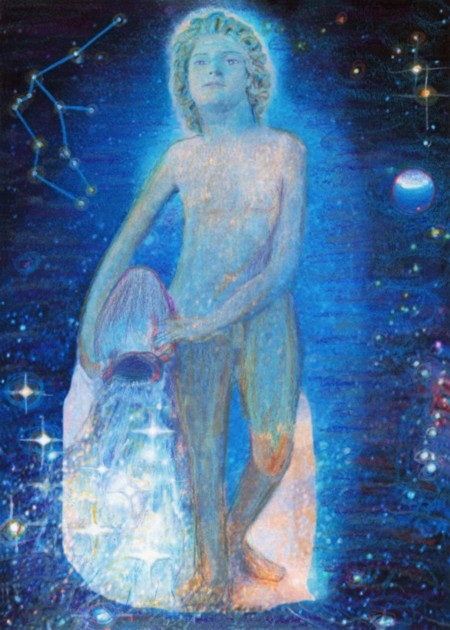
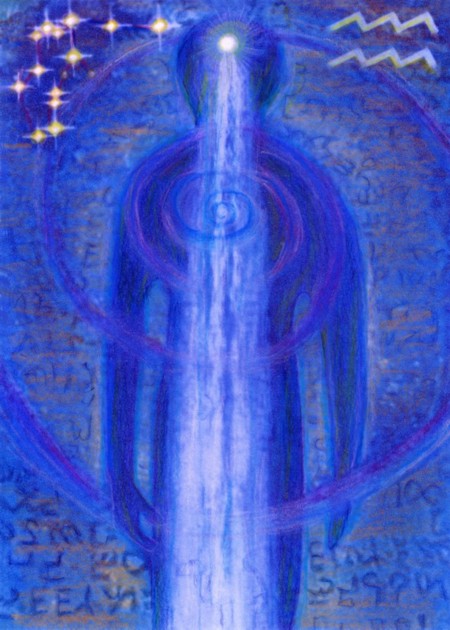
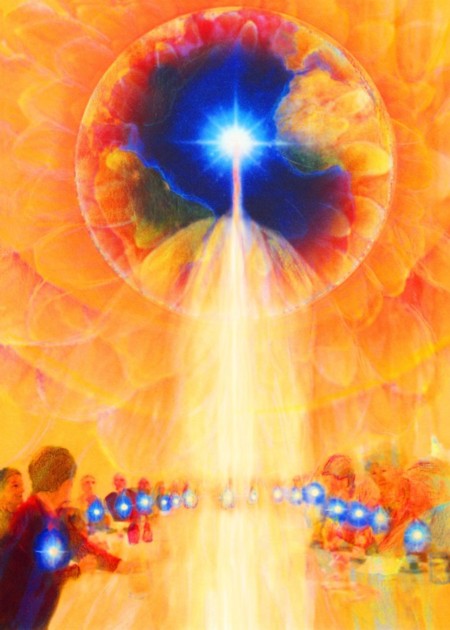
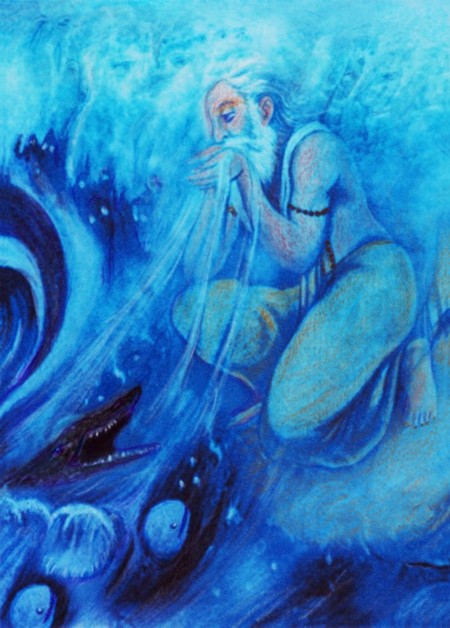
15 Aquarius Paintings

January 30th, 2025

The path of Aquarius is mysterious. It demands enquiry and intense search into the occult for lifting veil after veil. Unfolding concept after concept to realise that we are ourselves just a concept of THAT. Aquarius demands the letting go of concepts and the free flow of energies in all directions. We learn to BE and yet experience all states of consciousness simultaneously.

The 15 Images of Synthesis for the month of Aquarius illustrate the related symbolism. You find there all previous Aquarius paintings with detailed explanations in four languages (en/de/es/fr). You can also download print-versions for free. Find here the Images of Synthesis with short extracts from the wisdom teachings. Or subscribe to the Lunar Messenger newsletter giving thoughts from the wisdom teachings to inspire putting them into practice.

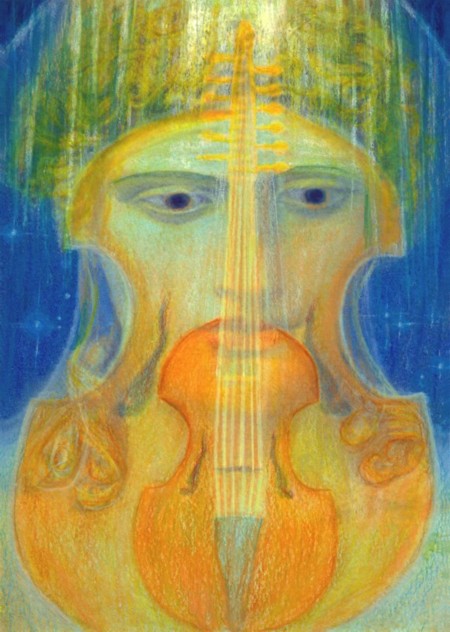
Aquarius – Eternal Flow of the Sound of Life
30 October 2010, pencils, crayons and photo work

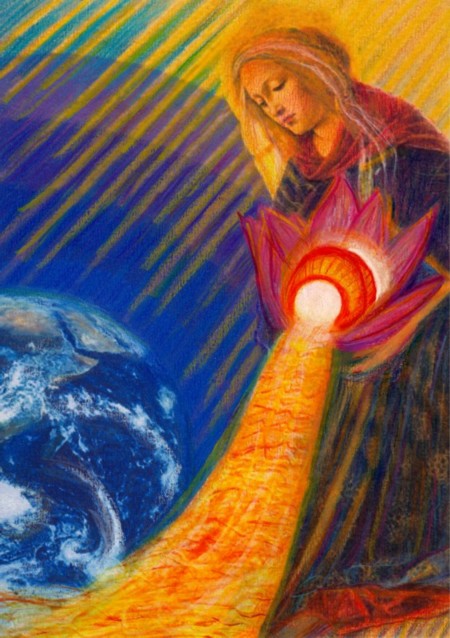
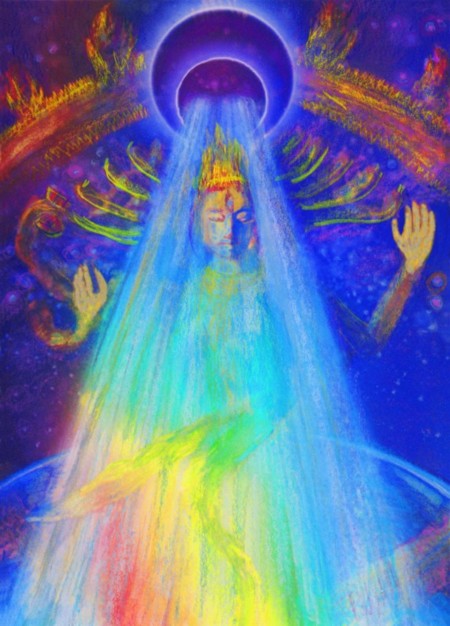
Aquarius – The Mother with the Aquarian Pot
01 October 2011, pencils, crayons and photo work

Aquarius – The Twin Gods and the Downpour of Cosmic Energies
25 September 2012, pencils, crayons and photo work

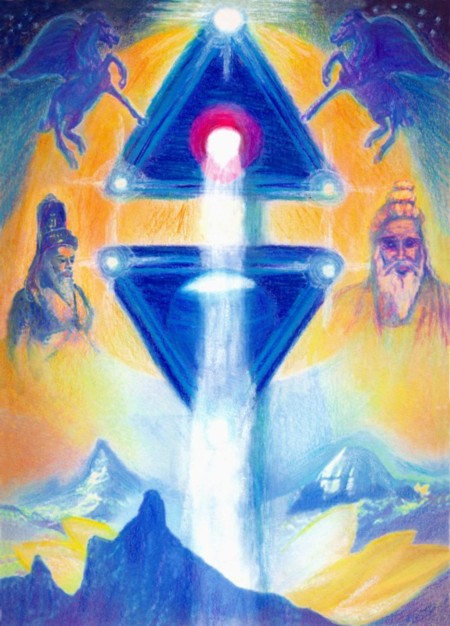
Aquarius – Agastya and Sirius
30 September 2013, pencils and photo work

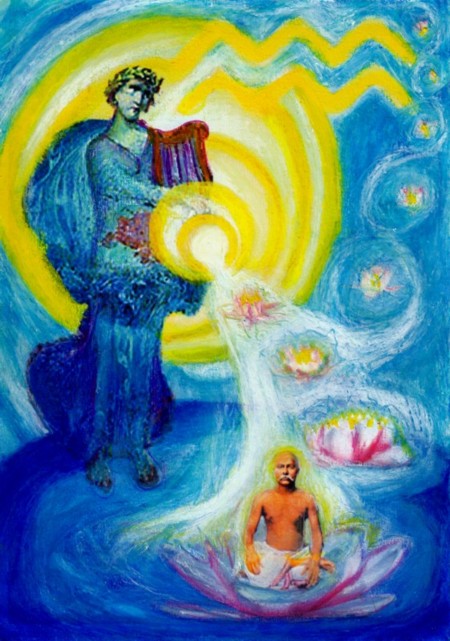
Aquarius – Apollo and the Song of Light
16 October 2014, pencils and photo work

Aquarius – The Aquarian Passage
12 October 2015, pencils and photo work

Aquarius – The Aquarian Pot and the Eternal Dancer
8 October 2016, pencils and photo work

Aquarius – The Lord of the Eye
17 October 2017, pencils and photo work

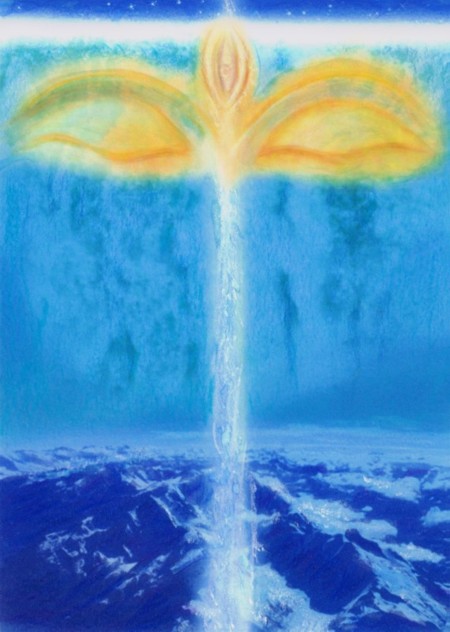
Aquarius – The Flow of Spiritual Light
4 October 2018, pencils and photo work

Aquarius – The Magic of Creation
10 October 2019, pencils and photo work

Aquarius – The Spiral Hieroglyphs of Ages
28 October 2020, pencils and photo work

Aquarius – Cooperation in Goodwill and Light
12 November 2021, pencils and photo work

Aquarius – The Manu and the Spirals of Time
1 November 2022, pencils and photo work

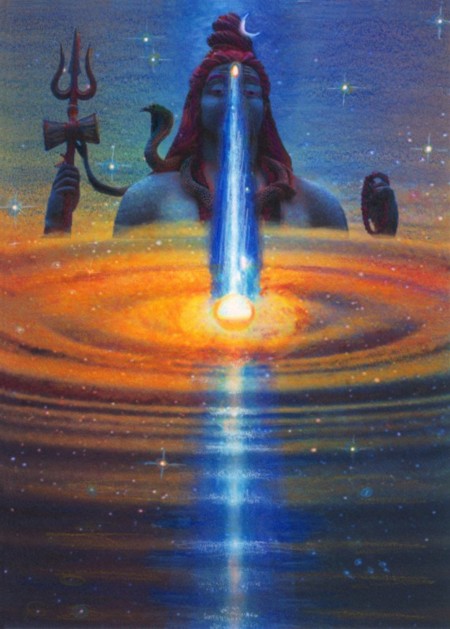
Aquarius – Agastya drinking the Waters of the Ocean
13 November 2023, pencils and photo work

Aquarius – Vena the Gandharva
16 November 2024, coloured pencils and photo work

Journey to India 24-25, 3: Pilgrimage to Places of Lord Dattatreya – 2

January 28th, 2025

Journey Part 1, 2, 3, 4, 5, 6, 7, 8, 9, 10, 11, Summary: Gangapur – Kadaganchi – Ladchincholi

From Kuruvapur, we continued our journey to Gangapur, the place where Narasimha Saraswati, the second incarnation of Dattatreya in Kali Yuga, the present dark age, had stayed for a number of years in the 15th century AD.
We stayed overnight in the Avadhoota Ashram, a beautiful and serene place on the banks of the Bhima river.

Entrance of the Avadhoota Ashram

At the reception, a young man gave me a warm welcome: “Namaskarams Master, we have met at May Call 2022 in Bengaluru, with Master KPK.” Manu is living in Gangapur and doing volunteer service at the reception of the Ashram.

A golden Sripada statue at the reception of the Ashram
Statue of Krishna surrounded by gopis and elephants in the inner yard of the ashram

We had a hearty exchange and together with Karin and Katrin, we gathered in his Manu’s room for evening meditation.
Next morning, 24 December, we went to the Narasimha Theerta, at the confluence of the Bhima and Amaraja river, where Narasimha Saraswati had meditated for a longer time. He used to regularly walk along the Bhima river from Gangapur to this place and impregnated it with his energy.

Bath in Bhima River

The old Audumbara tree
Temple with the tree inside
Statue with a statue of Narasimha Saraswati in a nearby temple with a strong, mystic ambiance.

Together with other pilgrims, we took a bath in the river greeting the morning sun. There is an old Audumbara tree, a sacred fig tree, which is a sprout of the tree under which Narasimha Saraswathi used to meditate. The pilgrims walk around the tree and chant mantrams – a mystical ambiance. We later returned to the Avadhoota Ashram.

Trees of the ashram at the Bhima River

Next to the ashram, there is a garden at the river with a greater number of pillars open towards the sky to receive energies. The pillars are arranged in a structure of the Sri Yantra, related to the divine Mother aspect and they are meant to receive the energies of the Mother.

Later, Manu guided me to a big hall, where a big box contained booklets full of hand-written mantrams of the Divine mother to anchor the energy. There were beautiful big stone statues of different forms of the Divine Mother and 10 metal statues of the Dasa Mahavidyas, 10 forms of the Divine Mother arranged in a semi-circle.

Statue of the divine Mother with skulls, symbol of total inward orientation beyond bodily awareness.

Manu explained that they are arranged as complementary energies. He much meditated on their symbolism and explained it to me showing parallels to the Mystic Mantrams of Master CVV. I felt a sublime divine presence.

Before leaving, I had a short talk with the head of the ashram, the son of the founder, a young man of vibrant energy.

We continued our journey and stopped in a small village, Kadganchi, with a special old Datta temple, Shree Sayandeo Datta Mandir. Inside, there were many people singing devotional hymns to Lord Dattatreya.

Entrance of the temple.

A man guided us into the basement of a house in the neighborhood with a cave-like room. There, a man, Sayandeo had received via intuitive impression the Guru Charitra, the biography of Narasimha Saraswathi about 100 years after the latter’s leaving Gangapur at the age of about 78.

The Guru Charitra contains a short story of the life of Sripada Srivallabha (1320 – 1353 AD) in the first 5 chapters, the only information about him for centuries, kept in the awareness of the people in central India, until in 2001, the biography of Sripada was published in Telugu and then many other languages.

In the basement

We continued our journey and stopped in other village (Ladchincholi) , where from 1908 – 1973 lived Sridhara, a saint who was a reincarnation of the second eldest brother of Sripada, whose incarnation was already announced in the Sripada Srivallabha Charitamrutam, the biography of Sripada (chap. 9, 10, 41).

On the way to Ladchincholi

Ramaraja Sarma, second eldest brother of Sripada, born lame, was healed by Sripada; he became famous in his next incarnation as Avadhuta Sridhara, as a partial manifestation of Dattatreya (chap. 9, 11, 41). As said in the Sripada biography, a disciple of Sridhara, Sri Sajjanagada Ramaswamy, later founded the Mahasamsthan temple at the birthplace of Sripada in Pithapuram.

From there, we continued our journey to Akkalkot.

Sridhara
Sridhara (1908 – 1973)

Journey to India 24-25, 2: Pilgrimage to Places of Lord Dattatreya – 1

January 26th, 2025

Journey Part 1, 2, 3, 4, 5, 6, 7, 8, 9, 10 11, Summary: Mathangoud – Panchadev Pahad – Kuruvapur.

Next day, 22 Dec. towards noon, our friend Srinivas arrived at Divya Kalanjali together with his friend Santosh, to complete our travel group for the first part of the pilgrimage.

Srinivas is from New Jersey, USA, but is Indian by origin origin. He helped me much with the translation of the Sripada biography and also organised the first part of our pilgrimage tour. His friend Santosh comes from Hyderabad, and on the tour, we quickly also became good friends. Both are deeply linked to Lord Dattatreya and provided very good background information of the “how to” of the journey. Srinivas is a good driver and had rent the car. He drove good, as fast as the road allowed.

Leaving Divya Kalanjali
Dattatreya posters along the road

The first stop was Mathangoud, a very special and little known place where a miracle related to Sripada had happened during his incarnation in the 14th century. – Three robbers accompanied by a colleague beheaded a man at that place but when he remembered Sripada, the latter manifested, killed the robbers and put back the head of the man who came back to life. (See the Sripada biography, chap. 18, story of Vallabhesa).
A yogi later had traced inwardly this place in the 20th century and meditated there for long times in solitude, and then this little temple developed in the last decades. There is a group of huge rocks standing in the flat countryside surrounding a cave temple. And there was a very pure, serene ambiance, and the divine presence at this place touched us profoundly.

At the rock temple
Entrance area
Backside of the temple in the rocks
Inside the temple, statues of Lord Dattatreya, Sripada and the 2nd incarnation, Narasimha Saraswathi
Sripada statue on the roof
Santosh at a relief of the story of Vallabhesa
Karin and Katrin from Germany, our travel team members, in front of the rock temple

From there, we continued to Panchadev Pahad, the Sripada Chaya Ashrama, where we wanted to stay overnight.

Cows on their way through the Sripada Chaya Ashrama
Temple inside the hall

Inside the ashram hall, there was continuous singing the name of Sripada and two priest conducting a fire ritual.

The sun was already slowly setting when we set over to the island of Kuruvapur in the Krishna river.

At the Krishna river – the ferryboat and some coracles in the foreground

This time there were no more the coracles used for crossing like we had in 2017 but motorboats. In the river, I saw at some distance what I thought to be a branch of a tree. I only later came to know that there is a group of crocodiles near the island.

Crossing the river at sunset
Entrance of the ashram on Kuruvapur island

In the temple at the place where Sripada Srivallabha, the first avatar of Lord Dattatreya in Kali Yuga had lived and meditated for several years in the 14th century a group of about 50 people were chanting the name of Sripada. To enter the temple, the men had to put off shirts and shoes and put on Dhotis. Santosh gave me a dhoti and helped to put it on. Together with other pilgrims, we went into the innermost room of the temple while the priest was waving a camphor light giving us blessings. I again experienced the powerful divine presence which already had deeply touched me during my first visit in January 2017. We could not sit down but it was a trance-like experience in standing and with open eyes.

Inside the ashram

We stayed a while in the presence and then crossed again the river for spending the night in the ashram at Panchadev Pahad.

There was a beautiful sunrise in the morning when we again crossed over to the island. However, this morning there was no Sripada statue in the temple – preparations for some other ritual were going on. It was like experiencing the divine presence without a physical form. We stayed some time in the presence.

Sacred Audumbara tree inside the temple

Several people came and wanted to take photos with me – Srinivas had informed them that I had translated the Sripada biography to German. In the book, 4th chapter, there is a story with a prophecy given by Sripada in the 14th century that in the future the book would be translated to German and to many other languages. So, people were interested in the fulfilment of this prophecy. For me, it was a strange feeling – the interest of the people in me was not me as a person but as a bridge to a miraculous prophecy of 700 years ago taking to manifestation now, as other prophecies in the Sripada biography had manifested in the past and are manifesting through his expression of divine Will.

Srinivas and Santosh

Afterwards, we went to a nearby huge bayan tree and a small cave-house temple, where Vasudevanand Saraswati, (Tembe Swami) hat meditated a while my friends creeped in – I preferred to stay outside and absorb myself into the beauty and ambiance of the place and in observing the people around.

A lady coming out of the cave-temple
A nearby temple under a huge Banyan tree
The Vittal Baba temple in Panchadev Pahad – relief of the cosmic vision given by Krishna to Arjuna on the battlefield

We then visited the Vittal Baba temple in Panchadev Pahad opposite of Kuruvapur at the Krishna river and then continued our journey, the next goal being Gangapur.

Journey to India 24-25, 1: The Start

January 25th, 2025

Journey Part 1, 2, 3, 4, 5, 6, 7, 8, 9, 10, 11, Summary

The last days before the start of the journey to India were very intense. I was happy to finally close down the computer and to finish last details of packing very early morning. It was 20 December, the day before winter equinox, and there had been ice rain in the night. Luckily, I had covered the car windows the evening before, so that the ice could easily be removed.
My wife took me to the nearby railway station and we said good-bye – I won’t be online the first 11 days of the journey. In the train, people were on their way to work, and I on the way to Zurich airport. After arrival, the luggage was quickly checked in. When I was on the way to passport control, I took a shortcut. A lady in the 30th smiled to me saying, “I also thought of taking this shortcut but then took the longer way.” We met again in the queue and later at the dock of the Etihad flight to Doha.

Zurich airport, on the way to departure

We quickly started conversation. She was a Kundalini yoga teacher from Zurich going to a seminar on an island in Thailand and I told her that I was going on a pilgrimage to places of Lord Dattatreya in central India and a seminar on wisdom teachings in Visakhapatnam on the Bay of Bengal. She was from Albanian background, Muslim by origin but felt drawn to yoga. Her family of origin had let her go where she felt drawn to, being the youngest of the children. I enjoyed hearing this – spirituality makes rigid mental / emotional concepts porous and opens inlets for the light of the soul and new ways of life.

Zurich airport, the plane waiting outside

We spoke about this special combination in her spiritual background. She shared more about her search and how she had traveled with her husband in an old camping bus to Turkey and Syria, originally planning to go to Afghanistan a few years ago, dreaming that a day might come again to travel to India via land like it was possible some decades ago… Then, we exchanged the addresses of our websites, and our paths took again different directions in Doha.

Abu Dhabi airport

The plane to Hyderabad was a little late, but this way, Karin and Katrin, my two travel companions from Germany, whose plane from Frankfurt was late, arrived in time. On the plane, we sat in different corners. I took a cinema journey to a distant future in another galaxy – diving into “Dune, part 2“. On my last journey to India a year ago, I had seen part 1. I only watch and enjoy movies while traveling.
We arrived early morning in Hyderabad. There was a long queue at immigration. Later, money change and taking a taxi. Vasishta from Divya Kalanjali, a WTT group of Hyderabad, gave directions to the taxi driver via phone.

In the prayer room at the 6th floor

We arrived at the WTT center during morning prayer / meditation, hearing “Namaskarams Master CVV” and were happy to sit down. Later, after breakfast, when I unpacked, I couldn’t find my spectacles. We searched everywhere, recapitulated every step, from the money change to the room – but we could not trace where the glasses had left nor the taxi driver find anything…. Luckily, a group member helped out with reading glasses from her late mom which worked fine for me…

We relaxed the rest of the day and met different families in Divya Kalanjali. They gave us a very warm welcome. It was like coming home, a soft landing in India.

Sunrise over Hyderabad, seen from the terrace at the 6th floor

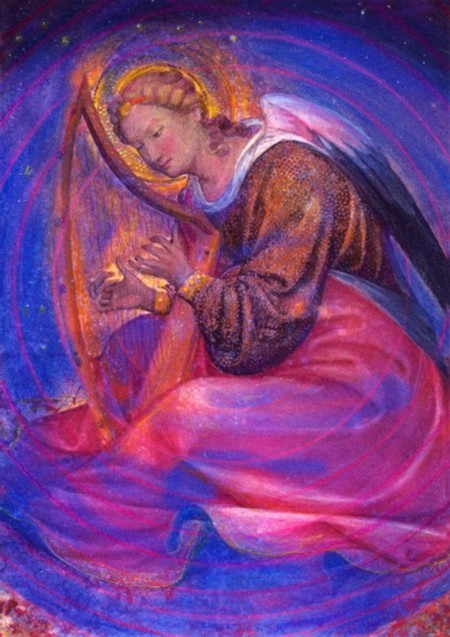
Aquarius – Vena the Gandharva

January 23rd, 2025

Picture to the Month of Aquarius

The Indian Puranas describe musical intelligences which are called Gandharvas. They are supra-cosmic beings who are not bound to creation. They exist as musical movements in space and assist the work of creation. The music of the Gandharvas brings about the union of the souls with the Supersoul and bestows the bliss of liberation.

There is a royal Gandharva called Vena. He is poetically described as the essence of the Aquarian passage between apparent non-existence to apparent existence. Vena moves with ease between these two states like a spiritual and fiery river. This flow energy can also be described as a bridge going up to the highest and coming down from the highest. In us, the flow of the river Vena is located between the seventh and sixth chakras, i.e. the Sahasrara and Ajna.

The most important function of Vena is the neutralisation of binding karma. For this purpose, Master CVV gives the mystical mantra ‘Electric Hint’. It enters us like an electrical manifestation and then wipes off the images of the subconscious mind. For this purpose, the Master also gave the meditation 31 in the ‘Occult Meditations’:

“Vena, the Gandharva, is wiping off the pictures of the subconscious mind on the walls of my nature with the hieroglyphs of sound from his seven stringed lyre.” When we work with the sound key CVV, we can visualise how the energy of that Gandharva enters us from above our Sahasrara and fills all seven centres with the working of light and sound. This brings about purification and good changes within in us.

To illustrate the music of Vena, I used the picture of an angel playing music in a fragment of an altarpiece by Gherardo Starnina, painted between 1400 and 1410 A.D. A female angelic figure plays a harp, and the vibrations of the music travel in circles through space. Visualisations of the supra-cosmic plane are always only poetic approximations.

The Images of Synthesis for the month of Aquarius illustrate the related symbolism. You find there all previous Aquarius paintings with detailed explanations in four languages (en/de/es/fr). You can also download print-versions for free. Find here the Images of Synthesis with short extracts from the wisdom teachings. Or subscribe to the Lunar Messenger newsletter giving thoughts from the wisdom teachings to inspire putting them into practice.

16 November 2024, coloured pencils and photo work