
erk admin

spacerCircle of Good Will - Blog

Archive for the ‘Good Will’ Category

Rhythm – A Red Rag?

Saturday, April 26th, 2008

Yesterday evening we had another of our public evening themes meeting on Basics of Spiritual Life. Already beforehand some friends told us that this evening they won’t have time. So just a few stalwarts came. There was an elderly, distinguished Dutchman, whose curiosity had been attracted by the announcement in the newspaper. He asked some questions and followed with attention.

The topic of my talk was “Routine, Rhythm, Ritual” – you can find the English powerpoint presentation here, or if you prefer a PDF without animation, it’s here.

Rhythm is a red rag for some. A friend first said to my wife, she wouldn’t come, for she didn’t want to get a headache hearing about rhythm and feeling that she doesn’t get into it. She nevertheless came. Afterwards she said she was happy that she changed her mind, for the topic was quite different from what she expected, and she felt inspired.

Indeed, sticking to a self-chosen rhythm isn’t easy for many. Most people don’t organize well their day-to-day lives, they let themselves guide by the outside. The outer life generates so many programs for engagements which drive us away from the inner life.

However, rhythmical living gives you energy, and rhythm in spiritual exercises causes inner transformation.

When we try to take up a new rhythm, we much more often fail than succeed, because the power of the old rhythm opposes us. The ability to follow our own decisions is frequently tested. That’s very normal, and there is no reason to be worried about it. The impulse for change comes from the inner, without an outer compulsion. Nobody can do the rhythm for you.
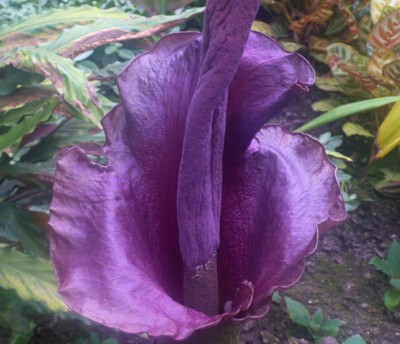

A violet flower expressing the 7th ray of order, rhythm and ritual. Photo taken in the botanical garden of the Elfenau, 2008.

CharityFocus – An Innovative Volunteer Initiative

Saturday, April 19th, 2008

Through a link on the Kalliopeia site I found CharityFocus.org, an innovative volunteer initiative:

“CharityFocus is an experiment in the joy of giving. Our services enable inspired people to contribute in meaningful ways to the world around them. Together, we hope to ‘be the change we wish to see in the world’.”

The organisation is fully volunteer-run. they aim to “act in concert to create service opportunities for each other and to support each other’s service journeys.”

They have some very interesting service approaches:

  • They provide technical help for small nonprofit organizations (NPOs) to develop a web-presence.
  • They inspire people to create inspiring content, such as writing success stories of nonprofit organisations, creating videos about something uplifting, providing photos for good stories, writing songs or realising some kind of art to make the world a better place.
  • They motivate people to do acts of kindness or make somebody smile (they have created Smile Cards…)
  • They guide people to set up local event activities, either alone or in partnership with other NPOs.

In order to help other service related NPOs to realise websites themselves, they have developed CFSites, an instrument to help the nonprofits to get on the web more quickly.

They have collectively designed hundreds of free websites for nonprofits and allowed some thousand sites to be created with their CFSites tool.

The CharityFocus project clearly shows that intelligent service is more than just a good intention, but requires skills and group work. Then you do efficient good will work with an attitude of professional quality, with a dedicated focus.

Kalliopeia or Supporting the Oneness of Life

Sunday, April 13th, 2008

Some days ago I came across the website of the Kalliopeia Foundation, a private philanthropic foundation, located in San Rafael, California. (Kalliopeia or Kalliope is one of the Muses of ancient Greece, the goddess of music, song and dance. They chose this name as a symbol “of the intuitions and faculties centered in the higher self which call on us “to remember.”).

Kalliopeia is giving grants to support a cultural shift towards a recognition of oneness of life within diversity: “Kalliopeia Foundation contributes to the evolution of communities and cultures that honor the unity at the heart of life’s rich diversity.” They “support projects which bring together the voices of those who are inspired to create, express and define an emerging consciousness of oneness through many areas of human endeavor”.

They have very inspiring principles and areas of sponsorship:
“Kalliopeia supports projects that contribute to a growing awareness of what unifies, rather than divides, all people. Through our grantmaking programs we support the work of people committed to holistic personal, community and planetary transformation and healing based on the recognition that we are at the core one humanity, expressing itself through myriad ways and forms.

We are particularly interested in projects that help to deepen our understanding of what it means for humanity to live in harmony with the whole of life. Central to this question is the need to evolve local to global systems of living that are founded upon a recognition of the oneness at the core of life and what that means in terms of how we live, both individually and collectively.”

You find interesting projects when looking at the page with the organisations they sponsored. One of the projects they supported with grants is the Kosmos Journal (“An Integral Approach To Global Awakening” – ” KOSMOS is an ancient Greek term meaning the harmony and beauty of the universe wherein all parts have their place within the Whole”).

An Argentinian friend living in Spain yesterday sent me a link to this journal writing: “I know the people and they are well-intended seekers, to my humble understanding.” I also saw that a lady whom I met 8 years ago at a seminar is working for the journal … A small world.


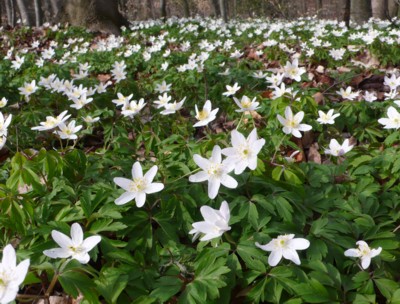
A forest cosmos of anemones

The Global Oneness Project – Exploring Global Interconnectedness

Saturday, April 5th, 2008

A friend from America sent me the link to the “Global Oneness Project”, a very interesting web-based video initiative, which is “committed to documenting what is being born during this time of planetwide transformation. While we are confronted with unmistakable signs that our current way of life is no longer sustainable, inspiring and innovative people and programs are blossoming in all areas of our collective society.”

They are portraying everywhere in the world “subjects live and work with many of the following values, attitudes, and beliefs:

  • We are responsible to each other, the earth, and future generations.
  • There are enough resources for us all, if we share.
  • Free exchanges of information allow for greater, collective creative potential.
  • Love, care and compassion have the power to transform the fabric of society.”

“The Global Oneness Project is exploring how the radically simple notion of interconnectedness can be lived in our increasingly complex world.”

You find a number of short films and interview on their site “showing the diverse ways oneness is expressed—in the fields of sustainability, conflict resolution, spirituality, art, economics, indigenous culture, and social justice— others will be inspired to create solutions to personal and community challenges from their own lived understanding of oneness.”

The Global Oneness Project is a special project of Kalliopeia Foundation, a private grantmaking foundation committed to honoring the unity that lies at the heart of life’s rich diversity. On the Kalliopeia site I saw links to a number of inspiring projects dedicated to good will activities, which I will highlight in some other blogpost.

Playing Guitar without Hands

Tuesday, March 18th, 2008

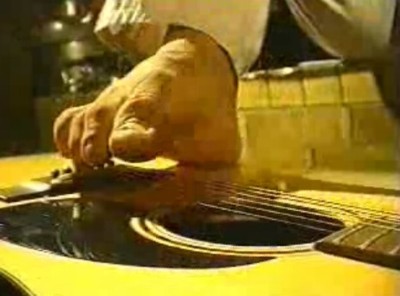
Today a Spanish friend sent the link to a YouTube video about Tony Melendez (here with English sub-titles), a musician from Nicaragua living in the United States. He is playing guitar and giving concerts  – but without hands, since he has no arms. In the video you see him also giving a concert for Pope John Paul 2.

A fascinating demonstration of overcoming handicaps or barriers, even under most difficult situations, when there is a will to do so. An inspiration for many.

tonymelendez.jpg

World Forum of Civil Societies Network UBUNTU – Statement on the 60th Anniversary of the Universal Declaration of Human Rights

Sunday, March 16th, 2008

The World Forum of Civil Society Networks UBUNTU have worked out a very important Declaration on the context of the 60º Anniversary of the Universal Declaration on Human Rights UDHR. This Declaration was published with the first 50 signatures on 14 March 2008 in the International Herald Tribune (London – NY). Since last Friday dozens of people and organizations are signing this Declaration (and we have signed it, too).

The drafters of this Declaration have given a clear message to the world: to reach peaceful societies we need to promote human right to peace, right to development and environment protection.

By signing this Declaration you can express you support of the UDHR.

By the way, the name of the world forum UBUNTU, “is an age-old African term for humaneness – for caring, sharing and being in harmony with all of creation. As an ideal, it promotes co-operation between individuals, cultures and nations.”

globe1.JPG
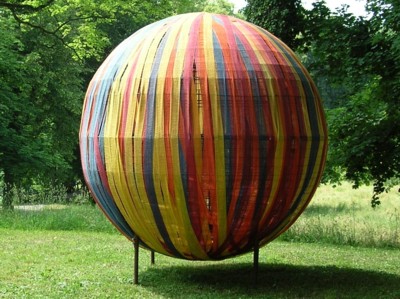
Colourful globe of world union – sculpture in the Elfenau Park, Berne, June 2007

Meditational Networking Initiative

Sunday, March 2nd, 2008

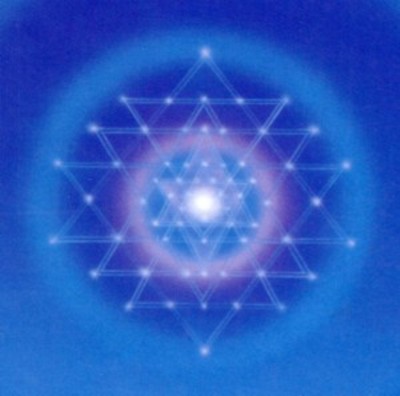
Two weeks ago our spiritual teacher, K. Parvathi Kumar, started a meditation network initiative in the groups called “Networking The Global Diamond Temple for Social Justice” (since yesterday the program and structure are online): The plan of a triangle network was conceived by Master DK, and it started after the Second World War as an inner work. Now this initiative is a continuation of the work, but with a new accent.

The idea is to see that social justice, as conceived by the Masters of Wisdom, is brought nearer to the minds of those who are in the governments through prayers and meditation. Justice from this standpoint is to find a common point where the seeming oppositions merge – neither extreme capitalism nor extreme communism or any “ism” of extremity. Through the meditational work we try to work to supply more light. The light knows where to go and what to do. So this way we are not taking sides and not directly getting into the politics of the governments, but stay away to bring nearer the social justice, to see how to include the welfare of all.

Three members residing in a nation form a triangle. The chosen triangle members will conduct the temple building meditation at 6 AM on Sundays, thus building a Diamond Temple. They are integrating nationally to constitute a national Diamond Temple, then such temple is visualised to integrate with the temple visualized for a continent and the continental temples are visualized to form a Global Diamond Temple. It is offered by the networking groups as a humble contribution to the Masters of Wisdom for their appropriate utilisation to inspire the global, continental and national governments with a view to manifest the plan of social justice.

People might be sceptical about such work and its effect. Of course everybody is free to join or not, and mental scepticism is a sure block-off.

It is my experience that there are few who join, for it requires an understanding beyond intellectual taking note, and also quite a commitment of inner determination. I like such meditational work together with friends, and I am sure that the power of combined focus of beneficial attention has a tremendous influence and is an effective work of good will.

sri_a.jpg

Warren Buffet – Interesting Aspects of his Life

Wednesday, February 27th, 2008

I got today an interesting powerpoint-presentation from a friend in Mysore (which I converted to PDF), about Warren Buffet, said to be now the world’s richest man. Warren Buffet has given 31 billion US$ to good-will activities, especially to the Bill and Melinda Gates foundation.

Have a look at the inspiring presentation. It ends with the words: “The happiest people do not necessarily have the best of all. They simply appreciate what they find on their way.”

fortuna.JPG
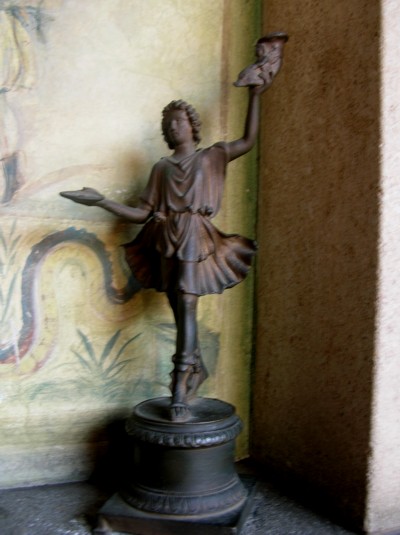
A statue of Fortuna, the Roman goddess of good luck, from Augusta Raurica, Switzerland.

Research into the Spiritual Dimension

Tuesday, February 12th, 2008

I yesterday received an e-mail pointing to the website of the Spiritual Research Foundation SSRF, mentioning that they are doing extensive research in Spiritual Sciences and sharing the benefits obtained from this research freely with all. On the site they write:

“The organisation conducts spiritual research which includes the spiritual realm, along with physical and psychological factors in determining the causative factors behind problems in life. By spiritual realm, SSRF means the realm of heaven, hell, netherworld, etc. which cannot be analysed by conventional research methodologies. It maintains that spiritual research can only be conducted by the use of an advanced sixth sense (ESP) and is more holistic than conventional research methodologies….

The Spiritual Science Research Foundation is dedicated to exploring the Spiritual science and presenting this knowledge to the world in a modern, contemporary and scientific way. This is so that the common man can understand it regardless of race, religion or culture… Our research does not offer any quick fixes to life’s problems, but what we do say is that if you sincerely put into practice the tools we suggest on a daily basis, then you will witness many positive changes in your life just as the seekers of the foundation have experienced.”

They present with practical illustrations a number of topics about which they have done research in the subtle worlds, giving an overview of spiritual causes of difficulties in life, of spiritual research in physical and mental health and of healing or of diverse spiritual facts.

On their site they present spiritual seekers/persons who have the ability of not only perceiving the subtle worlds, but also of reproducing what is perceived in the form of sketches/pictures.

A fascinating field of research, even if there might be speculative parts in it.

ssrf.jpg

A Visit to Rajahmundry

Thursday, January 24th, 2008

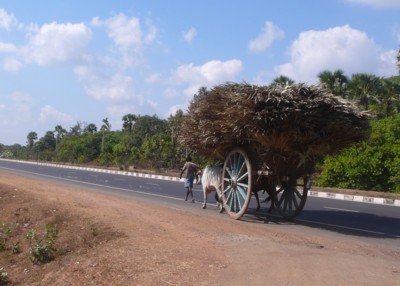
Early Wednesday morning after breakfast the group started for a journey to Rajahmundry. On the highway you could see ox-carts or motor rickshaws going on the verges of the road – and sometimes also a rickshaw came driving in the wrong direction – flexibility.

rajamundri1.JPG
An ox-cart on the highway

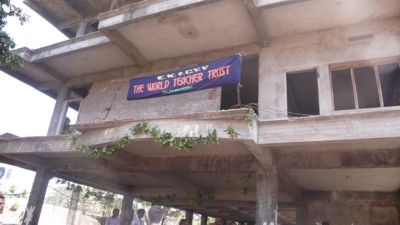
In Rajahmundry the World Teacher Trust is constructing a 5 storey building on the banks of the river Godavari – the 2nd longest and a most holy river of India. On the banks of the river the Government has given to 12 spiritual organisations, who are doing service activities, ground to establish buildings there. Since over 20 years the WTT-Rajahmundry is doing substantial service activities and is well-known in the surroundings.

In Rajahmundry all 12 years, when Jupiter is entering Leo, there is a huge gathering of pilgrims from all over to take a bath in the Godavari during the auspicious time of 12 days. Especially around that time the WTT-brotherhood is caring for pilgrims, offering food and shelter, doing transportation etc. The building is still a structural shell, but will be finished during 2008. The brotherhood offered us a warm welcome and showed us the building, explaining the different activities to be held there in future.

rajamundri2.JPG

After lunch we went to a landing stage and entered a boat, which took us on a 2.5 hours ride up and down the huge river.

rajamundri3.JPG
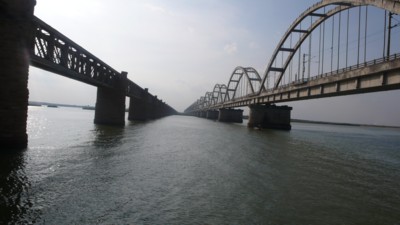
The two bridges in Rajahmundry are the most attractive long bridges found in Andhra Pradesh.

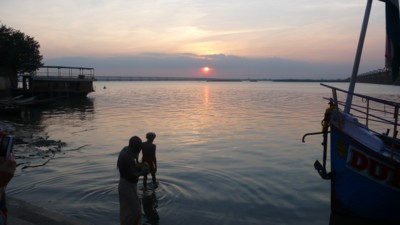
We landed on a sandy beach to enter into the river and enjoy the scene. On the way back to the landing stage the group chanted Purusha Sooktam, Sri Sooktam and other mantrams, while a beautiful sunset shed its light over the river.

rajamundri4.JPG

Afterwards we went to a silent place at the banks of the Godavari River. The river is dedicated to Rishi Gautama, who had been meditating there, and there was a statue of the seer at the river. We sat for a while on the banks for a meditation.
Then we had a short visit to some of the spiritual centres in the immediate vicinity of the WTT-centre: A temple of Lord Dattatreya, where a little pooja was being done, and an ISKON (Hare-Krishna) Temple, where we witnessed singing of Krishna mantrams and an arati (waving camphor light in front of the altar) and returned to the WTT-building for dinner.
The group of Rajamundri had prepared a gift for each of the Western group members, with photo of the future centre in a beautiful golden frame, for the ladies a panjabi dress and a small decorated box and for the men a towel and a little statue of Ganesha.
Later in the evening we returned back to Visakhapatnam, where we arrived after a 4.5 hours drive in the early morning hours.