
erk admin

spacerCircle of Good Will - Blog

Archive for the ‘Stories’ Category

Wisdom Stories

Sunday, June 10th, 2007

I yesterday finished typing my notes from the seminar with Sri K. P. Kumar. The seminar was quite intense, but he gave a lot of illustrations and stories to make abstract thoughts more comprehensible. Here are a few examples and stories, which can be understood without the bigger context:

A businessman was in a shop selling and buying. A madman passed by and asked him: What are you doing? He said: I’m doing business. – What for? – To make profit. – What is profit? – Making 2 out of one. The madman replied: That’s not profit, that is loss. If you make 2, 3, 5, 10 out of one, it is loss. If you make One out of 10, then that is profit. The businessman was confused. He know hot to multiply. We know how to multiply thoughts, money… Multiplication is anti-yoga. Bringing to One from many is yoga. The businessman said: How? Madman: Yoga is to be One, to join, enjoy.

* * * * * * *

The butterfly is totally different from the caterpillar. The flower is totally different from the tree, but it has come from the tree. The Master is totally different from the man, but he has come from the man. Yoga is nothing but cultivation of the field.

* * * * * * *

This is a story related to balancing. There was a Zen master always laughing. We believe that when someone gives us a laughing Buddha we get luck, that is our own perception. The more we seek luck, the more we are in the contrary. That is our own expertise. This Zen master is always laughing like laughing Buddha. He was considered very highly accomplished. In the high land of Tibet they are scarcely habited. One day a disciple requested to be in his house. The master was in the basement, he was in the first floor. In the midnight hours the devotee found him moving on the roof of the house. He knew the master is in the basement, but he found him over there. He asked: What are you doing there, master? Dancing. How did you go there? – I fell up there. We fall down, he fell up. Wherever you keep me, I fall up.
I tell these stories, because we are all inclined to move up. Moving up is possible only when we balance the lateral, then the centripetal and centrifugal, the internalization and externalization.

* * * * * * *

Blind following is not recommended, especially in the Aquarian Age.
On the Indian roads, in the busses, when you travel with speed it is 80 km. When you travel in such busses, there will be a lot of backbone adjustments. Traveling takes long hours, much more so in such busses. A group was traveling at night in such a bus for long hours. The bus stopped because of a problem. The driver said, it takes one hour to repair, stay in the bus and relax. You cannot relax there, so the passengers came out. One looked into the sky, then the next one did the same, then the others. The last one came out and asked: What are you looking into the sky? – I don’t know. No one knew why he was looking. The last one asked all, the first one said: I am not looking at anything; I had a back pain and was stretching, thanks to the bus and the roads.
Like that the humans visualize consciousness. We have that habit. All sheep go without knowing. Like that many people keep on doing it, not knowing what it is. Better know and do it.

* * * * * * *

There was a man who said that rabbits have three legs. Even if you say to him, it has four legs, he would not agree. And he would demonstrate it, holing a rabbit by one leg and showing the other three legs. What do you tell him? Likewise people are fixed with their own viewpoints, they cannot see the others’ viewpoints. Be open to see some more viewpoints. Be open, but be not fixed.

* * * * * * *

There is a nice story in Zen Buddhism:
A man was living all alone. He never had a companion to see. Once he had to travel from one place to the other. On the way when it was dark he had to take a place in a transit house. There was a group living. All sleep in a hall. They went to sleep, but he could not. He was feeling the discomfort.
In some of the side-beds his neighbor saw the person: What is the problem? – I cannot sleep. – Every day or today? – Today. – What is it today? – I am not accustomed to sleep with so many. Tomorrow when I get up, I don’t know who I am when I get up, for there are many. It is like a wave going into the ocean. How do you know it is the same wave in the ocean? When we sleep together, we all become one. When I wake up in the morning, I don’t know who I am. If there are 100 waves merging into the ocean, the waves come out again. How do you identify the waves? You cannot.
That is his problem. The next time he gets up, he has a problem, who I am. The neighbor said: Don’t worry, I shall bind a red ribbon to your body. When tomorrow you get up, by the red ribbon you know. He remembered the colour of the ribbon and comfortably slept. When he was in deep sleep, the other untied the ribbon and tied it around another person. In the morning when he woke up, the ribbon is with the other. There is a great confusion: “I know he is me, but I don’t know who I am – because our identity is by the ribbon of name, form, nationality.
We think we are these ribbons, because we don’t know who we are. There are many stories like this in India.
When we identify ourselves by our peripherals, we are lost. If we daily practice, it will be helpful to identify the wrong identities. The real identity is, I am That and That I am. Other identities are bound to mislead you.

wisdom.JPG
Wisdom stories are colourful illustration for a better digestion of ideas. Photo: India 06

Transmutation to Brilliancy (3)

Monday, April 23rd, 2007

Our friend, a healing practitioner, whom we visited last weekend, has been involved with Qi-Gong since 1990 with Master Zhi Chang-Li. He had come to Europe in 1988 in order to spread here the teaching of Qi-Gong. Our friend told us that in the beginning of his teachings the Master still was hesitating a lot what to give out to the people seeking instructions and what not. For in the traditional teaching a teacher formed just one student, who had to undergo a very severe and long training. It is not possible to impart the teachings through mere teaching, but through intense integration into life. Master Li had been in a process of learning since his early youth, also during the times of the cultural revolution, when all spiritual tradition were violently suppressed in China.

One little story our friend told from Master Li was about how students were tested that they were mastering the life-giving energy Chi: They were brought to the snowy mountains and clad in wet towels to stay out there over night. Next morning the teacher was looking, not only if the student was having warm, but also how much snow around him he could get melted through the heat he had created in his inner…

I don’t want to retell here the stories about the life of Master Li our friend reported to us. What impressed me most was that through incredible hardships and strict training a process of deep transformation took place. Thus the wisdom slowly shone forth and found a living expression. It is like with carbon dusk being transformed under extreme pressure to a diamond. Chemically carbon and diamond have the same substance, but only through transmutation the brilliance is gained.

kugel.JPG

Little Events of Teaching Practical Wisdom (2)

Monday, April 23rd, 2007

Over two decades ago my friend had invited Master EK to his house in Munich to give lectures to interested persons. He was deeply touched by the freshness and naturalness with which the master was expressing spirituality in all aspects of life.

Once they were walking through some shoppings streets in the centre of Munich, when a derelict person came along, obviously being under the influence of alcool. Someone of the people accompanying the master expressed his disgust about the dosser, but the master simply replied: “He is God, too.”

* * * * * * *

My friend had a beautiful old Art Nouveau villa in Munich, where the seminars with Master EK were going on. A lady remarked to the master: “Such a big house, just for one person.” The master only replied: “He is sharing it with others.”

* * * * * * *

In the assembly hall where the lectures were taking place everybody was chitchatting or preparing something, so that nobody noticed the master entering the room. He went to his place and starting intonating the mantram with which he used to begin his lectures. Everybody rushed to their places. The master started his lesson speaking about discipline.

My friend said the master was absolutely right reminding the people of getting into attention, but he might have felt that he was strict in his words. For in the evening, in a small round, the master was joking and playing magical tricks, as if he wanted to express: Look, everything has its time, there is not just only discipline, and I’m not a rigid fellow.

* * * * * * *

The master was fond of cooking, and he loved preparing delicious meals for the whole group. He was doing it full of joy. In this he was throwing away some vegetables which weren’t totally fresh any longer. Someone mentioned that he is wasting the materials. He remarked it, continued his work, but the joyful expression was away. He didn’t say anything, but it was as if he wanted to express that criticising is like tossing away joy.

* * * * * * *

My friend had planned to organise more seminars with Master EK near Munich on specific topics, but the master surprisingly passed over in March 84, so that all further plans had to be cancelled. The work, however, went on a few years later with Master KPK, whom Master EK had prepared for continuing his impulse.

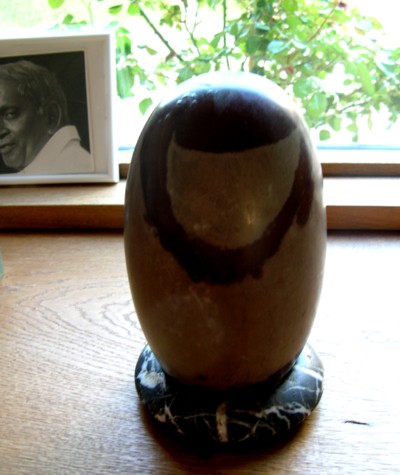
eklingam.JPG
Lingam stone with a picture of Master EK

A friend from Argentina translated this blog-post into Spanish (PDF).

We are the Donner Party

Saturday, February 24th, 2007

A friend from Reno, Nevada, US, sent me a copy of a little article on the lessons learned from the “Donner Party.” The Donner’s were a German family who helped organize a wagon train to travel to California 150 years ago. Of the 90 souls who set out to go West about half of them died in the Sierra Nevada Mountains at a place that is called Donner Lake today. The story of the Donner tragedy is very familiar in the Western USA. Some of the party, in order to survive starvation, ate the remains of those who had died.

Frank Mullen, author of the book “The Donner Party Chronicles”, writes: “They were like us because we make the same mistakes. Nothing has really changed. They are us in every way. Their hopes and dreams. Their desire to be heroic. Their ‘watch out for number one’ attitude. In a sense we haven’t learned anything from history. I think we seldom do. We make the same mistakes. We allow the same divisions of class, race, national origin, and wealth to keep us apart. We act the same way, except maybe in a big flood like the one we had in Reno last year, where we saw homeless people filling sand bags beside casinos bosses downtown. But you see it in most cases of adversity in general life and in politics especially, where people blame each other instead of working together.”

“It’s really a human story. And when you see the human personalities in the Donner Party, when you see how people reacted to adversity, you realize you know people like Donner, Reed, Breen, and the others. We really know these people because they haven’t changed much in 150 years. … You see this with environmental problems and what to do with the homeless… Prejudices tend to lump people together and say, ‘Let’s get rid of all of them.’ But there’s something wrong with the logic of that. It doesn’t work.”

Read
the article if you have time.

mongolia.JPG

Gobi Desert

Urban Legend on “Does Evil Exist?”

Tuesday, January 2nd, 2007

Two days ago I got a Powerpoint-presentation entitled “Does Evil Exist?” (1.7 MB), with beautiful photos. The story is supposed to be an incident from the life of Albert Einstein, but a look into Google quickly showed that it was an urban legend, using Einstein and the atheist professor as stereotypes. Nevertheless it is a nice story, and legends are also illustrating the search for truth. Here it goes:

The university professor challenged his students with this question. Did God create everything that exists? A student bravely replied, “Yes, he did!” “God created everything? The professor asked. “Yes sir”, the student replied. The professor answered, “If God created everything, then God created evil since evil exists, and according to the principal that our works define who we are then God is evil”. The student became quiet before such an answer.

The professor was quite pleased with himself and boasted to the students that he had proven once more that the Christian faith was a myth. Another student raised his hand and said, “Can I ask you a question professor?” “Of course”, replied the professor.
The student stood up and asked, “Professor, does cold exist?” “What kind of question is this? Of course it exists. Have you never been cold?” The students snickered at the young man’s question. The young man replied, “In fact sir, cold does not exist. According to the laws of physics, what we consider cold is in reality the absence of heat. Every body or object is susceptible to study when it has or transmits energy, and heat is what makes a body or matter have or transmit energy. Absolute zero is the total absence of heat; all matter becomes inert and incapable of reaction at that temperature. Cold does not exist. We have created this word to describe how we feel if we have no heat.”

The student continued, “Professor, does darkness exist?” The professor responded, “Of course it does.” The student replied, “Once again you are wrong sir, darkness does not exist either. Darkness is in reality the absence of light. Light we can study, but not darkness. In fact we can use Newton’s prism to break white light into many colors and study the various wavelengths of each color. You cannot measure darkness. A simple ray of light can break into a world of darkness and illuminate it. How can you know how dark a certain space is? You measure the amount of light present. Isn’t this correct? Darkness is a term used by man to describe what happens when there is no light present.”

Finally the young man asked the professor, “Sir, does evil exist?” Now uncertain, the professor responded, “Of course as I have already said. We see it every day. It is in the daily example of man’s inhumanity to man! It is in the multitude of crime and violence everywhere in the world. These manifestations are nothing else but evil.”

To this the student replied, “Evil does not exist sir, or at least it does not exist unto itself. Evil is simply the absence of God. It is just like darkness and cold, a word that man has created to describe the absence of God. God did not create evil. Evil is not like faith, or love that exist just as does light and heat. Evil is the result of what happens when man does not have God’s love present in his heart. It’s like the cold that comes when there is no heat or the darkness that comes when there is no light.”
The professor sat down.

The young man’s name – Albert Einstein.

A Story about the Magic of the Heart

Tuesday, December 12th, 2006

I just got a link from a friend of a beautiful animated short film (7 min) called “The Potter“, done by the young animator Josh Burton and a team of friends. The film was Josh Burton’s final senior thesis project for Savannah College of Art and Design completed in 2005.

The Potter is an ancient creature who gives life to clay. In his care is an apprentice who wants learn how. It is a story full of magic, about how to learn using the heart. Here it goes directly to the film.

A Touching Story about Appreciation

Wednesday, November 29th, 2006

Today I got an e-mail from a friend forwarding a nice story in German about the power of appreciation and recognition. It seemed that it was translated from English, so I “googled” it out and found several versions of the story, which is said to be true (by “truth or fiction”). So here it is:

ALL GOOD THINGS
By Sister Helen P. Mrosla
He was in the first third grade class I taught at Saint Mary’s School in Morris, Minn. All 34 of my students were dear to me, but Mark Eklund was one in a million. Very neat in appearance, but had that happy-to-be-alive attitude that made even his occasional mischievousness delightful.

Mark talked incessantly. I had to remind him again and again that talking without permission was not acceptable. What impressed me so much, though, was his sincere response every time I had to correct him for misbehaving – “Thank you for correcting me, Sister!” I didn’t know what to make of it at first, but before long I became accustomed to hearing it many times a day.

One morning my patience was growing thin when Mark talked once too often, and then I made a novice teacher’s mistake. I looked at Mark and said, If you say one more word, I am going to tape your mouth shut!” It wasn’t ten seconds later when Chuck blurted out, “Mark is talking again.” I hadn’t asked any of the students to help me watch Mark, but since I had stated the punishment in front of the class, I had to act on it. I remember the scene as if it had occurred this morning. I walked to my desk, very deliberately opened my drawer and took out a roll of masking tape. Without saying a word, I proceeded to Mark’s desk, tore off two pieces of tape and made a big X with them over his mouth. I then returned to the front of the room.

As I glanced at Mark to see how he was doing, he winked at me. That did it! I started laughing. The class cheered as I walked back to Mark’s desk, removed the tape, and shrugged my shoulders. His first words were, “Thank you for correcting me, Sister.” At the end of the year, I was asked to teach junior-high math. The years flew by, and before I knew it Mark was in my classroom again. He was more handsome than ever and just as polite. Since he had to listen carefully to my instruction in the “new math,” he did not talk as much in ninth grade as he had in third.

One Friday, things just didn’t feel right. We had worked hard on a new concept all week, and I sensed that the students were frowning, frustrated with themselves and edgy with one another. I had to stop this crankiness before it got out of hand. So I asked them to list the names of the other students in the room on two sheets of paper, leaving a space between each name. Then I told them to think of the nicest thing they could say about each of their classmates and write it down. It took the remainder of the class period to finish their assignment, and as the students left the room, each one handed me the papers. Charlie smiled. Mark said, “Thank you for teaching me, Sister. Have a good weekend.”

That Saturday, I wrote down the name of each student on a separate sheet of paper, and I listed what everyone else had said about that individual. On Monday I gave each student his or her list Before long, entire class was smiling. “Really?” I heard whispered. “I never knew that I� meant anything to anyone!” “I didn’t know others liked me so much.” No one ever mentioned those papers in class again.

I never knew if they discussed them after class or with their parents, but it didn’t matter. The exercise had accomplished its purpose. The students were happy with themselves and one another again.

That group of students moved on. Several years later, after I returned from vacation, my parents met me at the airport. As we were driving home, Mother asked me the usual questions about the trip, the weather, my experiences in general. There was a lull in the conversation. Mother gave Dad a sideways glance and simply says, “Dad?” My father cleared his throat as he usually did before something important. “The Eklunds called last night,” he began “Really?” I said. “I haven’t heard from them in years. I wonder how Mark is.”

Dad responded quietly. “Mark was killed in Vietnam,” he said. “The funeral is tomorrow, and his parents would like it if you could attend.”

To this day I can still point to the exact spot on I-494 where Dad told me about Mark. I had never seen a serviceman in a military coffin before. Mark looked so handsome, so mature. All I could think at that moment was, “Mark, I would give all the masking tape in the world if only you would talk to me.”

The church was packed with Mark’s friends Chuck’s sister sang “The Battle Hymn of the Republic.” Why did it have to rain on the day of the funeral? It was difficult enough at the graveside. The pastor said the usual prayers, and the bugler played taps. One by one those who loved Mark took a last walk by the coffin and sprinkled it with holy water. I was the last one to bless the coffin. As I stood there, one of the soldiers who acted as pallbearer came up to me. Were you Mark’s math teacher?” he asked. I nodded as I continued to stare at the coffin. “Mark talked about you a lot,” he said.

After the funeral, most of Mark’s former classmates headed to Chuck’s farmhouse for lunch. Mark’s mother and father were there, obviously waiting for me. “We want to show you something, his father said, taking a wallet out of his pocket. “They found this on Mark when he was killed. We thought you might recognize it.”

Opening the billfold, he carefully removed two worn pieces of notebook paper that had obviously been taped, folded and refolded many times. I knew without looking that the papers were the ones on which I had listed all the good things each of Mark’s classmates had said about him. “Thank you so much for doing that,” Mark’s mother said. “As you can see, Mark treasured it.”

Mark’s classmates started to gather around us. Charlie smiled rather sheepishly and said, “I still have my list. I keep it in the top drawer of my desk at home.” Chuck’s wife said, “Chuck asked me to put his in our wedding album.” ”I have mine too,” Marilyn said. “It’s in my diary.”

Then Vicki, another classmate, reached into her pocketbook, took out her wallet and showed her worn and frazzled list to the group. I carry this with me at all times,” Vicki said without batting an eyelash. “I think we all saved our lists.” That’s when I finally sat down and cried. I cried for Mark and for all his friends who would never see him again.

The density of people in society is so thick that we forget that life will end one day. And we don’t know when that one day will be. So please, tell the people you love and care for, that they are special and important. Tell them, before it is too late.

Most Unusual Therapist

Monday, August 28th, 2006

Today I got an e-mail from a friend with the following text of a newsletter, which I put below, because it is quite interesting. Thought the authors website might sound a bit ballyhooing, it shows up principles in accordance with the wisdom teachings. There was also a reference to a website on huna and ho’oponopono mentioned in the text, a very ancient wisdom conserved on Hawaii. Enjoy the text:


“Truth is often stranger than fiction. Anyone who is aware of recent research conclusions in frontier science (such as in entanglement physics, quantum mechanics, astronomy, astro-biology, etc) would readily agree. Actually, recent frontier science can be used to, at least, partially explain the „strange“ technique of the „World’s Most Unusual Therapist.”

PS If the article seems to you to be complete fantasy without even a 5% probability of possibility, try these phrases (copy and paste each line, separately for each search, as is written below) into your Internet browser’s search engine (such as WebCrawler, Clusty, or even Google) on the World Wide Web; very interesting “stuff!“ Then reread the article.

  • “entanglement physics“
  • „action at a distance“ „physics“
  • “Time reversal symmetry“
  • „neuro synchrony“
  • “water molecules” “Emoto“
  • „Evoked potential“
  • “Biology of Belief“
  • “role of the observer in scientific experimentation” “physics“

All truth goes through three stages.
First it is ridiculed.
Then it is violently opposed.
Finally, it is accepted as self-evident.

Arthur Schopenhauer


The World’s Most Unusual Therapist

by Dr. Joe Vitale

Two years ago, I heard about a therapist in Hawaii who cured a complete ward of criminally insane patients–without ever seeing any of them. The psychologist would study an inmate’s chart and then look within himself to see how he created that person’s illness. As he improved himself, the patient improved.

When I first heard this story, I thought it was an urban legend. How could anyone heal anyone else by healing himself? How could even the best self-improvement master cure the criminally insane?

It didn’t make any sense. It wasn’t logical, so I dismissed the story.

However, I heard it again a year later. I heard that the therapist had used a Hawaiian healing process called ho ‘oponopono. I had never heard of it, yet I couldn’t let it leave my mind. If the story was at all true, I had to know more.

I had always understood “total responsibility” to mean that I am responsible for what I think and do. Beyond that, it’s out of my hands. I think that most people think of total responsibility that way. We’re responsible for what we do, not what anyone else does. The Hawaiian therapist who healed those mentally ill people would teach me an advanced new perspective about total responsibility.

His name is Dr. Ihaleakala Hew Len. We probably spent an hour talking on our first phone call. I asked him to tell me the complete story of his work as a therapist. He explained that he worked at Hawaii State Hospital for four years. That ward where they kept the criminally insane was dangerous. Psychologists quit on a monthly basis. The staff called in sick a lot or simply quit. People would walk through that ward with their backs against the wall, afraid of being attacked by patients. It was not a pleasant place to live, work, or visit.

Dr. Len told me that he never saw patients. He agreed to have an office and to review their files. While he looked at those files, he would work on himself. As he worked on himself, patients began to heal.

“After a few months, patients that had to be shackled were being allowed to walk freely,” he told me. “Others who had to be heavily medicated were getting off their medications. And those who had no chance of ever being released were being freed.”

I was in awe.

“Not only that,” he went on, “but the staff began to enjoy coming to work. Absenteeism and turnover disappeared. We ended up with more staff than we needed because patients were being released, and all the staff was showing up to work. Today, that ward is closed.”

This is where I had to ask the million dollar question: “What were you doing within yourself that caused those people to change?”

“I was simply healing the part of me that created them,” he said.

I didn’t understand.

Dr. Len explained that total responsibility for your life means that everything in your life – simply because it is in your life–is your responsibility. In a literal sense the entire world is your creation.

Whew. This is tough to swallow. Being responsible for what I say or do is one thing. Being responsible for what everyone in my life says or does is quite another. Yet, the truth is this: if you take complete responsibility for your life, then everything you see, hear, taste, touch, or in any way experience is your responsibility because it is in your life.

This means that terrorist activity, the president, the economy–anything you experience and don’t like–is up for you to heal. They don’t exist, in a manner of speaking, except as projections from inside you. The problem isn’t with them, it’s with you, and to change them, you have to change you.

I know this is tough to grasp, let alone accept or actually live. Blame is far easier than total responsibility, but as I spoke with Dr. Len, I began to realize that healing for him and in ho ‘oponopono means loving yourself. If you want to improve your life, you have to heal your life. If you want to cure anyone–even a mentally ill criminal–you do it by healing you.

I asked Dr. Len how he went about healing himself. What was he doing, exactly, when he looked at those patients’ files?

“I just kept saying, ‘I’m sorry’ and ‘I love you’ over and over again,” he explained.

That’s it?

That’s it.

Turns out that loving yourself is the greatest way to improve yourself, and as you improve yourself, your improve your world. Let me give you a quick example of how this works: one day, someone sent me an email that upset me. In the past I would have handled it by working on my emotional hot buttons or by trying to reason with the person who sent the nasty message. This time, I decided to try Dr. Len’s method. I kept silently saying, “I’m sorry” and “I love you,” I didn’t say it to anyone in particular. I was simply evoking the spirit of love to heal within me what was creating the outer circumstance.

Within an hour I got an e-mail from the same person. He apologized for his previous message. Keep in mind that I didn’t take any outward action to get that apology. I didn’t even write him back. Yet, by saying “I love you,” I somehow healed within me what was creating him.

I later attended a ho ‘oponopono workshop run by Dr. Len. He’s now 70 years old, considered a grandfatherly shaman, and is somewhat reclusive. He praised my book, The Attractor Factor. He told me that as I improve myself, my book’s vibration will raise, and everyone will feel it when they read it. In short, as I improve, my readers will improve.

“What about the books that are already sold and out there?” I asked.

“They aren’t out there,” he explained, once again blowing my mind with his mystic wisdom. “They are still in you.”

In short, there is no out there.

It would take a whole book to explain this advanced technique with the depth it deserves. Suffice it to say that whenever you want to improve anything in your life, there’s only one place to look: inside you.

“When you look, do it with love.”

This article is from the forthcoming book “Zero Limits” by Dr. Joe Vitale and Dr. Len. Copyright © 2005 by Joe Vitale. All rights reserved. You may forward this in its entirety to anyone you wish.


From Wasteland to Paradise

Wednesday, August 2nd, 2006

You might have come across in the media about the amazing true story of a baby hippo having lost his mother during a tsunami and got adopted by a tortoise, a story about love and acceptance, which even was published as a children’s book, Owen and Mzee – The True Story Of A Remarkable Friendship.
Even more interesting is the story about the Haller Park, in which this animal romance happened:
In 1952, a Swiss company, Cementia Holding AG Zurich, built a cement factory in Kenya just behind the palm-fringed Bamburi Beach, 12 kilometres north of Mombasa, which became the biggest of Kenya’s industrial giants, and East Africa’s biggest cement producer, but which destroyed the ecosystem of the area. In 1959, the plant hired Dr Rene Haller, a young agronomist from Lenzburg in Switzerland, with the mandate to produce food – fruit and vegetables – for employees of the factory, many of whom were undernourished, as well as spruce up the area surrounding the site. In the 1970s he started a unique ecological experiment, attempting to rehabilitate the limestone quarries scarring the Mombasa coastline. Today he has transformed much of the seven square kilometre Bamburi site from a barren and dusty lunar landscape to an ecological haven. The quarries are now a combination of lakes, wetlands and savannah grasslands, with walking and cycling trails, as well as a Nature Park and Wildlife Sanctuary – nearly 100,000 visitors came in 2002.
Dr. Haller published a book called From Wasteland to Paradise, where he presents the remarkable history of the transformation. Rene Haller recalls “The ugly wasteland expanded annual by tens of thousands of square meters. No plants seemed able to establish themselves. I spent countless hours in the hot dusty barren land, found a few ferns and perhaps half a dozen� grasses struggling to take root� – it was hardly an encouraging environment for tree planting. However one day I discovered in a remote part of the quarry five small casuarina trees . Finally I had found some life which inspired me – a glimmer of hope giving a direction which might be worthwhile following”.
His “Baobab Trust” is a charitable organisation committed to working closely with the surrounding local communities to develop innovative environmental and wildlife conservation practices.

Fairy Tales and the Journey of the Soul

Wednesday, June 7th, 2006

Last week a friend from Germany sent us a folder with two fairy tailes of the Brothers Grimm and thoughts from her and from a group work. It is fascinating to see how the genuine folk tales contain in a symbolic form teachings of eternal wisdom stirring the souls of the readers or listeners. Many modern scientists think the tales, often full of seemingly cruel adventures, are expressions of existential fear and need to be “purged” before reading them to children. But when you read them with a spiritual understanding, you see that they are telling about the path of the soul. The soul,� encaged in matter, through a long journey (of many lives) finds back to a union with its origin.
One of the tales I got was about a girl whose hands were cut off to avenge a curse of the devil on her father, who later got silver hands, then, because of her pure life, new hands and finally found union with her husband, the king. The hands represent our attachment to material life (the grip) and silver or moonlight the denser worlds of matter. The girl are we as a soul, who finally finds back to an eternal life with the spirit-king.
This tale deeply touched me, because it expresses the inner urge towards light which is a thread through my life.