erk admin

spacerCircle of Good Will - Blog

Archive for the ‘Spiritual Life’ Category

Eastern and Western Minds

Thursday, June 7th, 2007

A thought from Tuesday’s talk with Sri Kumar came to my mind. He mentioned in our conversation that the Indian minds are generally more lithesome than the minds of Westerners. They don’t hold to an idea like we tend to do here. This makes it more difficult for them to plan and organise, but they don’t get stuck so much in concepts. Their mind is closer to the abstract realms, to the planes of energy or Buddhi. In the West the concrete mind is strongly developed, focused on efficiency and achievement.

For an Indian mind it is easy to look to a theme from many sides, again and again. I am fascinated how Sri Kumar in his lectures elaborates themes of the wisdom teachings from many angles, illustrating them with a variety of lively stories. I myself would think that all has already been said by mentioning a few aspects of a topic, but when you go deeper into it and ponder on different layers and facets, a movement of thoughts gives rise to a flow, which is nourished by the radiance of a subtle energy or light.

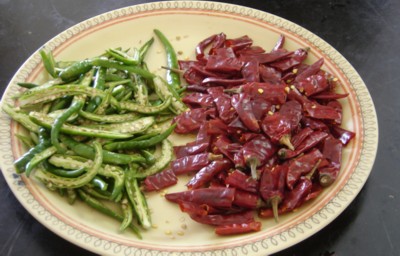
chili.jpg
Eastern and western approaches… Some Indian chilis

Signs from Subtle Worlds

Monday, June 4th, 2007

Having yesterday came back from an intense one week seminar on Yoga and Transcendence with Sri K. Parvathi Kumar in Kandersteg, which was fascinating, but not so suited for blogging… It was much focused on experiencing inner dimensions and gaining the related understanding. Meditating and focusing on subtle topics with about 200 people creates a field of vibrating energy which for me is very thrilling.The seminar was also inspiring because of meeting a lot of friends from different countries and continents and have exchanges with them.

When this evening I went through the pictures I took one jumped into my eyes, though seemingly uninteresting. I had been taking several pics of the Blümlisalp-Mountain from out of the hotel window at different times of the day. On one I had taken last Wednesday at about 5 o’clock in the morning, there were all over the photo balls of different size. You can recognize them in the sky:

devas1a_400.jpg
Click on the photo to see it enlarged (also the other picture).

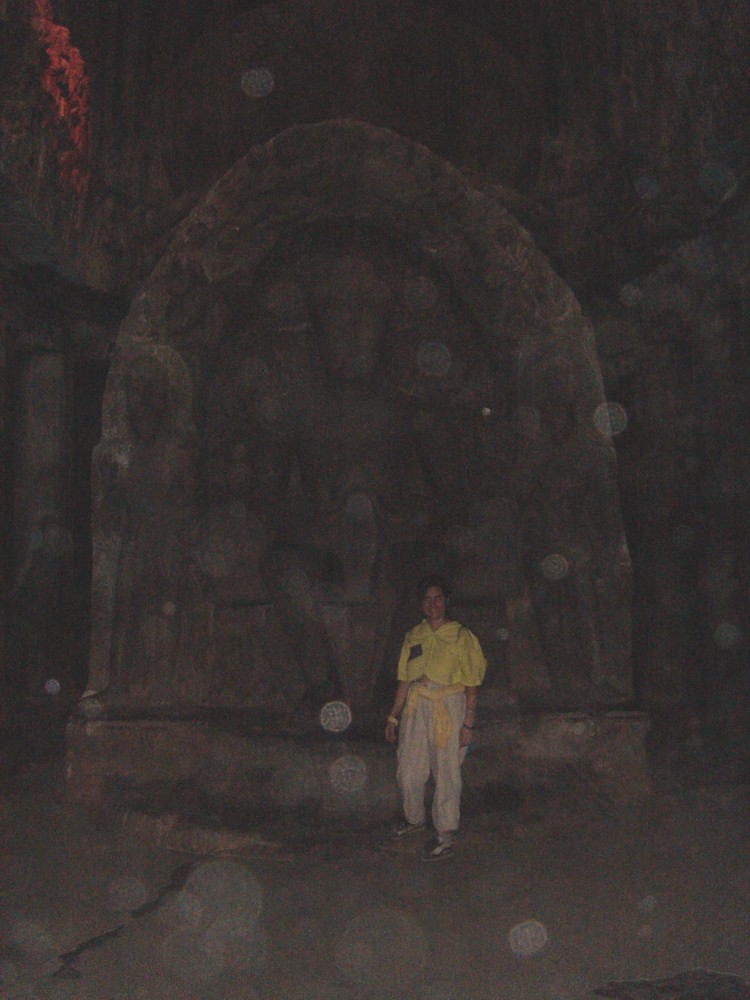
It is the only photo of all the pictures with these circles. But they reminded me of a series of photos a friend from Spain had taken in the Ajanta caves in India, where exactly the same balls had appeared, and this in the holy atmosphere of the temple caves. He told me that these were energy patterns of subtle beings, devas, and that also other people had made such photos. Here is one pic of this series:

devas3_400.jpg

It is easy and common to intellectualize these phenomena away, while others might be getting enthusiastic about such things manifesting, like for example Crop Circles (here a recent Lotus manifestation). For me they don’t have a value in themselves but are messengers, symbols or ciphers of the subtle worlds, pointing to that which is beyond.

For a deeper understanding of these energies you might like to read the Lunar Messenger on Cooperation with the Devas.

An Exchange on Astrology

Saturday, May 26th, 2007

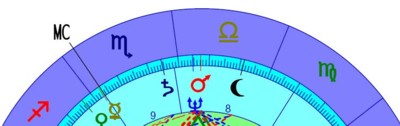
Yesterday a friend came for a night’s stay. He is an astrologer from the French Pyrenees whom I came to know via the good-will website and who is going with us to the seminar of the World Teacher Trust, with Dr. K. Parvathi Kumar, which is starting today. He is a full-time astrologer and has a very deep focus on Spiritual Astrology. We had a very lively exchange on various topics and his explanation of charts opened some new vistas of understanding for me. He sees himself in the ancient tradition of French occult astrologers and is expanding this through his understanding of Eastern wisdom.

Though misused a lot, and for a good deal a subtle science of intuition, you can gain through this wisdom key insights on themes of your live, helping to direct you on the steps ahead on your path.

chart.jpg

Eating the Leopard Cub, or The Subtle Meaning of Language

Monday, May 21st, 2007

My African friend from Congo (see the previous blogpost on Finding our Common Origin – Sanskrit and Kikongo Wisdom Teachings) just sent me a page with reflections about the veiled significance of eating: “Tell me what you eat, and I will tell you who your are“. A few extracts:

In the Kongo tradition, there is an expression related to both material and spiritual nutriment. Besides, the Kingdom of Kongo is picturesquely seasoned with cooking implements, hence the frequently used expression “MAKUKU MATATU MALAMBA KONGO” (Three fireplaces serving to cook Kongo) putting forward the tasty side of full existence as concocted by Nabi Kongo (Kongo Great Initiates).

On the other hand, the following formula comes as buzz words: ” Muana Ngo Tu Dia” = We are going to eat the leopard cub”. As regards the importance attached to this animal in most African societies (representing inter alia a symbol of royalty), the above-mentioned expression evokes a situation in which an emergency solution is a must on a given fact or problem undermining life in the village; otherwise, no one is entitled to escape from the case.

From the spiritual standpoint, words generally assuming double sense in Kikongo (a matter-of-fact sense and a lofty one), this means attaining self-realisation; The Multiple must merge into the One, to reach the Buddhist nirvana, moksha, Unio Mystica or triumph over the wheel of incarnations, uplifting towards celestial spheres.”

Enjoy reading.

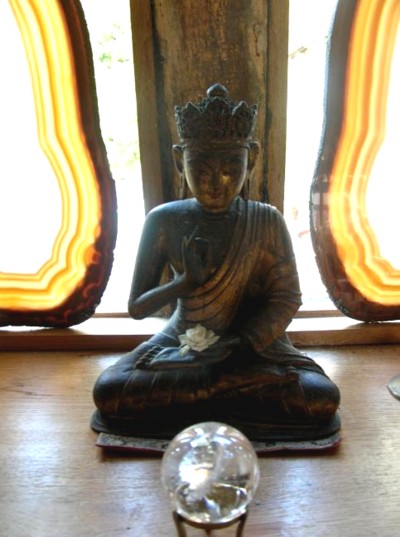
buddha.jpg
Buddha statue in the house of a friend

Cosmic and Kitchen Conflicts

Saturday, May 19th, 2007

During yesterday’s study group, while reading a transcription of a seminar by Sri K. P. Kumar on the Secret Doctrine, we came across a caption that there were failures on the subtle planes with the creation of the earth by the creative intelligences (devas), just as there are failures with what human beings are doing. We shouldn’t understand the devas as infallible. And just like people with power try to hide their mistakes or even justify them by making or manipulating laws in their favour, the same can be observed with these intelligences. However, in the long run they are getting into other cycles of adjusting and learning.

I like this idea. It is so very human and common in day-to-day life. You can also observe it in your own behaviour. I’m talented in creating excuses, also before myself, and observe the same with others:

Yesterday, a “low energy day”, I grew angry with my wife that the children hadn’t cleared their mess in the kitchen. With this simmering anger I got them do the washup.

For me, I was sure my growing angry was because of the mess of the children and that they had preferred gaming to cleaning up. Only later I came to see that already before that I felt a bit imbalanced. Out of this, my dealing with the kitchen situation came much more from my predisposition than from the actual situation.

pig.jpg

The White Lotus

Tuesday, May 8th, 2007

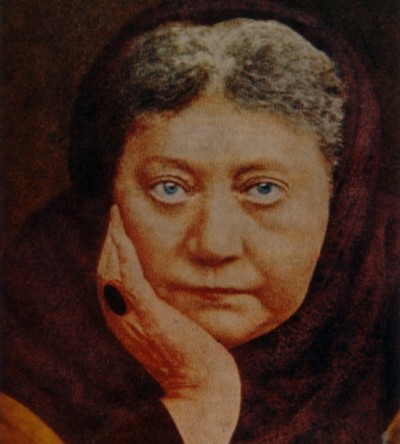
Today, 8th May, is not only the annual World Red Cross Red Crescent Day (the birthday of Henry Dunant, the founder of the Red Cross, this year’s motto: “Together for Humanity”), but also a more silent commemoration day, the White Lotus Day, the day of the passing of Helena P. Blavatsky (HPB) on May 8, 1891.

One year ago, I wrote already a blogpost about it, mentioning the little booklet I published two years ago: “H.P.B. – Trailblazer for the Aquarian Age” (free download). There is also an inspiring talk by K. Parvathi Kumar on The White Lotus.

The Lotus symbolises the life of man and also that of the Kosmos. The symbol stands for the principle of unfoldment and it is recommended for meditation. If you follow the right steps, the inner energy centres called chakras (: wheels) transform into lotuses. You might read more about it in the Lunar Messenger on Chakras and Lotuses.

white_lotus.jpg
Cover of the book The White Lotus, by K. Parvathi Kumar

HPB has let quite an impact in my life. In the 80ies I was fascinated over several years by the title of her opus magnus, The Secret Doctrine, without buying it. When I finally got it (5 volumes, nothing for casual reading), I had a dive through it, without understanding much. In the 90ies I studied the volumes for a second, and in the last years for the third time. (now in English). I like reading a little passage every morning after meditation, its great panorama of life opens up the view, before entering into the daily hustle and bustle. One sentence from this morning’s reading, Vol. I, Cosmogenesis, p. 56:

“No man is conscious of more than that portion of his knowledge that happens to have been recalled to his mind at any particular time, yet such is the poverty of languages that we have no term to distinguish the knowledge not actively thought of, from knowledge we are unable to recall to memory. To forget is synonymous with not to remember. How much greater must be the difficulty of finding terms to describe, and to distinguish between, abstract metaphysical facts or differences?”

hpb.jpg
Helena P. Blavastky (1831.1891)

Good Will Networking and Perseverance

Friday, May 4th, 2007

In the last weeks I had been working on compiling the elements for the Annual Report of the World Teacher Trust (WTT). Groups and individuals from different countries of the West, which feel related with this movement, have sent reports, about group livings (seminars) and about their good-will activities in different fields of social service activities as well as their spiritual work. The report is mostly in English, some contributions also in the local languages of the groups.

I have been doing the co-ordination and editing now since five years. Though it is quite some work, I like it. It is very inspiring to see the manifold good-will initiatives. In the course of the years several substantial activities have arisen out of the spiritual impulse of the WTT and our teacher, Dr. K. P. Kumar.

What fascinates me with this movement is that the focus on practice arises out of a deep spiritual impulse, and in general there is a hearty relation in the network of people. For me the annual report is an occasion to keep in contact with a number of persons. So it is a good networking instrument. It will be circulated to the groups and interested individuals in the course of May, but not in public. People committed to good work in silence don’t want their names to go out.

The report also makes me think of how difficult it is for many to establish a good balance between the different fields of life: Professional work for maintaining the living, family life, social contacts to keep good exchanges, then, for those who walk the spiritual path, maintaining a regular rhythm of inner work, plus some kind of a service activity. The report is for me a good testimony how people grow when they work with these essentials.

I come across others who lose themselves in fancies, in books and in imagining about sublime topics. Interested in many things they fail to focus on the essential and to go into depth. Respecting the basics is most important to gain a stable foundation. And building the foundation often takes years of perseverance.

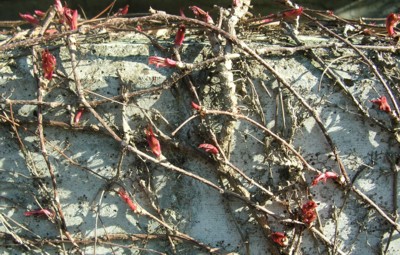
wall.jpg
The network of sprouting life

Nordic Links with the Ancient Mythology and Language

Tuesday, April 24th, 2007

A friend from Sweden sent me the following lines as a comment to the blogpost “Finding our Common Origin – Sanskrit and Kikongo Wisdom Teachings“:

“Also here in the North we have strong links with the ancient mythology and language. Madame Blavatsky writes in the Secret Doctrine that the Norse mythology is older than the Vedas, and that Egypt was colonised by emigrants from India. The Nile (“the Blue”) got its name from a river in India, just as today we find York in England and New York in the USA.

Some few examples: Not far from there I live here in Sweden there are some mountains with a unique geology, not found anywhere else, with intriguing names like “Omberg” (OM), “Hunneberg” (Dogmountain), “Halleberg” (Halla is an abode of a god as in Shambhala/Shamballa), and “Kinnekulle” there “Ki” is pronunced as Chi or Qi (life force). There is also “the quiet (or serene) mountain” – Lugnås. Berg/ås/kulle all mean mountain. We also have a holy cow named “Audhumbla”, which is the Vedic “Vach” and the Egyptian “Hathor”.

Karl means man, or great man. The Great Bear is called Karlavagnen, or the wagon of Karl. The worldtree is Ask which in English is Ash, and may have been Ash in ancient Swedish. Maybe to farfetched, but Kailash may be related.

In the end of time, the world will disappear and with that evil creatures, and a new more beautiful world will appear. The highest god Odin, who is one-eyed, will then also disappear and his son Balder will be the new highest god, just as Sanat Kumara, “the old man”, will stay with us until the end of time. The two Ravens which inform Odin about the world are called Hugin and Munin.

But also the new world will disappear, and yet another is to follow, and so on.

A legend here says that you can be teleported between Kinnekulle and Omberg. Monks at a monastery located at Omberg watched an area at Kinnekulle for centuries, and did not let in visitors. They were said to go forth and back by teleportation (some twenty or thirty kilometers, I think). This area was closed until recently. I visited it with a friend, but no teleportation occurred 🙂

The Nordic mythology has a preference over the mythologies of the rest of Europe as it is not mixed up with a lot of different influences, as e.g. Hellenistic and Egyptian mythologies.

The symbols and the legends move with us. There is an old temple for Isis worship in England, and the vikings frequently went to the English islands. May there have been a movement from the North to the East to the West, and the circle symbolically closed there, in that English Isis temple? And from Egypt other circles have appeared, towards the American continents and deep down into Africa. Today we can unwind our own past footsteps through easy global communication over the internet.”

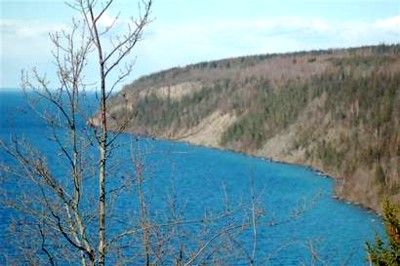
omberg.jpg
Omberg and the lake Vättern, Sweden

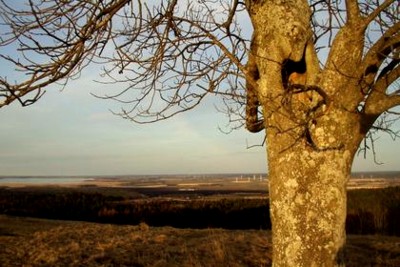
omberg2.jpg
A view from the Omberg

Transmutation to Brilliancy (3)

Monday, April 23rd, 2007

Our friend, a healing practitioner, whom we visited last weekend, has been involved with Qi-Gong since 1990 with Master Zhi Chang-Li. He had come to Europe in 1988 in order to spread here the teaching of Qi-Gong. Our friend told us that in the beginning of his teachings the Master still was hesitating a lot what to give out to the people seeking instructions and what not. For in the traditional teaching a teacher formed just one student, who had to undergo a very severe and long training. It is not possible to impart the teachings through mere teaching, but through intense integration into life. Master Li had been in a process of learning since his early youth, also during the times of the cultural revolution, when all spiritual tradition were violently suppressed in China.

One little story our friend told from Master Li was about how students were tested that they were mastering the life-giving energy Chi: They were brought to the snowy mountains and clad in wet towels to stay out there over night. Next morning the teacher was looking, not only if the student was having warm, but also how much snow around him he could get melted through the heat he had created in his inner…

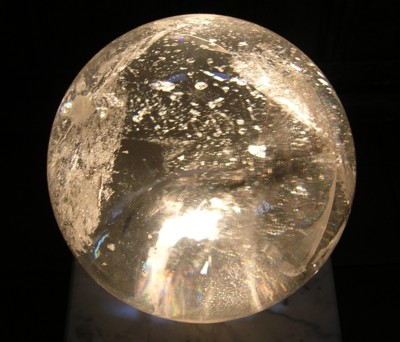
I don’t want to retell here the stories about the life of Master Li our friend reported to us. What impressed me most was that through incredible hardships and strict training a process of deep transformation took place. Thus the wisdom slowly shone forth and found a living expression. It is like with carbon dusk being transformed under extreme pressure to a diamond. Chemically carbon and diamond have the same substance, but only through transmutation the brilliance is gained.

kugel.JPG

Little Events of Teaching Practical Wisdom (2)

Monday, April 23rd, 2007

Over two decades ago my friend had invited Master EK to his house in Munich to give lectures to interested persons. He was deeply touched by the freshness and naturalness with which the master was expressing spirituality in all aspects of life.

Once they were walking through some shoppings streets in the centre of Munich, when a derelict person came along, obviously being under the influence of alcool. Someone of the people accompanying the master expressed his disgust about the dosser, but the master simply replied: “He is God, too.”

* * * * * * *

My friend had a beautiful old Art Nouveau villa in Munich, where the seminars with Master EK were going on. A lady remarked to the master: “Such a big house, just for one person.” The master only replied: “He is sharing it with others.”

* * * * * * *

In the assembly hall where the lectures were taking place everybody was chitchatting or preparing something, so that nobody noticed the master entering the room. He went to his place and starting intonating the mantram with which he used to begin his lectures. Everybody rushed to their places. The master started his lesson speaking about discipline.

My friend said the master was absolutely right reminding the people of getting into attention, but he might have felt that he was strict in his words. For in the evening, in a small round, the master was joking and playing magical tricks, as if he wanted to express: Look, everything has its time, there is not just only discipline, and I’m not a rigid fellow.

* * * * * * *

The master was fond of cooking, and he loved preparing delicious meals for the whole group. He was doing it full of joy. In this he was throwing away some vegetables which weren’t totally fresh any longer. Someone mentioned that he is wasting the materials. He remarked it, continued his work, but the joyful expression was away. He didn’t say anything, but it was as if he wanted to express that criticising is like tossing away joy.

* * * * * * *

My friend had planned to organise more seminars with Master EK near Munich on specific topics, but the master surprisingly passed over in March 84, so that all further plans had to be cancelled. The work, however, went on a few years later with Master KPK, whom Master EK had prepared for continuing his impulse.

eklingam.JPG
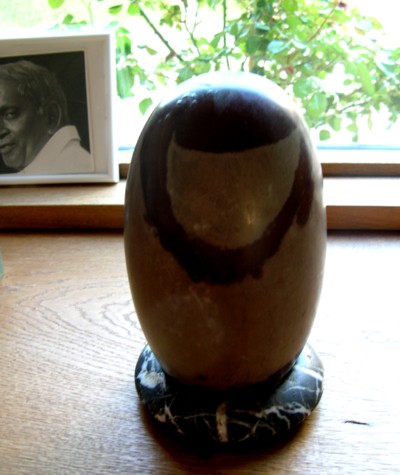
Lingam stone with a picture of Master EK

A friend from Argentina translated this blog-post into Spanish (PDF).