
erk admin

spacerCircle of Good Will - Blog

Archive for the ‘Art, Culture and Beauty’ Category

Silent Loudspeakers and the Expression of Silence

Saturday, November 25th, 2006

Yesterday morning I took some pictures from an installation with loudspeakers at the entrance of the Kunsthalle Berne (Art Gallery) of Pavel Büchler, a Czech born artist living in UK:

I was fascinated by the “silent loudspeakers”, overlooking a noisy square. On the website of the art gallery I then read about the artist:

“Summing up his own practice as “making nothing happen”, he is committed to the catalytic nature of art – its potential to draw attention to the obvious and revealing it as ultimately strange. His subtle interventions and wry texts are concerned with revealing the accepted and everyday as ultimately bizarre.”

“Concerned with the distortions of language, he gives a critical attention to the gaps in communication, fascinated as he is with the limits of the communicative properties of visual language. He often addresses the question of the legitimacy of communication in addition to its ephemeral and long-lasting nature.”

So the artist is searching along the threshold of the spiritual, which is “beyond the communication”, of the word, which is beyond sound, beyond form, even beyond manifestation, which is also called the “soundless sound”, or, in relation to communication, the “communicationless communication”. You might read our Basics of Spiritual Life on Working with Sound (PDF).

By the way, the exposition of Pavel Büchler is called: absentmindedwindowgazing. When the mind is “absent”, by wide awake, there is a chance of perceiving glimses of the suble worlds.

Wabi-Sabi: Beauty in Simplicity

Wednesday, November 22nd, 2006

Today I got the latest newsletter of “The Soul Journey“, from friends in the States, this time on “Wabi-Sabi”:

“Beauty in simplicity – that’s what wabi-sabi is. In Japanese, wabi means humble and sabi suggests the presence of beauty in the natural progression of time. In short, wabi-sabi can be seen as an aesthetic appreciation of all things, no matter how humble or simple. Or it can be seen as connecting with the essence or soul of all things, especially in their lack of adornment.
Soulful wabi-sabi is about appreciating the form that naturally occurs such as in the weathering of wood, the shape of landscapes, the colors of rocks or flowers, the flight of a bird, and other natural appearances. The wabi-sabi mindset also uses recycled materials, often in ways that are creative and unique, for waste is contrary to this aesthetic approach. Hand-crafted items are also present in a wabi-sabi environment, because of their frequently found soulful characteristics.
When the form is appreciated for what it is without the compulsion of changing it, then we can be at ease in our environment. It also encourages us to create comfort and to enjoy the experiences of our senses. It has something to say to us about simplicity and clutter as well. Simplicity has a Zen way of evoking the soul within us all since it shows the soul of things when we do not surround ourselves with excess. There is now a movement in house design based on this wabi-sabi idea. It is more than a fad since it reflects a growing soul consciousness among people.
Wabi-sabi is also about appreciating time, as having something to enjoy and value in each moment. When we do not try to cram as much as possible into the shortest amount of time, we can perhaps savour the riches, the beauty and the insights that each moment offers. This is when we can access soul naturally and spontaneously.
Let the ordinary speak to you in new ways, revealing its soul, and evoking yours. Remind yourself to live in the moment, open to inspiration and the joy of being present to your life and soul.”

Another e-mail from a German friend brought a link to a German website on the great Russian artist Nicholas Roerich (the site of the Roerich Museum in New York), where you find a short Quicktime movie about the pictures of Roerich. Roerich is for me really an example of Wabi-Sabi, beauty in simplicity

Journeys in Imagination

Saturday, November 18th, 2006

In the last two days I got two beautiful powerpoint presentations from friends in Spain, one with photos from a journey to Tibet (3 MB), another with most delicate motives from China (5.9 MB). Have a look at them, if you like to make a journey in your imagination.

Cosmic Painting

Monday, November 13th, 2006

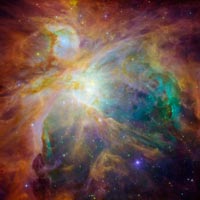
A beautiful new photo of the Hubble space telescope looking like a modern painting shows the Orion nebula in an explosion of infrared, ultraviolet and visible-light colors. It was “painted” by hundreds of baby stars on a canvas of gas and dust, with intense ultraviolet light and strong stellar winds as brushes.

Art in Nature

Sunday, November 12th, 2006

This morning I saw in the customer magazine of the “BKW Energie” an article about the Swiss artist Urs-P. Twellmann, who is creating beautiful artworks in nature – circles, spheres, spirals… He is working mainly with wood and ice. You might like to have a look at his website:

Striving and the Grace of Silence

Tuesday, October 31st, 2006

In the Neue Zürcher Zeitung (New Zurich Newspaper) there was yesterday an article on Praise of Silence, a talk of the author Ralf Rothmann, who received the Max-Frisch-Price of the Town of Zurich. In the text there were some interesting statements, one allegedly by Max Frisch: “You have to aspire for the perfect, otherwise you go crazy.” And another by Mahatma Gandhi: “The mission of every man towards the world is to become a saint, not more and not less.” Even if we don’t succeed, our endeavour has to go into this direction. Rothmann adds: “For you cannot exist without the real feeling of unity with all, that is with the cosmos, you become a cripple with body and soul, and nothing helps if you don’t realise it your whole life long. We have to want the perfect, otherwise you go gaga. And even if it cannot be successful, if our thoughts and works will never become perfect – or endeavour can be so.
And about creativity Ralf Rothmann said: “What really wants to come to light, you don’t have to press. It happens, it grows, it flourishes – everyone who writes or paints or composes has this experience. It is really grace, it comes to us – most beautifully when we don’t think of it, when we forget our ideas and concepts for a moment and, for example, peel an apple. It comes to us out of silence, out of quietude, for you have to desist from speech in order that the world speaks again with you. This might seem to be paradox, especially when a writer says this, but we are conditioned up to the most tiniest, we are even still framed if we ‘go overboard’, and our materialistic basic attitude, which doesn’t even spare language, has made us forget that nothing, really nothing has a name, that there is in reality neither inside nor outside and that the body lives in the soul and not the other way round. Only silence teaches us this.”

See also the post on Experiencing Silence.

Amazing Microscopic Art

Thursday, September 21st, 2006

A friend from California sent me the link to a site about the amazing micro-sculptures created by Willard Wigan. He makes the micro-sculptures out of dust particles, sugar crystals etc.

He quotes William Blake’s famous poem:

To see a World in a Grain of Sand
And a Heaven in a Wild Flower
Hold Infinity in the Palm of your Hand
And Eternity in an Hour.

By the way, Snoopes certifies, that these astonishing artworks are not a fake, but true.

Picture of the Month – The White Island

Tuesday, September 12th, 2006

Thang-La, by Nicholas Roerich

The White Island is a secret place which, in ancient times, was located in an inland lake and is currently located in the Desert Gobi. It is the place of descent of many sublime beings of higher intelligence where the Lord of the World, Sanat Kumara, is said to be at home. The painting “Shamballa” by Nicholas Roerich shows the glacier peaks of the mountain range of Thang-La which reminds of the White Island. The painting stems from an expedition through the Himalayas, Tibet, and the Desert Gobi in the 1920s. Many thanks to the Roerich Museum in New York.

Send it as a postcard

Picture of the Month – Buddha-Statue in Bhutan

Tuesday, September 12th, 2006

Buddha Statue in Bhutan

Golden-yellow is the color of the Buddhic plane, the supra-mental, the light of wisdom. Buddha is seen as the embodiment of wisdom, and statues that depict him are often golden. Contemplation upon this helps the observer to move beyond the boundaries of the mental and to move into the higher light. The picture by Christa Bischoff, Hamburg, shows a Buddha statue in Bhutan. The arms outstretched remind us of the qualities of mercifulness and helpfulness toward fellow men.

Send it as a postcard

Picture of the Month – Music of the Soul

Tuesday, September 12th, 2006

Two Bhutanese Monks playing music

Breathing and sound are the twin aspects which conduct the creation in space and time. By continuously listening to the rhythmic sound of respiration, the mind unites with the pulsation. Thus we enter into the inner space, where we can hear the music of the soul. The picture of the two young Bhutanese monks making music, by Christa Bischoff, Hamburg, depicts very well the twin sound of respiration.

Send it as a postcard