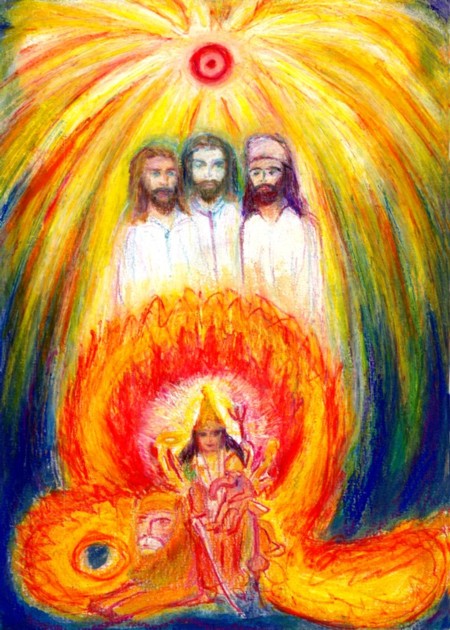
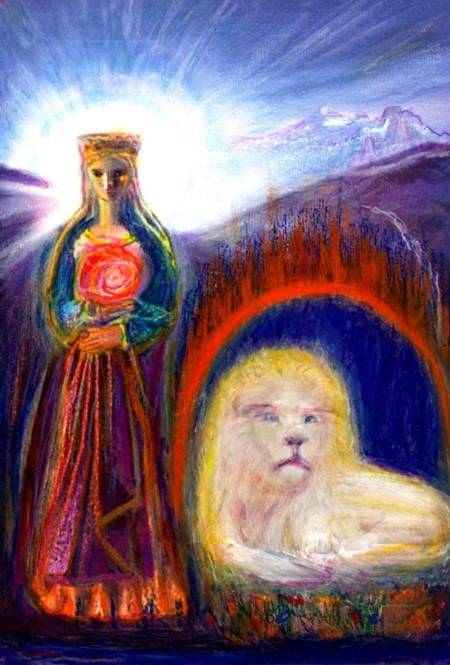
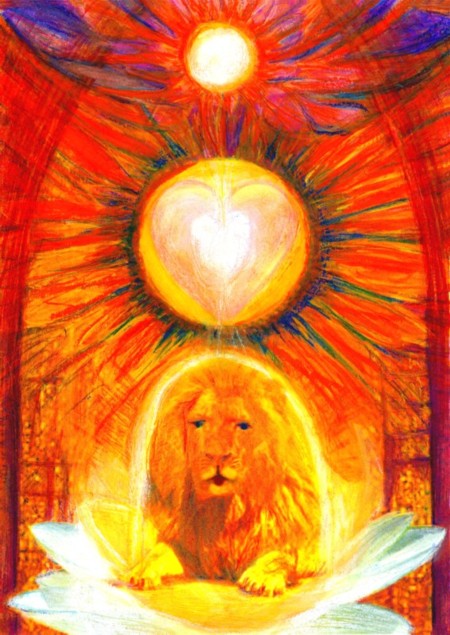
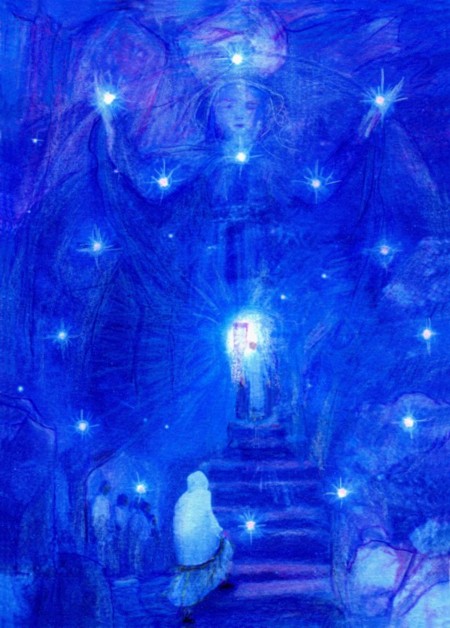
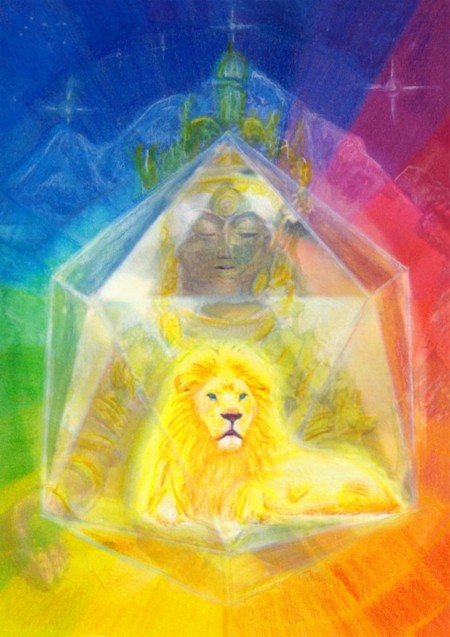
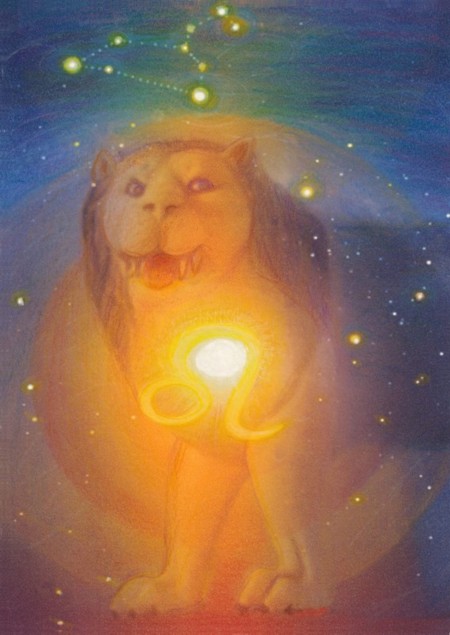
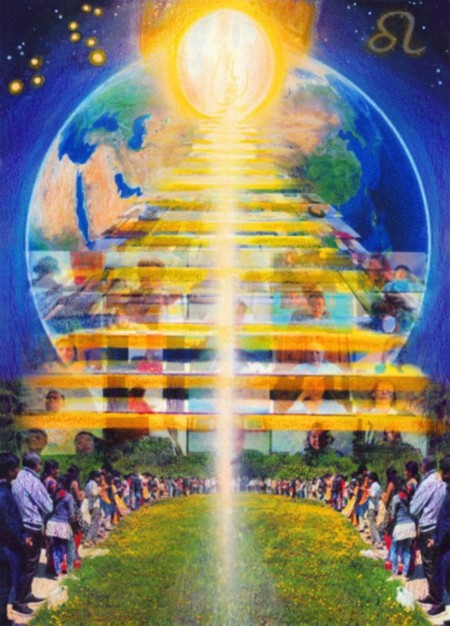
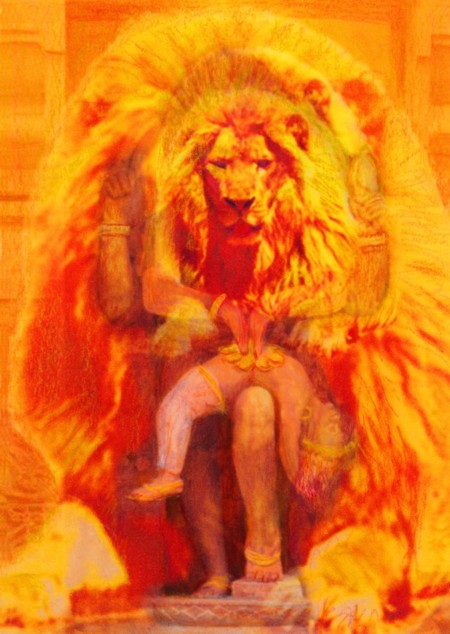
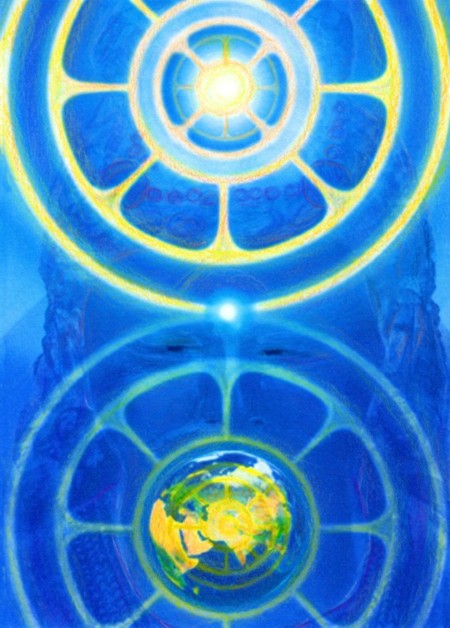
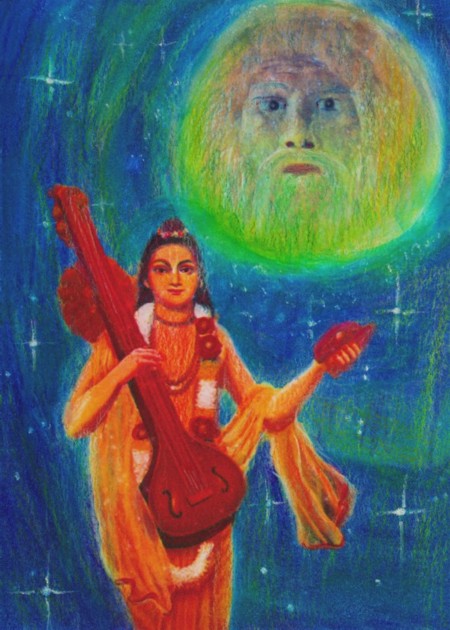
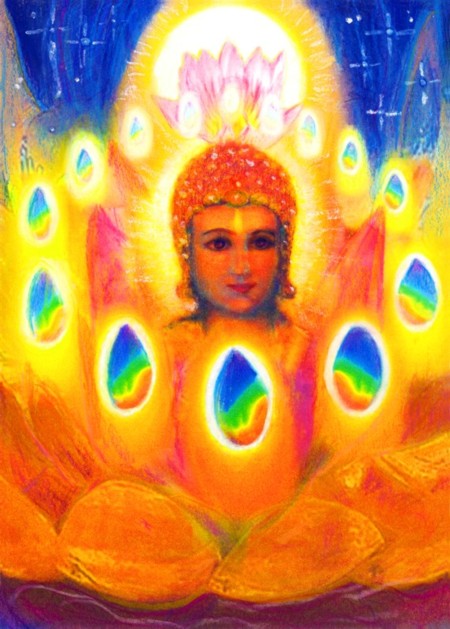
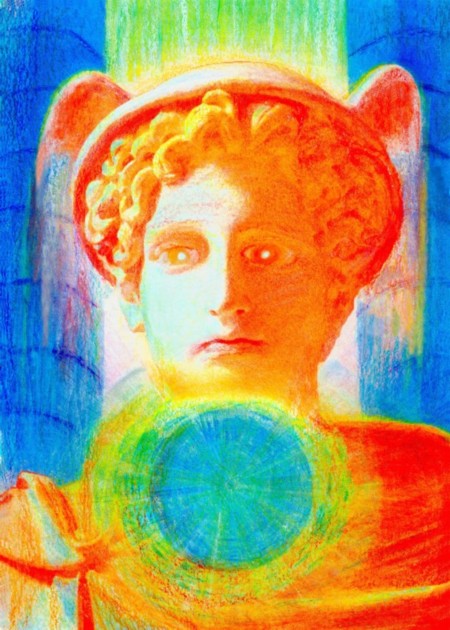
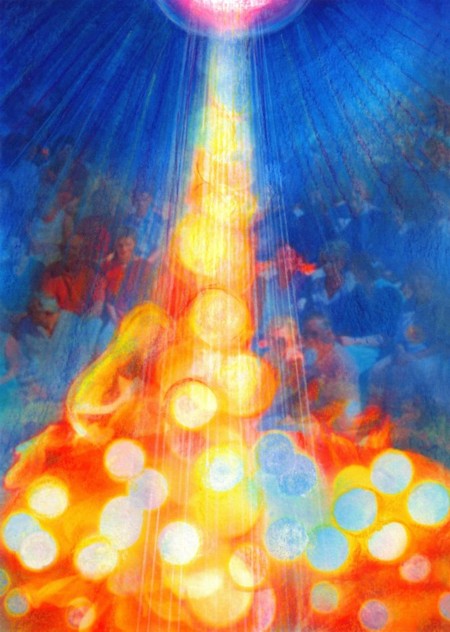
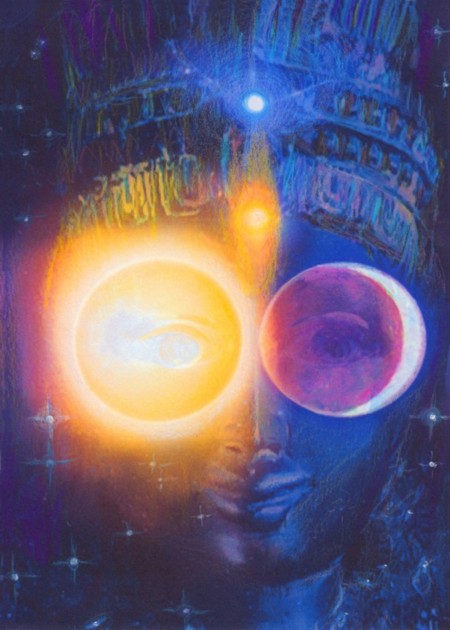
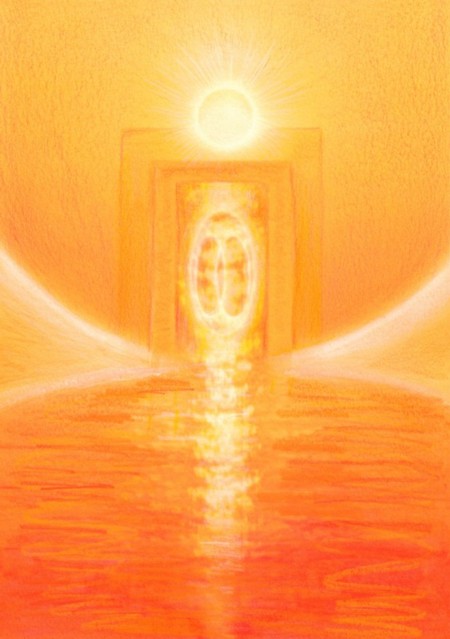
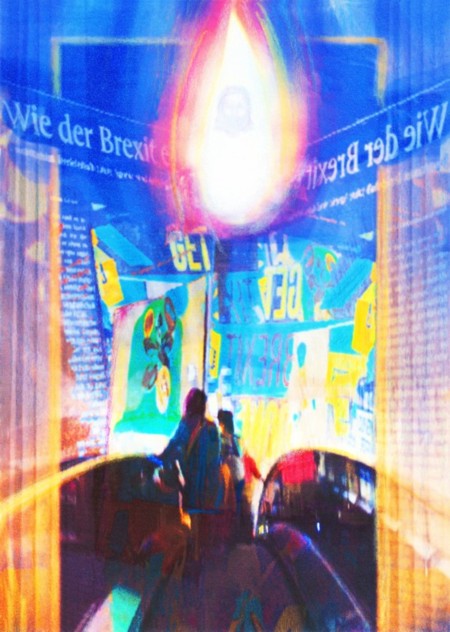
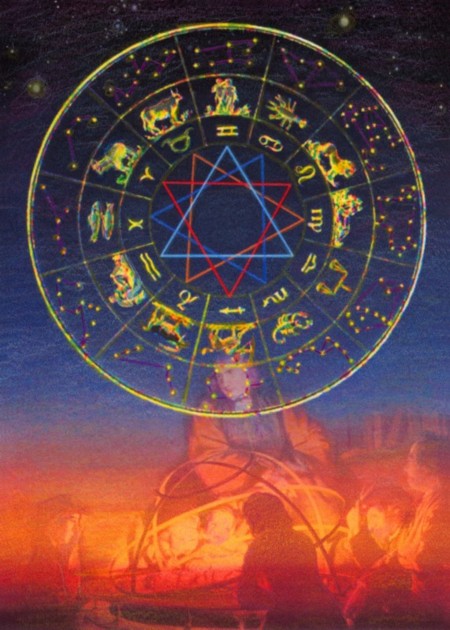
Leo is a fire sign; together with Aries and Sagittarius it transmits the different qualities of the fire of the soul. Astrologically, Leo is governed by the Sun, which is “at home” in this sign. In this month, we can link especially well with the colour of golden light to the power of the inner Sun in the heart centre. On the outside, the Leo energy appears to be gentle, but on the inside, it is a fiery force. The heart is the seat of the Hierarchy, and the rapprochement of the Hierarchy with humanity is through Leo.
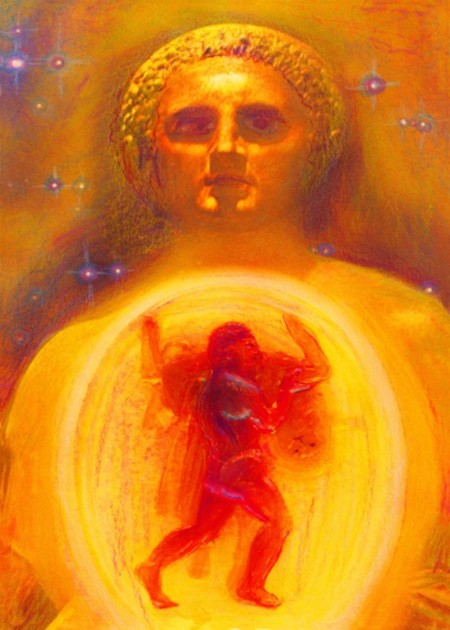
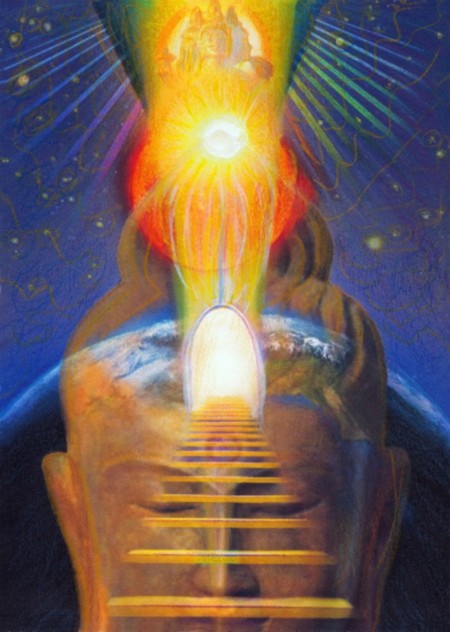
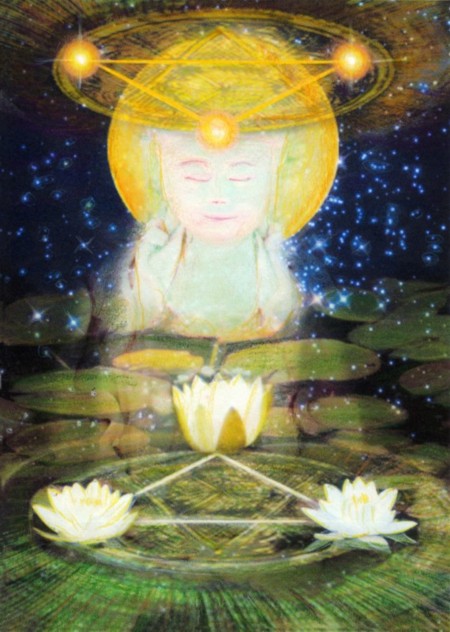
When pondering on which new image for Leo might develop, I contemplated on the inner vertical alignment from the heart to the head centre and its planetary correspondence: As there is an individual head centre, the Sahasrara, there is also a Sahasrara of the Earth called Shambala.
The innermost point of the head centre is called the Jewel in the Lotus. And there is a corresponding jewel at the innermost point of the planetary head centre called Chintamani (see the painting on “The White Island“). Both gems are referred to with the mantra OM MANI PADME HUM.
The image of two wheels forming the number 8 showed up in contemplation. I formed each wheel with the help of the symbol used on the cover of the book “The Teachings of Sanat Kumara” by Dr K. Parvathi Kumar. The graphic contains eight sections. I placed a miniature form of the symbol into the centre of each wheel as the jewel in the lotus. For visualising Sanat Kumara, the lord of Shambala, I reworked the photo of an old Bodhisattva bust, probably of Lord Maitreya, from the Metropolitan Museum of Art.
I arranged the centre of the upper wheel as the Sahasrara of Sanat Kumara; the lower wheel leads downward from his Ajna centre, a star forming the contact point. In the centre of the lower wheel there is an image of the earth showing the Eastern hemisphere. I finally worked on the colours of the structure to give expression to the circulation of the energies.
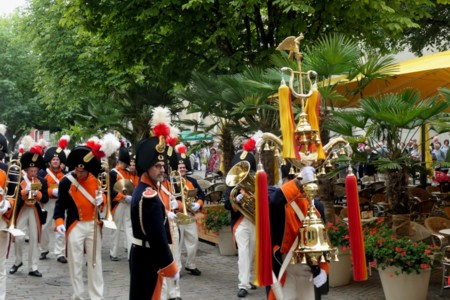
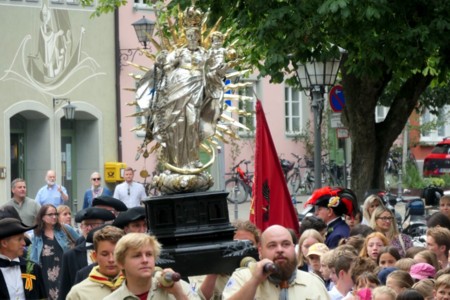
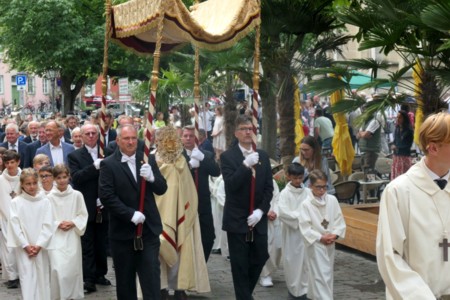
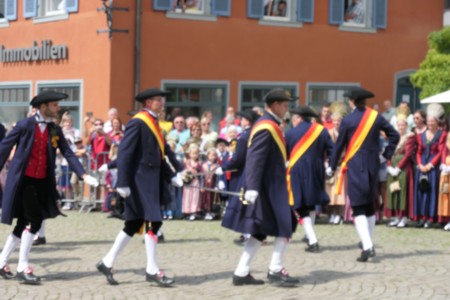
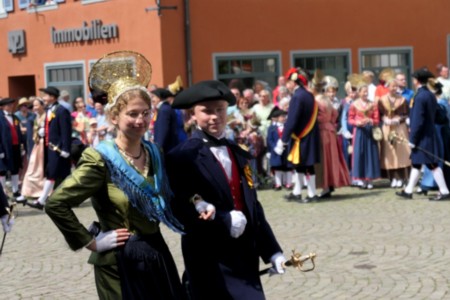
During my visit to friends in Heiligenberg (Holy Mountain) near Lake Constance (see the previous blogpost) Sabine and I went to the town of Überlingen last Sunday morning to see the “Sweden procession“. It is a tradition which started at the end of the Thirty Years’ War: In 1634, the citizens could successfully repel a besiegement of the Swedes which attacked the town over two years. In gratitude for this success, the citizens made a vow to hold twice a year a “Sweden procession”, where after a church service the “Sweden Madonna”, a figure of Mary gilded in silver in 1659, is carried on shoulders by scouts through the town, together with a youth choir, altar boys and girls, and men and women dressed in the traditional costumes.
The town band in traditional costume of soldiers
Scouts with the “Sweden Madonna”
Priest with the monstrance, baldaquin bearers and altar boys and girls
Memories came up: In my youth, feeling like aeons ago, I had participated in similar processions as an altar boy. I was now a tourist, an on-looker, touched by the ambiance of the spiritual orientation. The faces of the youngsters in the Sweden procession, dressed in white, were focused and full of devotion. I was astonished to see in the cortège people of all ages – also a lot of youngsters and middle-aged people. Sabine was greeting some she knew from her choir.
While we were walking along Lake Constance, she told me that in past times, there had been such processions at many places but modern life turned people away, so that nowadays there are only very few of such processions left.
The citizens of Überlingen, however, are very proud of their tradition and there is a strong social cohesion in the town. She knows of people who lived for longer time in other parts of Germany but felt lost there, and they came back to live and work in this area. You can feel this sense of togetherness in the town – and it could be seen in the “Sword Dance”, related to the Sweden procession, which was performed in the courtyard of Überlingen and in front of the archives an hour later.
Sword dance
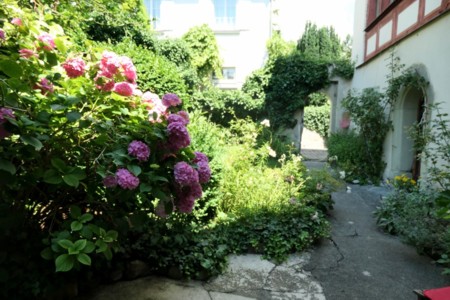
It was short before noon – and for us time to prepare for the Health & Healing – Prayer we do on Thursday and Sunday noon time. We rushed through some streets of the old town to the “Garden of Silence” at the “SusoHaus“, which might have been the birth place of Henry Suso (Heinrich Seuse), a mediaeval Dominican friar and mystic (1295-1366). In 2007, an association “New Mysticism in Dialogue” was founded to fill the house with life by transferring Heinrich Seuse’s spiritual impulses into our time and make them fruitful for people today. The house was renovated and now, visitors have the opportunity to become creatively active in writing, making music, philosophising, meditating and, above all, in dialogue with others in the sense of their own lives. (translated from their website)
The “Garden of Silence” at the SusoHaus is freely accessible at all times, and sitting there, under flowers, was an excellent place for our Health & Healing meditation.
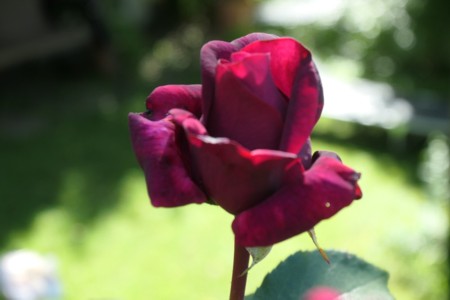
A week ago, I was in Heiligenberg (Holy Mountain), South Germany, near Lake Constance visiting Manfred and Sabine for 5 days. It was a precious time with these two friends filled with exchanges, meditations, little excursions and relaxing in their beautiful garden. Manfred has created a little paradise with many roses and other flowers, trees, and bushes with plenty of red and black currants, raspberries and blackberries at the moment – delicious…
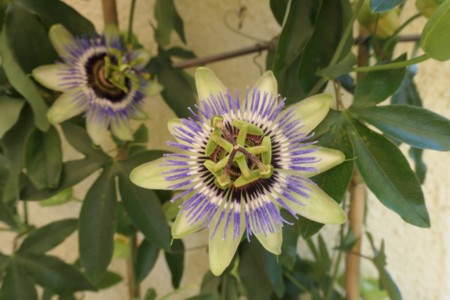
Passion flower, it says the flower shows the instruments of the crucifixion of Christ – and the radiance of overcoming death.
In the first evening, Manfred took me up to the forest near the castle where there are two natural burial sites and we spoke about our “transition planning”. In Germany, there are only such places where you can bury the urns outside traditional cemeteries – in Switzerland, it is allowed to give the ash into lakes, rivers, or places in nature.
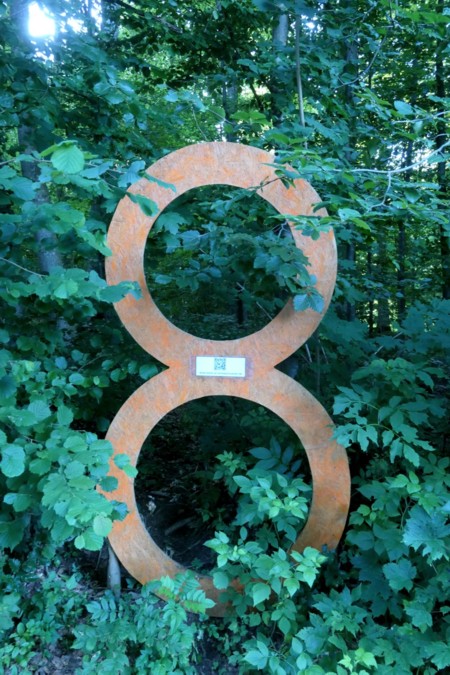
At the natural burial site – artwork symbol of infinity
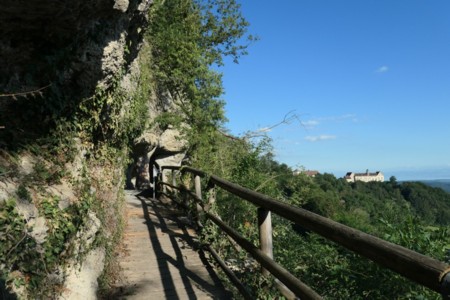
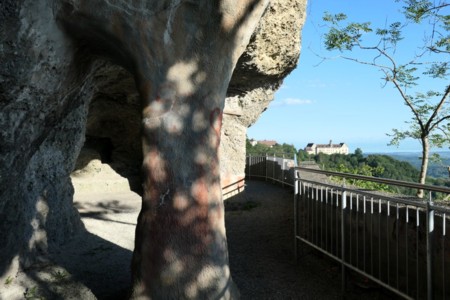
We then followed a path along the cliffs, which had been only recently re-opened after a longer renovation. It lead to the “friendship cave”, a natural cave, where some centuries ago castle servants were living.
Path to the “Friendship Cave” with the castle of Heiligenberg in the background
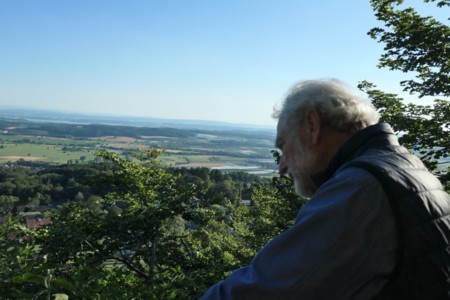
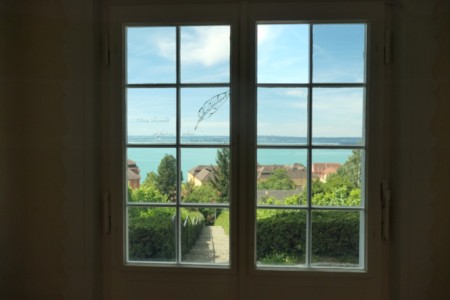
View of Lake Constance from Heiligenberg
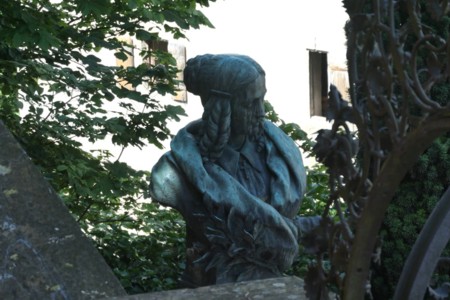
Next morning, Sabine took me to Meersburg on Lake Constance. We walked through the old town and the new castle. There, we saw a statue of the German poet Annette von Droste-Hülshoff (1797-1848), who lived for eight years in Meersburg.
Annette von Droste Hülshoff
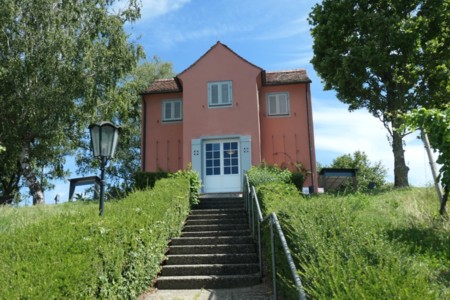
We then visited the Prince’s House, which Annette had purchased to live there, with a gorgeous view over the lake. Now, it is a museum dedicated to this first well-known German poetess.
It was very special for me: Already in school, we learnt some of Annette’s poems by heart and read texts. About 40 years ago, a dear friend of mine wrote his PhD about the chronology of her life for the historical-critical complete edition of her works. I was jobless at that time and he gave me his work for typing; thus, I knew many details about Annette. My friend then arranged that I became a museum guide at the Rüschhaus near Münster, North Germany, where Annette had previously lived. Now, in the Prince’s House, there were several pictures of this other house.
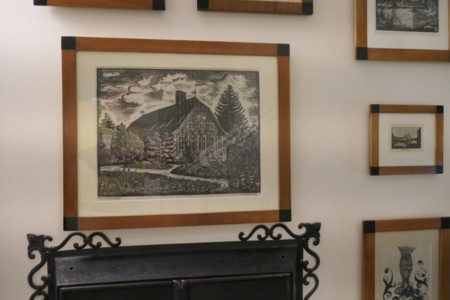
The Rüschhaus
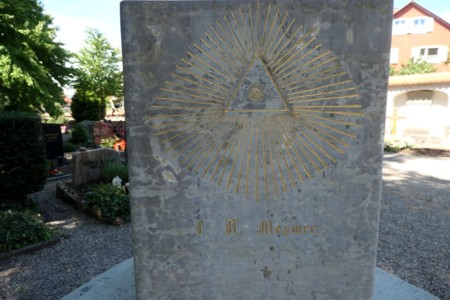
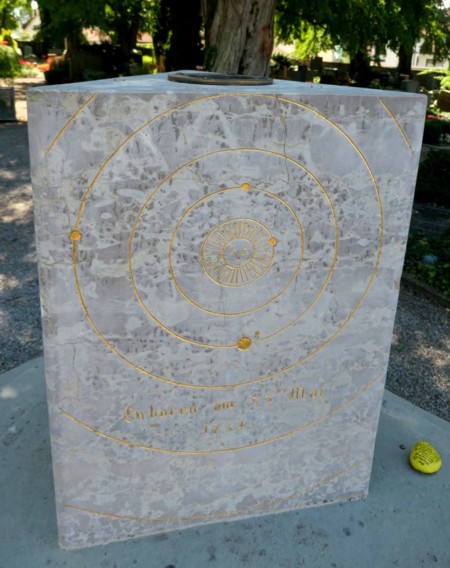
Afterwards, we visited the Meersburg cemetery where Annette is buried. We also wanted to see the grave of another famous person, Franz Anton Mesmer (1734–1815), who studied “animal magnetism”. He was hypnotizing people and healing with his hands – of course, much disputed and considered “imagination” by the mainstream physicians and scientists.
The Divine Eye
The Sun and the classical planets
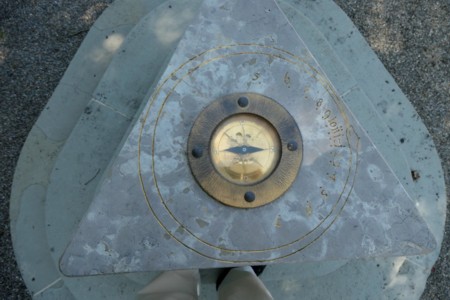
A compass on the top of the tombstone showing the north-south direction, surrounded by the symbol of the serpent of eternity.
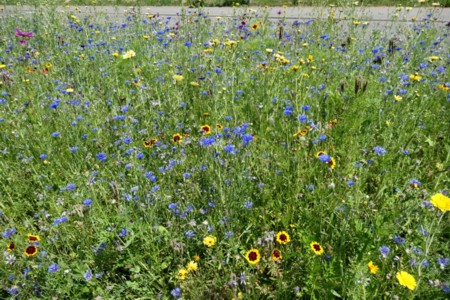
Outside the cemetery – and at other places: flowerbeds for nourishing the bees
We spent the afternoon in the garden, and in the evening, we went to a small theatre in an old basement vault in Überlingen. The “Noltes Theater” presented “Summer Night Rapture”, a poetic performance with songs, jazz and blues music – full of linguistic wit, furious piano playing, and enthusiasm for theatre.
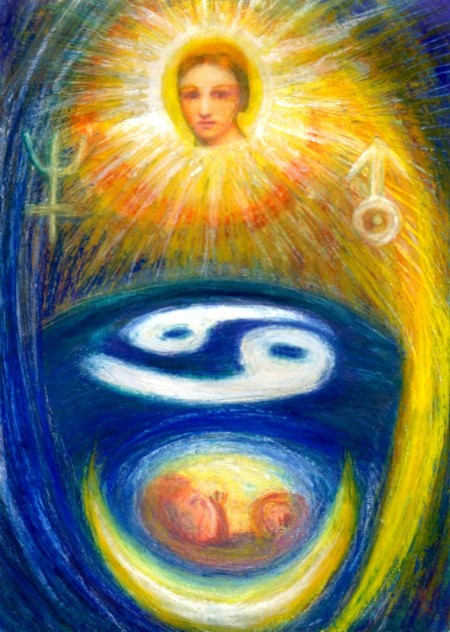
Cancer is the fourth sign of the zodiac. Sun in Cancer is said to be at home in the heart chamber, the home of the Divine. He comes out of compassion and remains for a month. It is like a Master of Wisdom visiting our home. We can relate to him, seek his guidance, listen to his advice and establish a cordial relationship. He gives us the impact of his light and love and conducts the needed rectifications. May we re-orient ourselves afresh to the divine messengers, the Teachers of Wisdom. They are commemorated during Cancer Full Moon, Guru Purnima, the full moon of the Teacher.
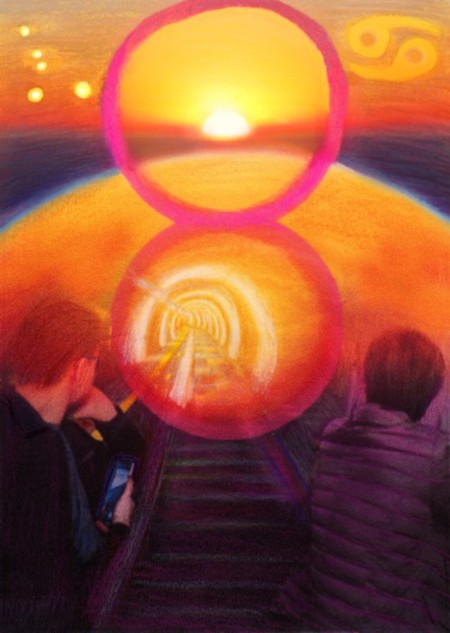
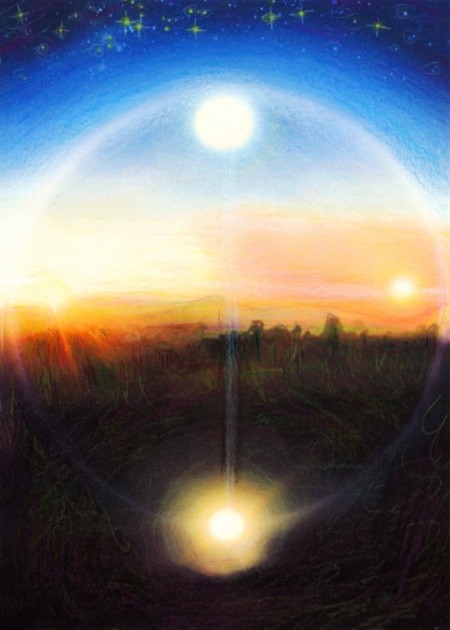
Each day, we experience the apparent movement of the Sun rising in the East, coming to the midheaven at noon and then setting in the West. At midnight, the Sun reaches the bottom point. These four points constitute the cardinal cross of the day. On the horizontal plane, they form the four directions of East, South, West, and North. They only exist in relation to a being standing on Earth.
The year has the same four cardinal points namely the two solstices and the two equinoxes. They form the cardinal cross with the cardinal signs of Aries, Cancer, Libra and Capricorn. The full moon and the new moon, together with the two crescent moons, are the four cardinal points of the month. The four cardinal points signify the secrets of birth, life, and death and the smaller and larger cycles of time.
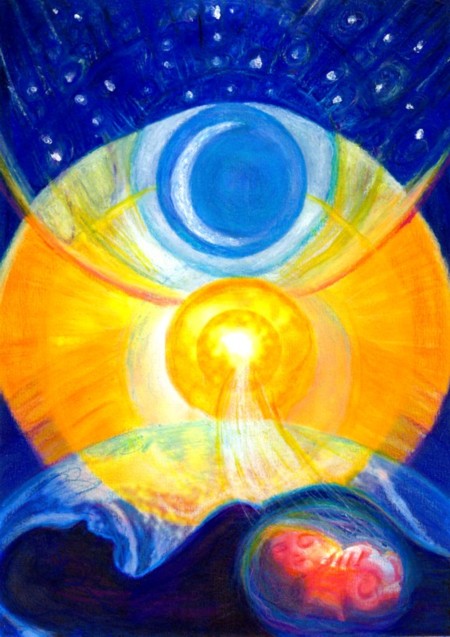
To depict this profound wisdom, I constructed the four cardinal points of the day by arranging pictures of the Sun taken in India and in Switzerland: sunrise, noon and sunset, and a daylight photo digitally transformed into a “midnight sun”. The background is designed with the help of a pre-sunrise picture taken on a flight over India.
The subtle shades of the sky needed special attention to modulate the colours. Rendering them for print on aquarelle paper, then drawing on paper, and scanning the image always changes the colours a lot, until the final version is ready for digital publishing and photo print. In each form of appearance the colours change, this being part of the creative process.
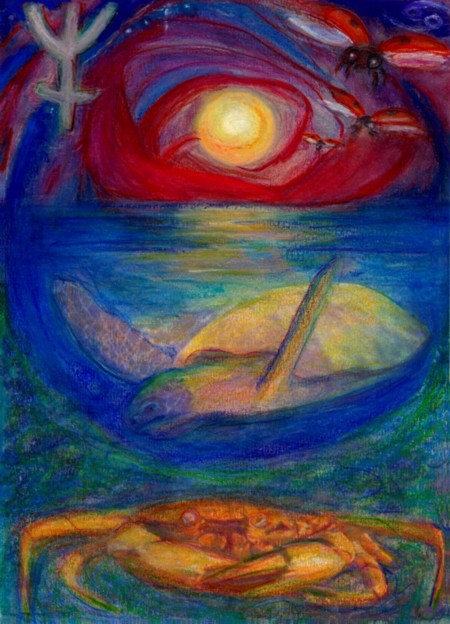
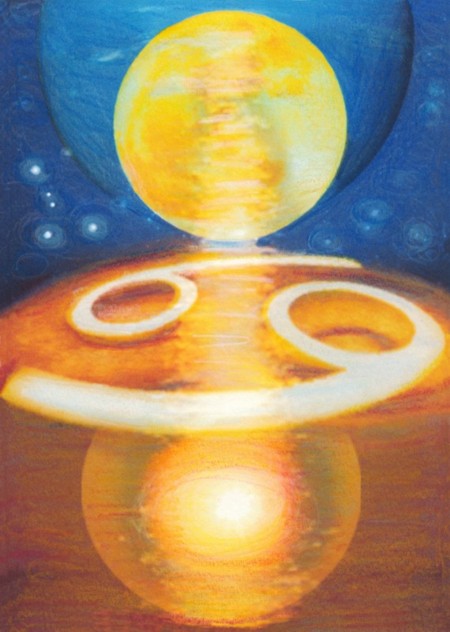
The symbolism of Cancer is visualised in the thirteen Cancer paintings done between 2010 and 2022. For detailed detailed descriptions please see the ludgerphilips.org website.
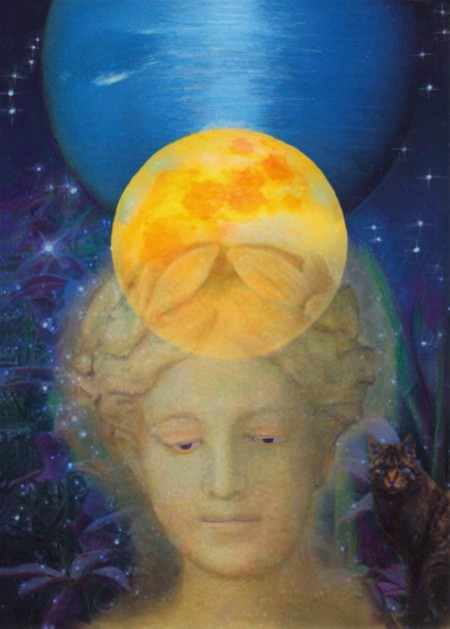
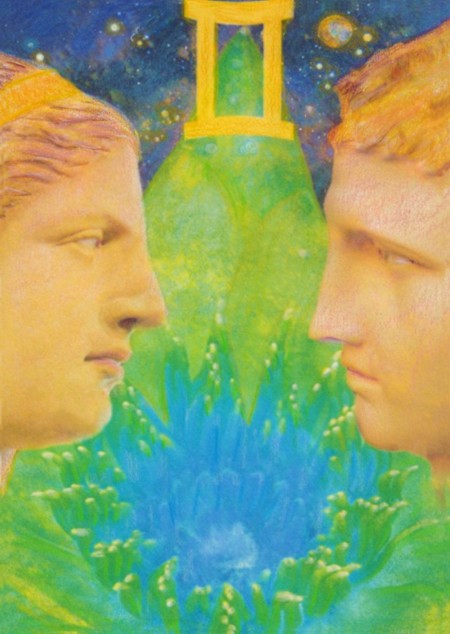
Gemini is the sign of duality, which at the same time also contains the key to unity. The symbol of Gemini consists of two vertical columns which are connected to each other. The two columns symbolise subjectivity and objectivity and they form a “doorway”. Every morning, when we awaken, the door opens to the world of objective activity and at night, when we go to sleep, the door to objectivity closes again. Similarly, the door leads to subjective activity at night and is closed again in the morning. When we go to sleep and when we wake up, we can experience both worlds for a moment. The wisdom of Gemini teaches us that we can consciously go through the gate in both directions and thus live simultaneously in the subjective and the objective world.
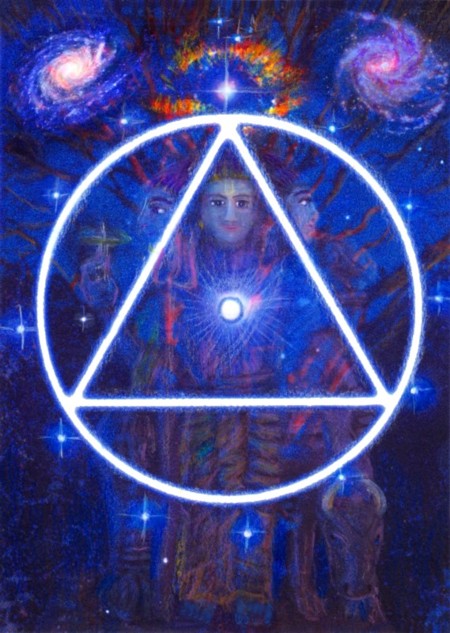
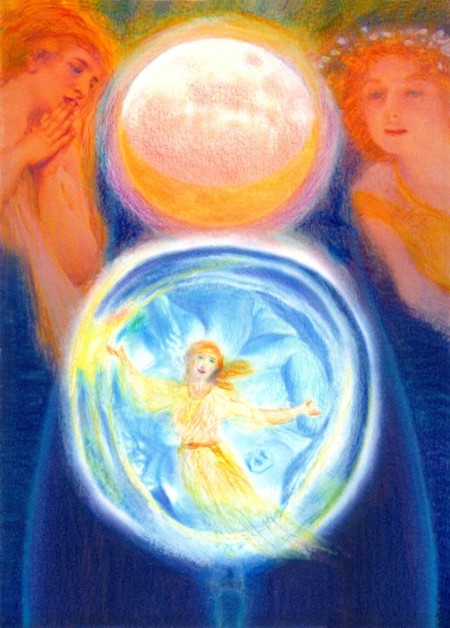
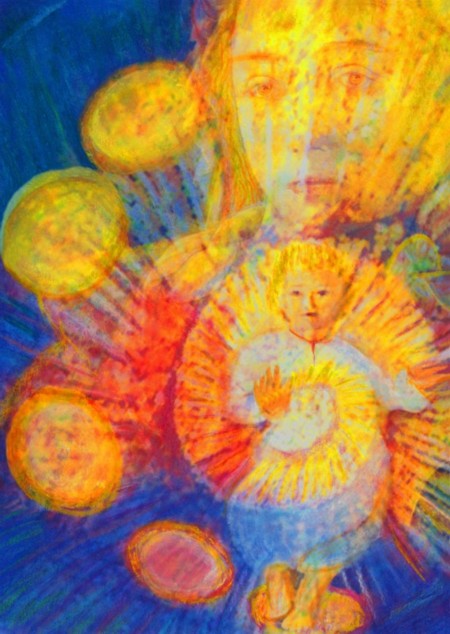
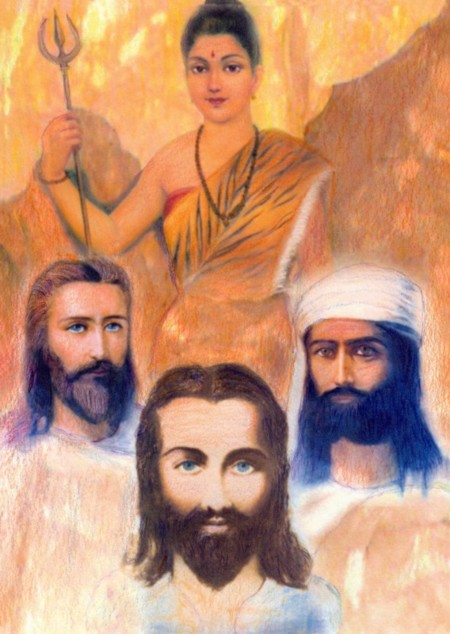
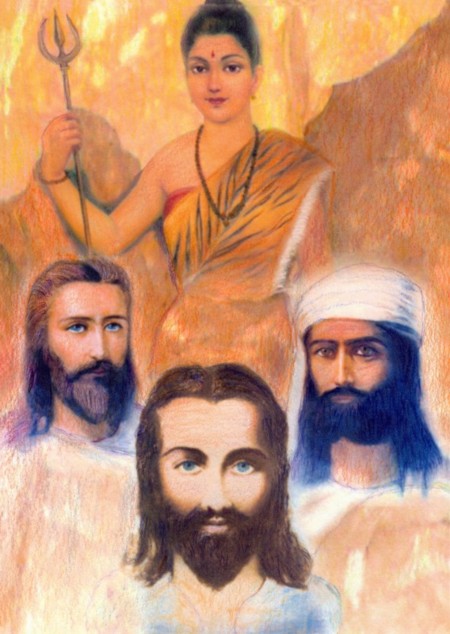
The Masters of the Spiritual Hierarchy are working at spreading the wisdom required to help in the evolution of the beings on the planet. Just as Lord Maitreya and the other great Masters exist, there is also a physical embodiment of the feminine energy in the Himalayas. This grand Master in a female form is called Shaila Putri, the Daughter of the Mountain. She appears as a young woman of eighteen years dressed in garments of tiger skin and holding a trident. She is the Mother of the World for our Planet and the power that assists the Hierarchy, especially in times of crises. She is the guiding star also called “the Exquisite Jewel, the Star of the Sea”. You find her described in the books “The World Teacher” and “Man Sacrifice” written by Master EK.
To illustrate this reality, I worked on images of Shaila Putri and the leading Masters of Hierarchy. To indicate the relation to the Himalayas, I arranged the pictures on a background created with the help of the photo of a crystal.
The symbolism of Gemini is visualised in the thirteen Gemini paintings done between 2010 and 2022. For detailed detailed descriptions please see the ludgerphilips.org website.
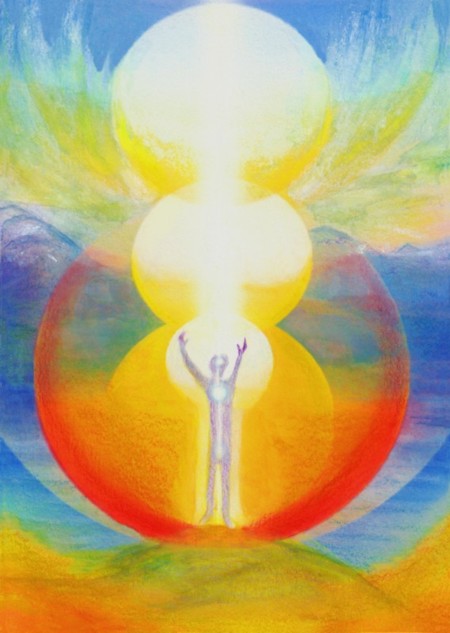
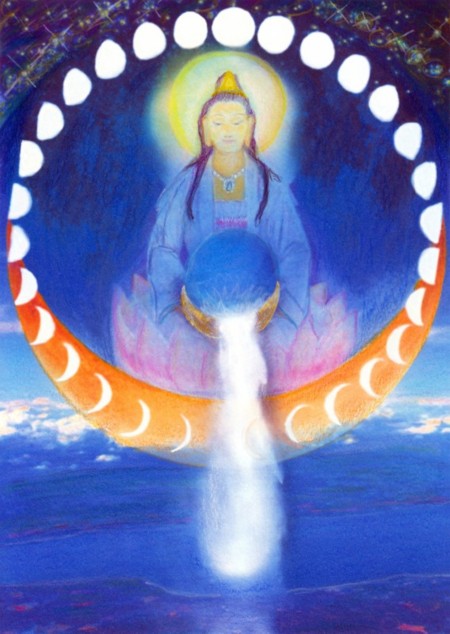
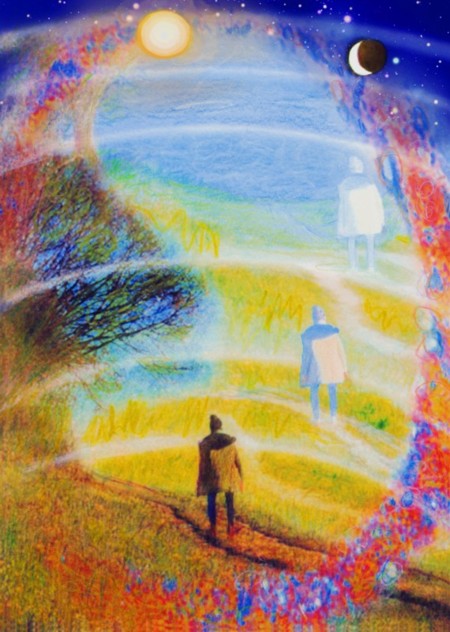
In the process of creation, the One Existence manifests as two. Spirit precipitates down as matter and matter ascends up as spirit. The first aspect is called the path of descent or involution; the second aspect is the path of ascent or evolution. On the path of descent, God comes down as this creation. The spiritual energies descend into matter, and the universal consciousness becomes the individual consciousness. On the path of ascent, we rise again by our spiritual practices and finally merge into God, just as the lesser light merges into the greater light.
The whole cycle of descent and ascent is called the ‘path of the waters’. For this flow of energy, the seers have conceived the sound formula as Narayana. ‘Na’ is the sound of ascent and ‘Ra’ is the sound of descent. The path of waters is ‘Ayana’ and it is immortal. To gain the freedom of the flow of energy, the seers keep singing OM Namo Narayanaya and they keep dancing in joy.
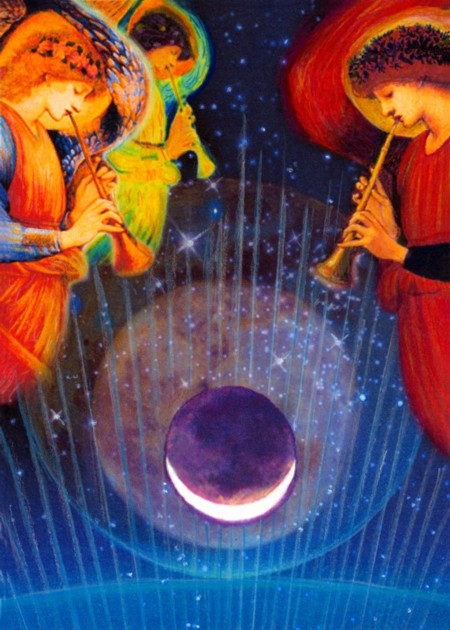
The picture visualises the path of ascent from the mundane to the super-mundane spheres by depicting a person on a path in three different degrees of density. The path leads further up into the blue sky towards the sun, the source of light. On the other side of the cycle, the movement goes via the Moon, the principle of reflection, down into the dense matter. The illustration of the cycle was designed with the help of extracts from a NASA photo of a galaxy.
The symbolism of Taurus is visualised in the thirteen Taurus paintings done between 2010 and 2022. For detailed detailed descriptions please see the ludgerphilips.org website.
I just came across the website of Siberian Roerich Society, , where I found the following about the King of Shambhala tanka, read with automatic translation (Google Chrome browser) – please read upto the end:
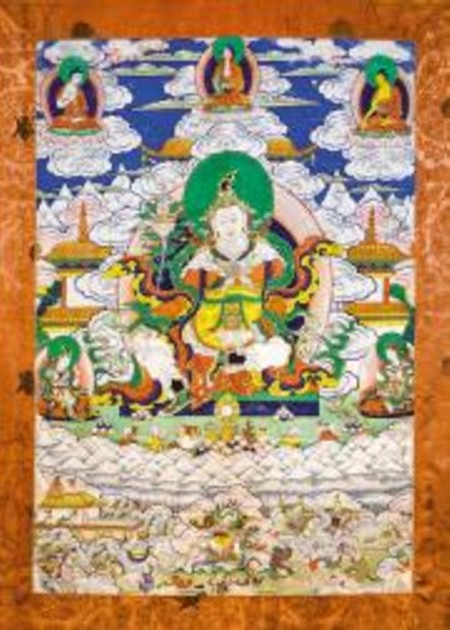
The King of Shambhala Tanka
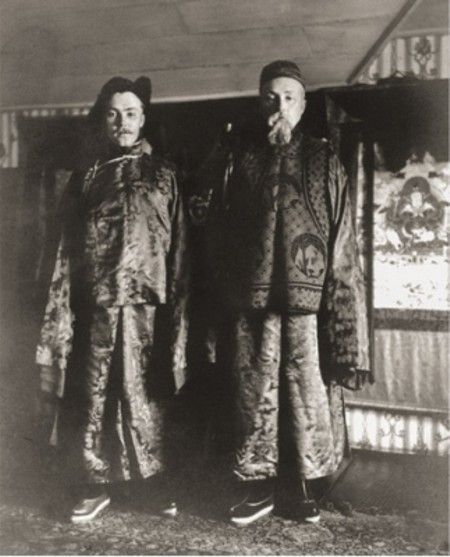
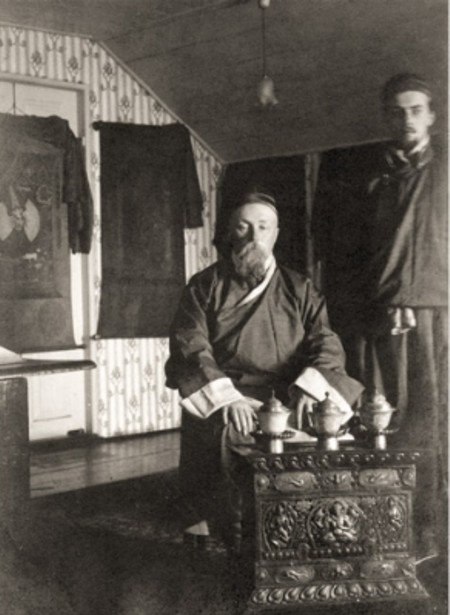
“In the exposition of the fireplace hall of the Novosibirsk Museum of N.K. Roerich can be seen the tanka “King of Shambhala” from the collection of the Roerich family. Let’s share the information that we managed to collect about this exhibit. At the end of 1923, the Roerichs left America and arrived in India. They chose the Principality of Sikkim as a place for a long stop, renting a house near the city of Darjeeling. (…) The entire Roerich family lived in this house for more than a year. They got acquainted with local sights, preparations were underway for the Central Asian expedition. The photographs of 1924 depicted N.K. Roerich with his sons Yuri and Svyatoslav in a room where the walls are hung with tankas, among which is the “King of Shambhala” tanka. In the letters to N.K. Roerich to American collaborators dated August 20 and 27, 1924, we read: “Finally, an artist from Tibet has come to us and is now painting Shambhala, [beginning] with the King of the World in the center. Just think what we will bring to you! This cult is greatly revered in Tashi Lumpo (Tashi Lama Monastery). The expedition from Everest praised our collection of Tibetan paintings very much.” “And on the first floor [we] are painting the painting “King of Shambhala”…. When this unique exhibit arrived at our museum, we turned to Yulia Igorevna Elikhina (leading researcher at the Oriental Department, curator of the Hermitage’s Tibetan, Mongolian and Khotanese collections) to help us attribute the tanka. Here is her answer: “The second king of Shambhala, Manjushrikirti, is depicted in the center. He sits in the royal pose of rajalalitasana, with his right hand in the gesture of bestowing goodness (varada mudra), next to him is a lotus stem, on the flower of which there are attributes – a sword and a book (attributes of the bodhisattva of wisdom Manjushri, whose incarnation he is). In his left hand he holds a chakra, a wheel of teaching and a symbol of royal power. His parents are shown next to him in the form of bodhisattvas, since the kings of Shambhala receive teachings from their parents. The father’s right hand is in the gesture of fearlessness (abhaya-mudra), the left hand is in the gesture of teaching (vitarka). Above are Buddha Shakyamuni teaching, with a white body, then Amitabha, with a red body, and Maitreya, the Buddha of the future, with a yellow body. Shambhala is surrounded by snow-capped mountains. Below is shown the war of the last king of Shambhala, after which the era of universal prosperity will come. Yulia Igorevna also drew our attention to the fact that in the picture N.K. Roerich’s “Banner of the Future” from the collection of the State Nizhny Novgorod Art Museum depicts exactly the “King of Shambhala” tanka. As you know, this painting is part of the Maitreya series, which the artist created in 1925-1926 and presented to the Soviet government when the expedition visited Moscow. Regarding the name of this painting – “The Banner of the Future” – we will quote the words of Yu.N. Roerich from his book “Tibetan Painting”: “The most characteristic work of Tibetan painting is the so-called tanka (than-ka), a word usually translated as a banner” 6 . The painting also has a second name – “The Song of Rigden-Jepo”.(name of Sanat Kumara) And one more picture of N.K. Roerich’s “Order of Rigden-Japo”, created in 1926-1927, brings us back to the image on the tank – the image of Rigden-Japo almost exactly repeats the appearance of the King of Shambhala.
In the book Shining Shambala, Nicholas Konstantinovich Roerich gives a conversation with one very respected lama: “… Rigden-Jepo, tireless, always awake for the benefit of mankind. His eyes never close. (…) Distance does not exist for him; he can help the deserving in the twinkling of an eye. Its bright light can destroy any darkness. (…) A great era is coming. The Ruler of the World is ready for battle. Many signs are happening. Cosmic Fire again approaches the Earth. The planets herald a new era. But many catastrophes will occur before the new era of prosperity comes. Again humanity will be tested to determine if its spirit has developed enough. Underground fire is now seeking to connect with the fire element of Akash; if all good forces do not unite their power, the greatest cataclysms are inevitable.”